Und dann auf "Zum Home-Bildschirm [+]".

Stöbern
genialokal zum Startbildschirm hinzufügen
Installieren Sie die genialokal App auf Ihrem Startbildschirm für einen schnellen Zugriff und eine komfortable Nutzung.
Installieren Sie die genialokal App auf Ihrem Startbildschirm für einen schnellen Zugriff und eine komfortable Nutzung.
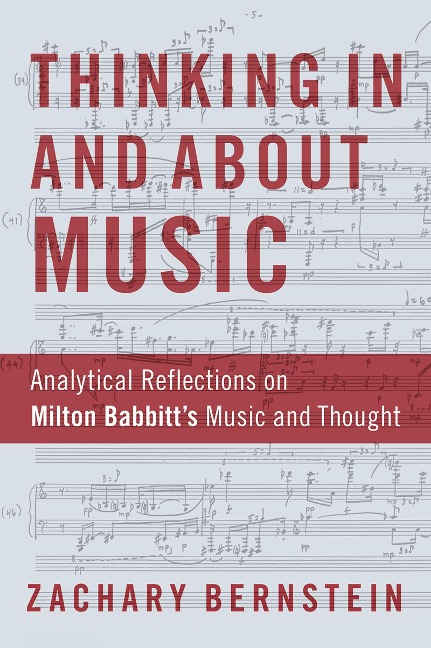
Milton Babbitt (1916-2011) was, at once, one of the century's foremost composers and a founder of American music theory. These two aspects of his creative life--"thinking in" and "thinking about" music, as he would put it--nourished each other. Theory and analysis inspired fresh compositional ideas, and compositional concerns focused theoretical and analytical inquiry. Accordingly, this book undertakes an excavation of the sources of his theorizing as a guide to analysis of his music. In Thinking In and About Music, author Zachary Bernstein shows how Babbitt's idiosyncratic synthesis of ideas from Heinrich Schenker, analytic philosophy, and cognitive science--at least as much as more obviously relevant predecessors such as Arnold Schoenberg--provide insight into his aesthetics and compositional technique. At the same time, a close look at his music reveals a host of concerns unaccounted for in his theories, some of which seem to directly contradict theoretical expectations. Bernstein argues, therefore, that new analytical models are needed to complement those suggested by Babbitt's theories. Departing from the serial logic of most previous work on the subject--and in an attempt to discuss Babbitt's music as it is actually heard rather than just deciphered--the book brings to bear theories of gesture and embodiment, rhetoric, text setting, and temporality. The result is a richly multi-faceted look at one of the twentieth century's most fascinating musical minds.
Zachary Bernstein is Assistant Professor of Music Theory at the Eastman School of Music. His writings on twentieth-century music have appeared in Music Theory Spectrum, Journal of Music Theory, Perspectives of New Music, Music Theory Online, Theory and Practice, and Oxford Bibliographies Online.
Preface Acknowledgments Permissions About the companion website Chapter 1 On Milton Babbitt, Schenkerian Introduction Goethe, Schenker, and Hierarchical Organicism Babbitt and Schenker The Implications of the Series Analepsis and Prolepsis Conclusion Chapter 2 Construction, Cognition, and the Role of the Surface A Way into Emblems Rudolf Carnap and Phenomenalistic Construction George Miller, Information Processing, and Memory Babbitt's Cognitively Informed Compositional Techniques Organicism as Cognitive Heuristic: The "Schenker Memorative Approach" "The Requirements"--and Responsibilities--"of Cognitive Communication" Conclusion: Babbitt's Psychology and the Analysis of His Music Chapter 3 The Seam in Babbitt's Compositional Development: Composition for Tenor and Six Instruments "My Most Difficult Piece" Trichordal and All-Partition Arrays "Nearly Divine" Proportions Generative Polyvocality Extending the Trichordal Array The Arrays of Composition for Tenor and Six Instruments "Invariants of Order Embedded in Invariants of Content" Chapter 4 The Surface and the Series in Composition for Four Instruments Chapter 5 Poetic Form and Psychological Portraiture in Babbitt's Early Texted Works Introduction "The Widow's Lament in Springtime" Du Two Sonnets Vision and Prayer Philomel Conclusion Chapter 6 Completeness and Temporality Introduction Over-, Under-, and Multiple Completeness Signals and Verticality Conclusion: "Sounds of Relations" Chapter 7 Babbitt's Gestural Dialectics Introduction: The First Measure of Post-Partitions Sources of Embodied Energetics: Kinesthetic Empathy and Musical Forces The Gestural Function of Virtuosity Liminal Periodicity and the Threat of Discontinuity Serial Anomalies and Text Setting Rhetorical Closing Gestures in Three Late Piano Pieces Conclusion: Babbitt's Gestural Music and Formalist Discourse Afterword: "Anything Vital is Problematical" Glossary References
Dieses eBook wird im PDF-Format geliefert und ist mit einem Adobe Kopierschutz (DRM) versehen. Sie können dieses eBook mit allen Geräten lesen, die das PDF-Format und den Adobe Kopierschutz (DRM) unterstützen.
Zum Beispiel mit den folgenden Geräten:
• tolino Reader
Laden Sie das eBook direkt über den Reader-Shop auf dem tolino herunter oder übertragen Sie das eBook auf Ihren tolino mit einer kostenlosen Software wie beispielsweise Adobe Digital Editions.
• Sony Reader & andere eBook Reader
Laden Sie das eBook direkt über den Reader-Shop herunter oder übertragen Sie das eBook mit der kostenlosen Software Sony READER FOR PC/Mac oder Adobe Digital Editions auf ein Standard-Lesegeräte mit epub- und Adobe DRM-Unterstützung.
• Tablets & Smartphones
Möchten Sie dieses eBook auf Ihrem Smartphone oder Tablet lesen, finden Sie hier unsere kostenlose Lese-App für iPhone/iPad und Android Smartphone/Tablets.
• PC & Mac
Lesen Sie das eBook direkt nach dem Herunterladen mit einer kostenlosen Lesesoftware, beispielsweise Adobe Digital Editions, Sony READER FOR PC/Mac oder direkt über Ihre eBook-Bibliothek in Ihrem Konto unter „Meine eBooks“ - „online lesen“.
Schalten Sie das eBook mit Ihrer persönlichen Adobe ID auf bis zu sechs Geräten gleichzeitig frei.
Bitte beachten Sie, dass die Kindle-Geräte das Format nicht unterstützen und dieses eBook somit nicht auf Kindle-Geräten lesbar ist.