Und dann auf "Zum Home-Bildschirm [+]".

Stöbern
genialokal zum Startbildschirm hinzufügen
Installieren Sie die genialokal App auf Ihrem Startbildschirm für einen schnellen Zugriff und eine komfortable Nutzung.
Installieren Sie die genialokal App auf Ihrem Startbildschirm für einen schnellen Zugriff und eine komfortable Nutzung.
Ihr gewünschter Artikel ist in 0 Buchhandlungen vorrätig - wählen Sie hier eine Buchhandlung in Ihrer Nähe aus:

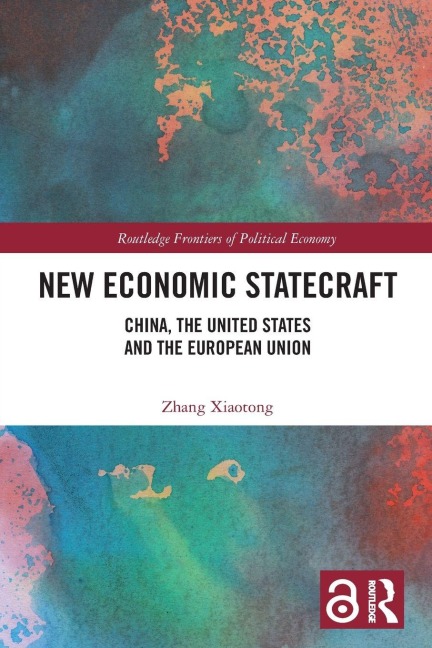

This book provides insights on the art of governing a state and managing its external relations from a wealth-power logic. It looks at "economic statecraft" which consists of wealth production, wealth mobilization and wealth-power conversion by a state.
Zhang Xiaotong is Professor of Institute of Belt and Road Initiative & Global Governance, Fudan University, Shanghai, China. He is a Researcher at Wuhan University Centre for Economic Diplomacy. He obtained a PhD in political science from Université Libre de Bruxelles (ULB) in Belgium.
Contents Acknowledgement * Introduction * 1 Economic Statecraft - Concepts and Theories * 1.1 Economic Statecraft as a Concept * 1.1.1 The origin of economic statecraft as a concept * 1.1.2 "Economic statecraft" versus "economic diplomacy" * 1.1.3 Analysis and critique of the concept of economic statecraft * 1.1.4 Reconstruction of the concept of economic statecraft * 1.2 The Theoretical Construct of Economic Statecraft * 1.2.1 Theoretical assumptions. * 1.2.2 The main actor of economic statecarft. * 1.2.3 Steps and methods of implementing economic statecraft * 1.2.4 Academic and theoretical standing of economic statecraft * 2 Paradigm Shifts in Economic Statecraft Over Time * 2.1 The Age of Classical Mercantilism (15th-18th centuries) * 2.2 The Age of Classical Liberalism (1846-1870) * 2.3 The Age of Imperialism (1870-1914) * 2.4 Marxism * 3 America's Economic Statecraft * 3.1 American Economic Statecraft in the Context of British Hegemony (1775-1898) * 3.1.1 Founding of the United States of America * 3.1.2 Continental Empire (1815-1850s) * 3.1.3 Civil War and Overseas Empire (1860/65-1898) * 3.2 American Economic Statecraft in the Context of U.S. Hegemony * 3.2.1 Rise to U.S. hegemony (1898-1913) * 3.2.2 Triumph of U.S. hegemony (1914-1945) * 3.2.3 Maturing of U.S. hegemony (1945-1967/73) * 3.2.4 Decline of U.S. hegemony (1967/73-2001/08) * 3.3 U.S. Economic Statecraft in the Context of the Rise of Other Great Powers (2008-2020) * 3.3.1 U.S. economic statecraft under president Obama (2008-2016) * 3.3.2 U.S. economic statecraft under president Trump (2016-2020) * 3.4 Paradigm Shift in U.S. Economic Statecraft: Pendulum Between Liberalism and Mercantilism * 3.4.1 The dilemma of de-globalization * 3.4.2 The dilemma of the U.S. hegemony * 3.4.3 The dilemma of U.S. domestic politics * 4 The EU's Economic Statecraft * 4.1 Inherent Deficiencies in the EU's Implementation of Economic Statecraft and the EU's Innovative Solutions * 4.2 Updating the EU's Economic Statecraft "Toolbox" since 2020 * 4.2.1 Promote the further instrumentalization of military and economic power to create a "Europa Geopolitica". * 4.2.2 Promote a "sovereign Europe" and protect the "economic sovereignty" of Europe. * 4.2.3 Promote the "geoeconomic Europe" agenda by vigorously implementing economic diplomacy. * 4.2.4 Economic coercion is an increasingly-important tool in the EU's economic statecraft. * 4.3 The History of EU Foreign Policy from the Perspective of Economic Statecraft * 4.3.1 The foundation of European power (1950-1967) * 4.3.2 The "upward spiral" of European power (1967-2008) * 4.3.3 Decline of European power (Since 2008) * 5 China's Economic Statecraft under Xi Jinping * 5.1 What was president Xi's Economic Statecraft in His First Term (2012-2017)? * 5.2 What was president Xi's Economic Statecraft in His Second Term (2017-2022)? * 5.3 Conclusion and Future Scenarios * 6 Competing Economic Statecrafts * 6.1 The Change of "the Spirit of the Times" * 6.2 The Manifestations of Competing Economic Statecrafts and Consequences * 6.3 Competing Thoughts behind Competing Economic Statecrafts *