Und dann auf "Zum Home-Bildschirm [+]".

Stöbern
genialokal zum Startbildschirm hinzufügen
Installieren Sie die genialokal App auf Ihrem Startbildschirm für einen schnellen Zugriff und eine komfortable Nutzung.
Installieren Sie die genialokal App auf Ihrem Startbildschirm für einen schnellen Zugriff und eine komfortable Nutzung.
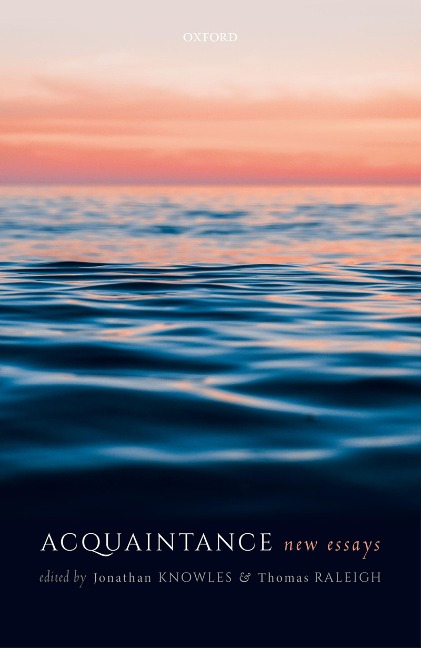
Bertrand Russell famously distinguished between 'knowledge by acquaintance' and 'knowledge by description'. For much of the latter half of the twentieth century, many philosophers viewed the notion of acquaintance with suspicion, associating it with Russellian ideas that they would wish to reject. However in the past decade or two the concept has undergone a striking revival in mainstream 'analytic' philosophy--acquaintance is, it seems, respectable again. This volume showcases the great variety of topics in philosophy of mind, epistemology, and philosophy of language for which philosophers are currently employing the notion of acquaintance. It is the first collection of new essays devoted to the topic of acquaintance, featuring chapters from many of the world's leading experts in this area. Opening with an extensive introductory essay, which provides some historical background and summarizes the main debates and issues concerning acquaintance, the remaining thirteen contributions are grouped thematically into four sections: phenomenal consciousness, perceptual experience, reference, and epistemology.
Jonathan Knowles is Professor of Philosophy at Norwegian University of Science and Technology in Trondheim. He has published books and papers on the philosophy of mind, philosophy of science, and pragmatism. He is particularly interested in questions about consciousness, naturalism, representation, and realism.
Thomas Raleigh is a Post-Doctoral Research Fellow at the Centre for Philosophical Psychology at the University of Antwerp. He has previously held positions at the Ruhr University Bochum, the University of Vienna, the Norwegian University of Science & Technology (NTNU), Concordia University, and the National Autonomous University of Mexico (UNAM). His research is primarily in philosophy of mind and epistemology.
- Introduction: The Recent Renaissance of Acquaintance - Part I: Phenomenal Consciousness - 1: Joseph Levine: Consciousness is Acquaintance - 2: Sam Coleman: Natural Acquaintance - 3: Alex Grzankowski and Michael Tye: What Acquaintance Teaches - 4: M. G. F. Martin: Betwixt Feeling and Thinking: Two-Level Accounts of Experience - Part II: Perceptual Experience - 5: David Woodruff Smith: Acquaintance in an Experience of Perception-cum-Action - 6: Tom Stoneham: Dreaming, Phenomenal Character and Acquaintance - 7: Jonathan Knowles: Relationalism, Berkeley's Puzzle and Phenomenological Externalism - 8: Anders Nes: Conceptualism and the Explanatory Role of Experience - Part III: Reference - 9: John Campbell: Acquaintance as Grounded in Joint Attention - 10: Jessica Pepp: Principles of Acquaintance - Part IV: Epistemology - 11: Richard Fumerton: Acquaintance: The Foundation of Knowledge and Thought - 12: Katalin Farkas: Objectual Knowledge - 13: Bill Brewer: Visual Experience, Revelation and the Three Rs
Dieses eBook wird im PDF-Format geliefert und ist mit einem Adobe Kopierschutz (DRM) versehen. Sie können dieses eBook mit allen Geräten lesen, die das PDF-Format und den Adobe Kopierschutz (DRM) unterstützen.
Zum Beispiel mit den folgenden Geräten:
• tolino Reader
Laden Sie das eBook direkt über den Reader-Shop auf dem tolino herunter oder übertragen Sie das eBook auf Ihren tolino mit einer kostenlosen Software wie beispielsweise Adobe Digital Editions.
• Sony Reader & andere eBook Reader
Laden Sie das eBook direkt über den Reader-Shop herunter oder übertragen Sie das eBook mit der kostenlosen Software Sony READER FOR PC/Mac oder Adobe Digital Editions auf ein Standard-Lesegeräte mit epub- und Adobe DRM-Unterstützung.
• Tablets & Smartphones
Möchten Sie dieses eBook auf Ihrem Smartphone oder Tablet lesen, finden Sie hier unsere kostenlose Lese-App für iPhone/iPad und Android Smartphone/Tablets.
• PC & Mac
Lesen Sie das eBook direkt nach dem Herunterladen mit einer kostenlosen Lesesoftware, beispielsweise Adobe Digital Editions, Sony READER FOR PC/Mac oder direkt über Ihre eBook-Bibliothek in Ihrem Konto unter „Meine eBooks“ - „online lesen“.
Schalten Sie das eBook mit Ihrer persönlichen Adobe ID auf bis zu sechs Geräten gleichzeitig frei.
Bitte beachten Sie, dass die Kindle-Geräte das Format nicht unterstützen und dieses eBook somit nicht auf Kindle-Geräten lesbar ist.