Und dann auf "Zum Home-Bildschirm [+]".

Stöbern
genialokal zum Startbildschirm hinzufügen
Installieren Sie die genialokal App auf Ihrem Startbildschirm für einen schnellen Zugriff und eine komfortable Nutzung.
Installieren Sie die genialokal App auf Ihrem Startbildschirm für einen schnellen Zugriff und eine komfortable Nutzung.
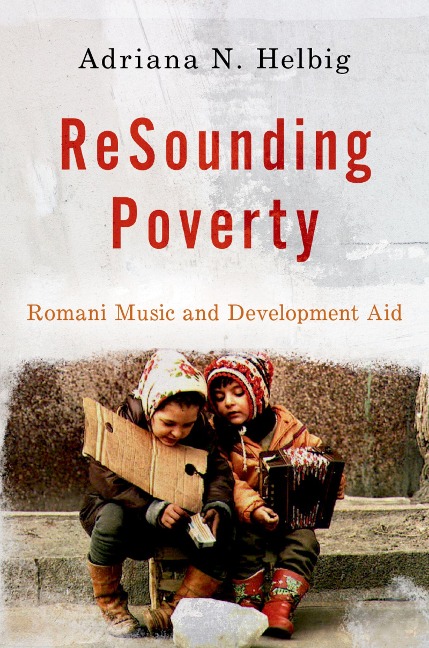
ReSounding Poverty: Romani Music and Development Aid engages with global scholarship on development, poverty, and applied research. It addresses the role of non-governmental organizations (NGOs) within postsocialist neoliberal processes and analyzes the economic structures within which Romani musics circulate. Specifically, ReSounding Poverty offers a micro ethnography of economic networks that impact the daily lives of Romani musicians on the borders of the former Soviet Union and the European Union. It argues that the development aid allotted to provide economic assistance to Romani communities, when analyzed from the perspective of the performance arts, continues to marginalize the poorest among them. Through their structure and programming, NGOs choose which segments of the population are the most vulnerable and in the greatest need of assistance. Drawing on ethnographic research in development contexts, ReSounding Poverty asks who speaks for whom within the Romani rights movement today. Framing the critique of development aid in musical terms, it engages with Romani marginalization and economic deprivation through a closer listening to vocal inflections, physical vocalizations of health and disease, and emotional affect. ReSounding Poverty brings us into the back rooms of saman, mud and straw brick, houses not visited by media reporters and politicians, amplifying the cultural expressions of the Romani poor, silenced in the business of development.
Dr. Adriana N. Helbig is Associate Professor of Music and former Assistant Dean of Undergraduates at the University of Pittsburgh where she teaches courses on world music, global hip hop, Romani music, music and disability studies, prison sounds, and bluegrass. She has received grants from the American Council of Learned Societies (ACLS), the Fulbright Foundation, the International Research and Exchanges (IREX), the Institute of International Education (IIE), the Shevchenko Scientific Society, the American Association for Ukrainian Studies, the Ukrainian Research Institute at Harvard University, and the Ukrainian Studies Program at Columbia University. Her work appears in numerous international academic journals and edited volumes. She is the author of Hip Hop Ukraine: Music, Race, and African Migration (2014) and the co-editor with Milosz Miszczynski of Hip Hop at Europe's Edge: Music, Agency, and Social Change (2017). She is also the co-author with Oksana Buranbaeva and Vanja Mladineo of Culture and Customs of Ukraine (2009).
Preface Acknowledgements Introduction
1. Transitions 2. Interventions 3. Accountability 4. Networks 5. Mobilities 6. Tuning In 7. Sound Health 8. Release
Epilogue
Dieses eBook wird im PDF-Format geliefert und ist mit einem Adobe Kopierschutz (DRM) versehen. Sie können dieses eBook mit allen Geräten lesen, die das PDF-Format und den Adobe Kopierschutz (DRM) unterstützen.
Zum Beispiel mit den folgenden Geräten:
• tolino Reader
Laden Sie das eBook direkt über den Reader-Shop auf dem tolino herunter oder übertragen Sie das eBook auf Ihren tolino mit einer kostenlosen Software wie beispielsweise Adobe Digital Editions.
• Sony Reader & andere eBook Reader
Laden Sie das eBook direkt über den Reader-Shop herunter oder übertragen Sie das eBook mit der kostenlosen Software Sony READER FOR PC/Mac oder Adobe Digital Editions auf ein Standard-Lesegeräte mit epub- und Adobe DRM-Unterstützung.
• Tablets & Smartphones
Möchten Sie dieses eBook auf Ihrem Smartphone oder Tablet lesen, finden Sie hier unsere kostenlose Lese-App für iPhone/iPad und Android Smartphone/Tablets.
• PC & Mac
Lesen Sie das eBook direkt nach dem Herunterladen mit einer kostenlosen Lesesoftware, beispielsweise Adobe Digital Editions, Sony READER FOR PC/Mac oder direkt über Ihre eBook-Bibliothek in Ihrem Konto unter „Meine eBooks“ - „online lesen“.
Schalten Sie das eBook mit Ihrer persönlichen Adobe ID auf bis zu sechs Geräten gleichzeitig frei.
Bitte beachten Sie, dass die Kindle-Geräte das Format nicht unterstützen und dieses eBook somit nicht auf Kindle-Geräten lesbar ist.