Und dann auf "Zum Home-Bildschirm [+]".

Stöbern
genialokal zum Startbildschirm hinzufügen
Installieren Sie die genialokal App auf Ihrem Startbildschirm für einen schnellen Zugriff und eine komfortable Nutzung.
Installieren Sie die genialokal App auf Ihrem Startbildschirm für einen schnellen Zugriff und eine komfortable Nutzung.
Ihr gewünschter Artikel ist in 0 Buchhandlungen vorrätig - wählen Sie hier eine Buchhandlung in Ihrer Nähe aus:


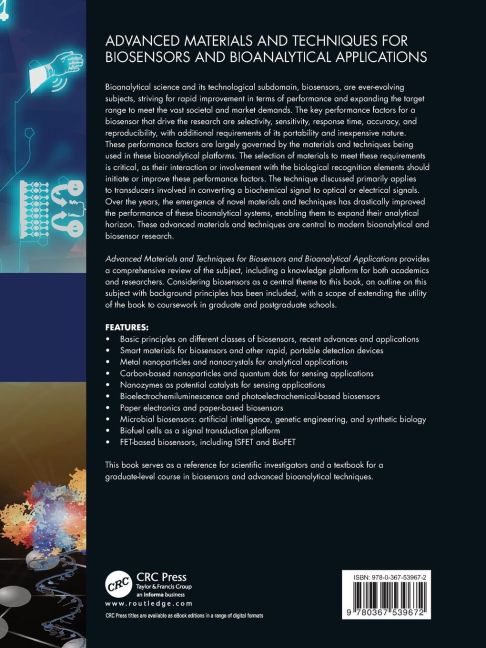
Bioanalytical science and its technological sub-domain biosensors are ever-evolving subjects, striving for rapid improvement in their performances. Advanced materials and techniques for biosensors and bioanalytical applications comprehensively reviewed the subject, providing a knowledge platform for both academics and researchers.
Prof. Pranab Goswami received M.Sc. degree in chemistry with specialization in organic chemistry from Gauhati University, India and subsequently, M.S. degree from BITS Pilani, Rajasthan, India and finally, a Ph.D. degree from his work at Regional Research Laboratory (Currently, NEIST, CSIR) Jorhat, India in 1994 in the area of biotechnology. Prof. Goswami was a BOYSCAST fellow of DST, India, at the University of Massachusetts Boston, USA. He started his professional carrier as a scientist at NEIST, CSIR Jorhat India during 1990, and continued there for 12 years. After that, Prof. Goswami moved to the Department of Biotechnology (renamed later as Department of Biosciences and Bioengineering) at the Indian Institute of Technology (IIT) Guwahati, India, as a faculty. He attained the level of Professor of Higher Academic Grade in the year 2015. Prof. Goswami also developed administrative experience in the capacity of Heads, in the Department of Biosciences and Bioengineering, Centre for Energy, and Centre for Central Instrument Facility at IIT Guwahati. The primary research area of Prof. Goswami is biocatalysis and biosensors. His research involves the development of nano-bio sensors for malaria, myocardial infarction (MI), alcohol, and bilirubin. One of his primary objectives is the development of novel biorecognition systems along with signal transduction platforms for the above targets. His group has developed many novel aptamers as recognition molecules for the detection of malaria and MI. Efficient signal transduction through nanomaterial interface for sensitive and selective detection of the targets is the primary activity in his research lab. In this aspect, his group explores the direct electron transfer from the biorecognition elements (enzyme and bacterial biocatalysts) to the electrode surface through various electrochemical transducing platforms to generate a seamless electrical signal for sensing applications. His achievement on direct electrical communication from the FAD-based very high molecular weight redox enzymes, mainly, alcohol oxidase is well known. Prof. Goswami has used the concept to develop not only a sensitive amperometric alcohol biosensor but also a prototype on enzymatic-biofuel cell cum bio-battery using the enzyme bioelectrode. Among the different electrochemical transducers, Prof. Goswami's lab is well known for enzyme and cyanobacteria based biofuel cells as signal-transducing platforms for generation and amplification of signals to detect alcohol and allied applications. A couple of proofs-of-concept his group has developed through the intensive basic research has already been translated to portable kits for detection of malaria, alcohol, methanol, and formaldehyde. Prof. Goswami has published more than 100 peer-reviewed scientific papers and filed ten patent applications, mainly in the field of biosensors and biocatalysis. He has supervised more than 30 Ph.D. students and received many awards and accolades, including many outstanding reviewers' awards from reputed journals and visiting professorship in premiere university in abroad. He is also an editorial board member of some international scientific journals.
Chapter 1 Fundamentals of Biosensors Chapter 2 Emerging Materials and Platforms for Biosensor Applications Chapter 3 Smart Materials for Developing Sensor Platforms Chapter 4 Aptamer: An Emerging Biorecognition System Chapter 5 Metal Nanoparticles for Analytical Applications Chapter 6 Metal Nanoclusters as Signal Transducing Element Chapter 7 Nanozymes as Potential Catalysts for Sensing and Analytical Applications Chapter 8 Carbon-Based Nanomaterials for Sensing Applications Chapter 9 Photoelectrochemical and Photosynthetic Material-Based Biosensors Chapter 10 Biofuel Cells as an Emerging Biosensing Device Chapter 11 Bioelectrochemiluminescence as an Analytical Signal of Extreme Sensitivity Chapter 12 Paper Electronics and Paper-Based Biosensors Chapter 13 Strategies to Improve the Performance of Microbial Biosensors: Artificial Intelligence, Genetic Engineering, Nanotechnology, and Synthetic Biology Chapter 14 FET-Based Biosensors (BioFETs): Principle, Methods of Fabrication, Characteristics, and Applications