Und dann auf "Zum Home-Bildschirm [+]".

Stöbern
genialokal zum Startbildschirm hinzufügen
Installieren Sie die genialokal App auf Ihrem Startbildschirm für einen schnellen Zugriff und eine komfortable Nutzung.
Installieren Sie die genialokal App auf Ihrem Startbildschirm für einen schnellen Zugriff und eine komfortable Nutzung.
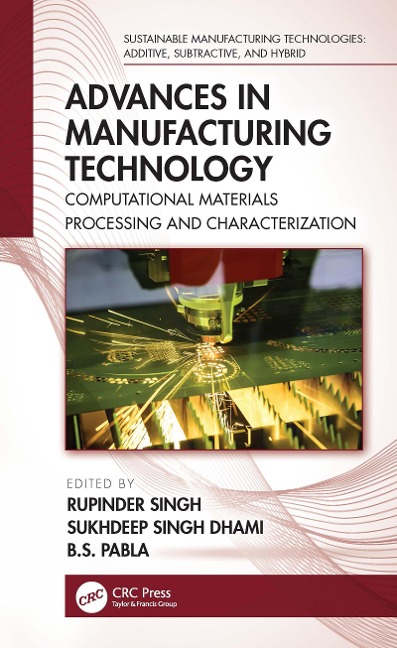
This cross-disciplinary book transcends departmental, institutional, industrial, public, and research organizations and goes beyond global barriers to cover the integration of research, education, and manufacturing in advanced materials processing and characterization, including CAD-CAM, Finite Element Analysis (FEA), and smart manufacturing. Advances in Manufacturing Technology: Computational Materials Processing and Characterization focuses on the design of experiment-based computational models, which involves FEA along with an ergonomics-based design of tooling for both conventional and nonconventional manufacturing processes. It discusses research, work, and recent developments in the field of production manufacturing of any mechanical system. Case studies and solved numerical solutions are included at the end of each chapter for easy reading comprehension. The book is helpful to those working on new developments in the field of product manufacturing. It also acts as a first-hand source of information for academic scholars and commercial manufacturers as they make strategic manufacturing development plans.
Rupinder Singh received his Ph.D degree in Mechanical Engineering in 2006 from T.I.E.T Patiala, Masters of Technology (Production Engineering) in 2001 and Bachelors of Technology (Production Engineering) in 1999 from Punjab Tech. University. He is Chartered Engineer by Institution of Engineers (India) and AICTE Young Teacher Awardee, DST Young Scientist Awardee, UGC Research Awardee. Currently, he is Professor at the Department of Mechanical Engineering, National Institute of Technical Teachers Training and Research, Chandigarh (India). He has more than 20 years of teaching and research experience in Production and Industrial Engineering, with special emphasis in additive manufacturing, non conventional machining and casting. He has guided 22 Ph.D. and 102 Master's students as well as coordinated 19 financed research projects. He has received several scientific awards. He has worked as evaluator of projects for International research agencies as well as examiner of Ph.D. thesis for many Indian universities. He is the Guest Editor for several International journals, books Editor, and Advisor for many international conferences. In addition, he has also published as author (and co-author) more than 20 monographs, 85 book chapters and 550 articles in journals and conferences (more than 300 articles in journals indexed in SCI (SCOPUS h-index:36+/5387+ citations). Sukhdeep Singh Dhami is working as Professor of Mechanical Engineering department in National Institute of Technical Teachers Training , Chandigarh, India. He has more than 25 years of experience in the area of automation, mechatronics and application of AI based tools in the domain of mechanical engineering. He has supervised numerous PhD and Master's level candidates in the field of manufacturing, automation and condition monitoring. He has published numerous research papers in reputed journals and presented his research work in International Conferences in USA, Australia, Japan and China. He is also coordinating funded research projects. B. S. Pabla is working as Professor of Mechanical Engineering department in National Institute of Technical Teachers Training , Chandigarh, India. He has more nearly 35 years of experience in industry, teaching and research. His areas of interest are Manufacturing Technology, Computer Integrated Manufacturing Systems and Engineering Optimization. He is also Principal Investigator for a large number of sponsored research projects. He has guided a number of PhD and Master's level students and published research papers in reputed international journals and conferences.
Section 1: Advanced Material Processing and Characterization. 1. Conventional and Un-Conventional Machining. 2. Forming, Casting, Joining and other Related Processes. 3. Processing, Characterization of Smart Composites (polymeric/metallic). 4. Surface Engineering and its Applications. Section 2: Industrial Engineering. 5. Human Engineering. Chapter 6. Plant Lay-Out and Material Handling. 7. Engineering Optimization. 8. Green Manufacturing. Section 3: CAD-CAM and FEA. 9. Concurrent Engineering. 10. Computers in Industry. 11. Structural and Modal Analysis. 12. Thermal Analysis and CFD. Section 4: Smart Manufacturing. 13. Robotics and Industrial Automation. 14. Industrial IoT. 15. AI Applications in Manufacturing. 16. Additive Manufacturing.
Dieses eBook wird im PDF-Format geliefert und ist mit einem Adobe Kopierschutz (DRM) versehen. Sie können dieses eBook mit allen Geräten lesen, die das PDF-Format und den Adobe Kopierschutz (DRM) unterstützen.
Zum Beispiel mit den folgenden Geräten:
• tolino Reader
Laden Sie das eBook direkt über den Reader-Shop auf dem tolino herunter oder übertragen Sie das eBook auf Ihren tolino mit einer kostenlosen Software wie beispielsweise Adobe Digital Editions.
• Sony Reader & andere eBook Reader
Laden Sie das eBook direkt über den Reader-Shop herunter oder übertragen Sie das eBook mit der kostenlosen Software Sony READER FOR PC/Mac oder Adobe Digital Editions auf ein Standard-Lesegeräte mit epub- und Adobe DRM-Unterstützung.
• Tablets & Smartphones
Möchten Sie dieses eBook auf Ihrem Smartphone oder Tablet lesen, finden Sie hier unsere kostenlose Lese-App für iPhone/iPad und Android Smartphone/Tablets.
• PC & Mac
Lesen Sie das eBook direkt nach dem Herunterladen mit einer kostenlosen Lesesoftware, beispielsweise Adobe Digital Editions, Sony READER FOR PC/Mac oder direkt über Ihre eBook-Bibliothek in Ihrem Konto unter „Meine eBooks“ - „online lesen“.
Schalten Sie das eBook mit Ihrer persönlichen Adobe ID auf bis zu sechs Geräten gleichzeitig frei.
Bitte beachten Sie, dass die Kindle-Geräte das Format nicht unterstützen und dieses eBook somit nicht auf Kindle-Geräten lesbar ist.