Und dann auf "Zum Home-Bildschirm [+]".

Stöbern
genialokal zum Startbildschirm hinzufügen
Installieren Sie die genialokal App auf Ihrem Startbildschirm für einen schnellen Zugriff und eine komfortable Nutzung.
Installieren Sie die genialokal App auf Ihrem Startbildschirm für einen schnellen Zugriff und eine komfortable Nutzung.


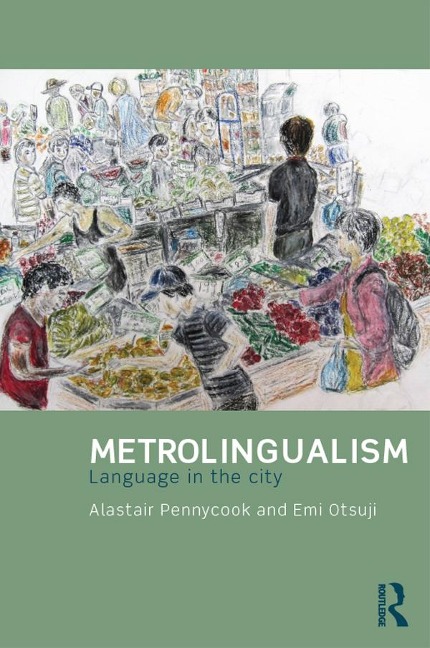
This book is about language and the city. Pennycook and Otsuji introduce the notion of 'metrolingualism', showing how language and the city are deeply involved in a perpetual exchange between people, history, migration, architecture, urban landscapes and linguistic resources. Cities and languages are in constant change, as new speakers with new repertoires come into contact as a result of globalization and the increased mobility of people and languages. Metrolingualism sheds light on the ordinariness of linguistic diversity as people go about their daily lives, getting things done, eating and drinking, buying and selling, talking and joking, drawing on whatever linguistic resources are available. Engaging with current debates about multilingualism, and developing a new way of thinking about language, the authors explore language within a number of contemporary urban situations, including cafés, restaurants, shops, streets, construction sites and other places of work, in two diverse cities, Sydney and Tokyo. This is an invaluable look at how people of different backgrounds get by linguistically. Metrolingualism: Language in the city will be of special interest to advanced undergraduate/postgraduate students and researchers of sociolinguistics and applied linguistics.
Alastair Pennycook is Professor of Language in Education at the University of Technology Sydney. He is the author of many titles, including Language as a Local Practice (2010) and Global Englishes and Transcultural Flows (2007). Emi Otsuji is a Senior Lecturer at the University of Technology Sydney. She is the co-editor of the book Languages and Identities in a Transitional Japan: From Internationalization to Globalization (2015) and the Japanese editor for The Japan Journal of Multilingualism and Multicultuarlism.
Chapter 1 Morning markets and metrolingual multitasking The Produce Market: Salamu alaykum mate Languages of the market: lingo-ing in their own language Multilingualism from below Metrolingual multitasking in a restaurant Beyond monolingualism: Niemand ist Einsprachig Research notes and emergent themes Chapter 2: Constructing affiliations and growing foreign vegetables Gwai Lou Coi: Growing foreign vegetables Metrolingualism, the rural and the urban 'People are basically from everywhere': Ethnicity and language at work Ethnic business and ethnolinguistic repertoires Ethnography as process Chapter 3: Mobility, rhythms and the city Catching a train in Sydney The breathing city Metrolingualism, space and mobility: 'chef, iedi efu iki kishu' Research: Languages and the unexpected Chapter 4 Kitchen talk and spatial repertoires The Pizzeria: 'it's all part of the Greek culture' Kitchen repertoires Spatial repertoires: "Pizza mo two minutes coming" Location and locution Researching language, mobility and practices in place Chapter 5: Convivial and contested cities 'It's too many languages': Suburban diversities Conviviality and the city "I'll fix you up, ya Lebs!": Everyday contestation The contested city Aussies and 'the worst general Asian ever' Research and stories: The chicken mime Chapter 6: Talking food: Commensality and the city The Fanta is always greener back home Talking food 'Makanai des pauvres' "Ma fi fruit bi nom? (There's no fruit at all?)" Red celery and the negotiation of meaning Relocalization Multitasking and participatory research Chapter 7: Layers, spaces, signs, networks Out-of-place texts The historical layers of cities Port cities Layered languages Researching networks: The multilingual cucumber Chapter 8 Metrolingua francas Languages and the market "-language---!": From niche to metrolingua francas Metrolingual pedagogies and policies Conclusion: Writing it all together
Dieses eBook wird im PDF-Format geliefert und ist mit einem Adobe Kopierschutz (DRM) versehen. Sie können dieses eBook mit allen Geräten lesen, die das PDF-Format und den Adobe Kopierschutz (DRM) unterstützen.
Zum Beispiel mit den folgenden Geräten:
• tolino Reader
Laden Sie das eBook direkt über den Reader-Shop auf dem tolino herunter oder übertragen Sie das eBook auf Ihren tolino mit einer kostenlosen Software wie beispielsweise Adobe Digital Editions.
• Sony Reader & andere eBook Reader
Laden Sie das eBook direkt über den Reader-Shop herunter oder übertragen Sie das eBook mit der kostenlosen Software Sony READER FOR PC/Mac oder Adobe Digital Editions auf ein Standard-Lesegeräte mit epub- und Adobe DRM-Unterstützung.
• Tablets & Smartphones
Möchten Sie dieses eBook auf Ihrem Smartphone oder Tablet lesen, finden Sie hier unsere kostenlose Lese-App für iPhone/iPad und Android Smartphone/Tablets.
• PC & Mac
Lesen Sie das eBook direkt nach dem Herunterladen mit einer kostenlosen Lesesoftware, beispielsweise Adobe Digital Editions, Sony READER FOR PC/Mac oder direkt über Ihre eBook-Bibliothek in Ihrem Konto unter „Meine eBooks“ - „online lesen“.
Schalten Sie das eBook mit Ihrer persönlichen Adobe ID auf bis zu sechs Geräten gleichzeitig frei.
Bitte beachten Sie, dass die Kindle-Geräte das Format nicht unterstützen und dieses eBook somit nicht auf Kindle-Geräten lesbar ist.