Und dann auf "Zum Home-Bildschirm [+]".

Stöbern
genialokal zum Startbildschirm hinzufügen
Installieren Sie die genialokal App auf Ihrem Startbildschirm für einen schnellen Zugriff und eine komfortable Nutzung.
Installieren Sie die genialokal App auf Ihrem Startbildschirm für einen schnellen Zugriff und eine komfortable Nutzung.
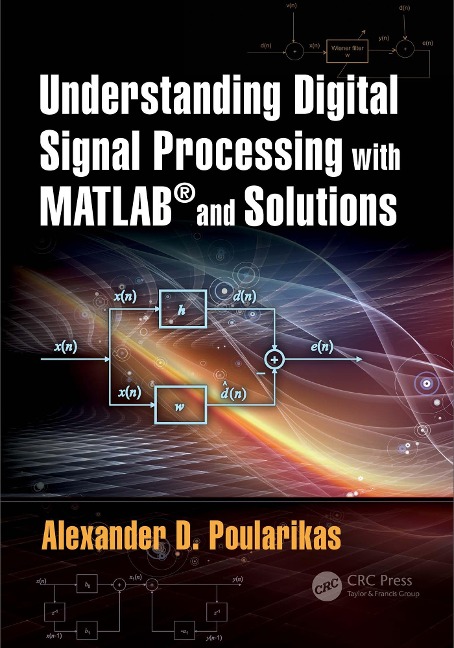
The book discusses receiving signals that most electrical engineers detect and study. The vast majority of signals could never be detected due to random additive signals, known as noise, that distorts them or completely overshadows them. Such examples include an audio signal of the pilot communicating with the ground over the engine noise or a bioengineer listening for a fetus' heartbeat over the mother's. The text presents the methods for extracting the desired signals from the noise. Each new development includes examples and exercises that use MATLAB to provide the answer in graphic forms for the reader's comprehension and understanding.
Dr. Poularikas previously held the positions of Professor at University of Rhode Island, Kingston, USA, Chairman of the Engineering Department at the University of Denver, Colorado, USA, and Chairman of the Electrical and Computer Engineering Department at the University of Alabama in Huntsville, USA. He has published, coauthored, and edited 14 books and served as an editor-in-chief of numerous book series. A Fulbright scholar, lifelong senior member of the IEEE, and member of Tau Beta Pi, Sigma Nu, and Sigma Pi, he received the IEEE Outstanding Educators Award, Huntsville Section in both 1990 and 1996. Dr. Poularikas holds a Ph.D from the University of Arkansas, Fayetteville, USA.
Abbreviations Chapter 1 Continuous and Discrete Signals Chapter 2 Fourier Analysis of Continuous and Discrete Signals Chapter 3 The z-Transform, Difference Equations, and Discrete Systems Chapter 4 Finite Impulse Response (FIR) Digital Filter Design Chapter 5 Random Variables, Sequences, and Probability Functions Chapter 6 Linear Systems with Random Inputs, Filtering, and Power Spectral Density Chapter 7 Least Squares-Optimum Filtering Chapter 8 Nonparametric (Classical) Spectra Estimation Chapter 9 Parametric and Other Methods for Spectra Estimation Chapter 10 Newton's and Steepest Descent Methods Chapter 11 The Least Mean Square (LMS) Algorithm Chapter 12 Variants of Least Mean Square Algorithm Chapter 13 Nonlinear Filtering Appendix 1: Suggestions and Explanations for MATLAB Use Appendix 2: Matrix Analysis Appendix 3: Mathematical Formulas Appendix 4: MATLAB Function Bibliography Index
Dieses eBook wird im PDF-Format geliefert und ist mit einem Adobe Kopierschutz (DRM) versehen. Sie können dieses eBook mit allen Geräten lesen, die das PDF-Format und den Adobe Kopierschutz (DRM) unterstützen.
Zum Beispiel mit den folgenden Geräten:
• tolino Reader
Laden Sie das eBook direkt über den Reader-Shop auf dem tolino herunter oder übertragen Sie das eBook auf Ihren tolino mit einer kostenlosen Software wie beispielsweise Adobe Digital Editions.
• Sony Reader & andere eBook Reader
Laden Sie das eBook direkt über den Reader-Shop herunter oder übertragen Sie das eBook mit der kostenlosen Software Sony READER FOR PC/Mac oder Adobe Digital Editions auf ein Standard-Lesegeräte mit epub- und Adobe DRM-Unterstützung.
• Tablets & Smartphones
Möchten Sie dieses eBook auf Ihrem Smartphone oder Tablet lesen, finden Sie hier unsere kostenlose Lese-App für iPhone/iPad und Android Smartphone/Tablets.
• PC & Mac
Lesen Sie das eBook direkt nach dem Herunterladen mit einer kostenlosen Lesesoftware, beispielsweise Adobe Digital Editions, Sony READER FOR PC/Mac oder direkt über Ihre eBook-Bibliothek in Ihrem Konto unter „Meine eBooks“ - „online lesen“.
Schalten Sie das eBook mit Ihrer persönlichen Adobe ID auf bis zu sechs Geräten gleichzeitig frei.
Bitte beachten Sie, dass die Kindle-Geräte das Format nicht unterstützen und dieses eBook somit nicht auf Kindle-Geräten lesbar ist.