Und dann auf "Zum Home-Bildschirm [+]".

Stöbern
genialokal zum Startbildschirm hinzufügen
Installieren Sie die genialokal App auf Ihrem Startbildschirm für einen schnellen Zugriff und eine komfortable Nutzung.
Installieren Sie die genialokal App auf Ihrem Startbildschirm für einen schnellen Zugriff und eine komfortable Nutzung.
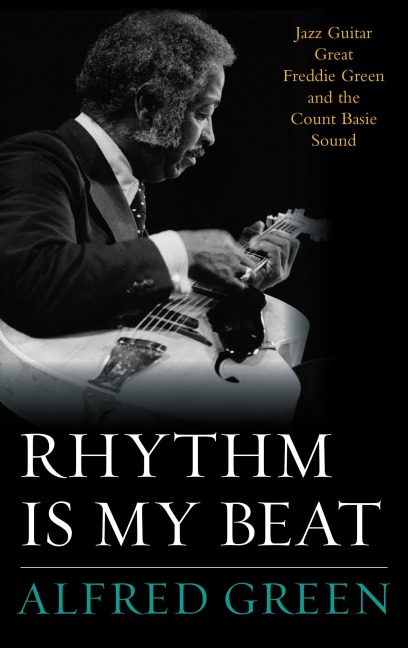
In Rhythm Is My Beat: Jazz Guitar Great Freddie Green and the Count Basie Sound, Alfred Green tells the story of his father, rhythm guitarist Freddie Green, whose guitar work served as the pulse of the Count Basie Band. A quiet but key figure in big band jazz, Freddie Green took a distinct pride in his role as Basie's rhythm guitarist, redefining the outer limits of acoustic rhythm guitar and morphing it into an art form. So distinct was Green's style that it would eventually give birth to notations on guitar charts that read: "Play in the style of Freddie Green."
This American jazz icon, much like his inimitable sound, achieved stardom as a sideman, both in and out of Basie's band. Green's signature sound provided lift to soloists like Lester Young and vocalist Lil' Jimmy Rushing, a reflection of Green's sophisticated technique, that produced, in Green's words, his "rhythm wave." Billie Holiday, Ruby Braff, Benny Goodman, Gerry Mulligan, Teddy Wilson, Ray Charles, Judy Carmichael, Joe Williams and other recording artists all benefited from the relentless fours of the man who came to be known as Mr. Rhythm. The mystique surrounding Freddie Green's technique is illuminated through generous commentary by insightful interviews with other musicians, guitar professionals and scholars, all of whom offer their ideas on Freddie Green's sound. Alfred Green throughout demystifies the man behind the legend.
This work will interest jazz fans, students, and scholars; guitar enthusiasts and professionals; music historians and anyone interested not only in the history of jazz but of the African American experience in jazz.
Alfred Green received his masters in social work from the University of Southern California. In 1984 he served as vice president of production at Academic Press Inc. in San Diego. Green was a freelance photographer for ten years and a member of the American Society of Magazine Photographers (ASMP) with assignments for Fortune, New York, Scholastic, Financial World and Black Enterprise Magazine. He covered the 12th OAU Conference in Kampala, Uganda, with additional assignments in Angola, Puerto Rico and Spain. He retired from the Los Angeles Unified School District as a psychiatric social worker. He currently lives on the west coast with his wife, Judy.
Dedication
Foreword
Preface
Acknowledgment
Chronology
Chapter 1: God Said: "Let There Be Rhythm" and Freddie Green Heard the Call
Chapter 2: The Trail to Basie
Chapter 3: Finding the Groove
Chapter 4: Building the Wave
Chapter 5: On the Road
Chapter 6: You Don't Screw With What Got You Here
Chapter 7: "You Don't Have to Shout to Be Heard."
Chapter 8: Mr. Rhythm the Man
Appendix 1: The Quest of Freddie Green: From Ukulele to "Mr. Rhythm" by Michael Pettersen
Appendix 2: The Dynamic Chord and Muted Notes (DCMN) analysis of Freddie Green's Rhythm Guitar Style: What's in a "One-Note" Chord? by M.D. Allen
Appendix 3: For the Experienced Jazz Guitarist: Freddie Green Fundamentals by Michael Pettersen
Appendix 4: Favorite Chord Voicings of Freddie Green by Michael Pettersen
Appendix 5The String Height of Freddie's Guitar and How It Shaped His Unique Style by Michael Pettersen
Appendix 6: Did Freddie Green always play the guitar chart "as written?" by Michael Pettersen
Appendix 7: Improvised Jazz
Dieses eBook wird im PDF-Format geliefert und ist mit einem Adobe Kopierschutz (DRM) versehen. Sie können dieses eBook mit allen Geräten lesen, die das PDF-Format und den Adobe Kopierschutz (DRM) unterstützen.
Zum Beispiel mit den folgenden Geräten:
• tolino Reader
Laden Sie das eBook direkt über den Reader-Shop auf dem tolino herunter oder übertragen Sie das eBook auf Ihren tolino mit einer kostenlosen Software wie beispielsweise Adobe Digital Editions.
• Sony Reader & andere eBook Reader
Laden Sie das eBook direkt über den Reader-Shop herunter oder übertragen Sie das eBook mit der kostenlosen Software Sony READER FOR PC/Mac oder Adobe Digital Editions auf ein Standard-Lesegeräte mit epub- und Adobe DRM-Unterstützung.
• Tablets & Smartphones
Möchten Sie dieses eBook auf Ihrem Smartphone oder Tablet lesen, finden Sie hier unsere kostenlose Lese-App für iPhone/iPad und Android Smartphone/Tablets.
• PC & Mac
Lesen Sie das eBook direkt nach dem Herunterladen mit einer kostenlosen Lesesoftware, beispielsweise Adobe Digital Editions, Sony READER FOR PC/Mac oder direkt über Ihre eBook-Bibliothek in Ihrem Konto unter „Meine eBooks“ - „online lesen“.
Schalten Sie das eBook mit Ihrer persönlichen Adobe ID auf bis zu sechs Geräten gleichzeitig frei.
Bitte beachten Sie, dass die Kindle-Geräte das Format nicht unterstützen und dieses eBook somit nicht auf Kindle-Geräten lesbar ist.