Und dann auf "Zum Home-Bildschirm [+]".

Stöbern
genialokal zum Startbildschirm hinzufügen
Installieren Sie die genialokal App auf Ihrem Startbildschirm für einen schnellen Zugriff und eine komfortable Nutzung.
Installieren Sie die genialokal App auf Ihrem Startbildschirm für einen schnellen Zugriff und eine komfortable Nutzung.
Ihr gewünschter Artikel ist in 0 Buchhandlungen vorrätig - wählen Sie hier eine Buchhandlung in Ihrer Nähe aus:

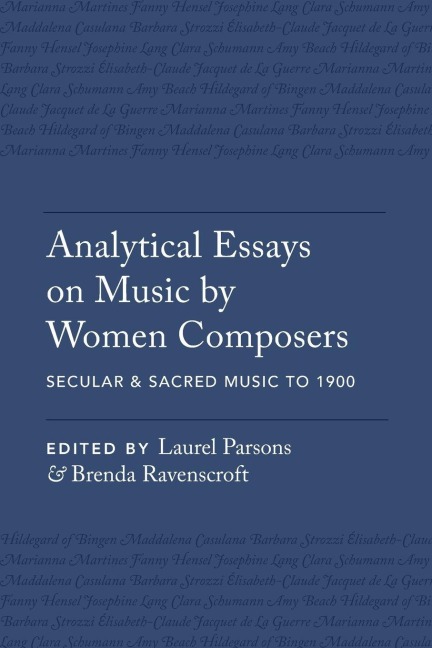
Through musical analysis of compositions written between the mid-twelfth to late nineteenth centuries, this volume celebrates the achievements of eight composers, all women: Hildegard of Bingen, Maddalena Casulana, Barbara Strozzi, Élisabeth Jacquet de la Guerre, Marianne Martines, Josephine Lang, Fanny Hensel, Clara Schumann, and Amy Beach. Written by outstanding music theorists and musicologists, the essays provide fascinating in-depth critical-analytic explorations of representative compositions, often linking analytical observations with questions of meaning and sociohistorical context. Each essay is introduced by a brief biographical sketch of the composer by the editors. The collection--Volume 1 in an unprecedented four-volume series of analytical studies on music by women composers--is designed to challenge and stimulate a wide range of readers. For academics, these thoughtful analytical essays can open new paths into unexplored research areas in the fields of music theory and musicology. Post-secondary instructors may be inspired by the insights offered in these essays to include new works in music theory and history courses at both graduate and upper-level undergraduate levels, or in courses on women and music. Finally, for soloists, ensembles, conductors, and music broadcasters, these detailed analyses can offer enriched understandings of this repertoire and suggest fresh, new programming possibilities to share with listeners.
Laurel Parsons, Ph.D., is a music theorist who has taught at the University of Victoria, University of British Columbia, Queen's University, and the University of Oregon. Her research interests include post-tonal music by Elisabeth Lutyens, Elizabeth Maconchy, and Danish electroacoustic composer Else-Marie Pade, representation of Inuit poetry in late 20th-century Canadian and British music, and post-secondary music pedagogy for students with learning differences. She has published articles on Lutyens's music in Theory & Practice and Canadian University Music Review, and on aural skills pedagogy for students with dyslexia in Music Theory Online. In addition, she has contributed chapters to Arctic Discourses (Cambridge Scholars Press, 2010) and British Modernism and Music 1895-1960 (Ashgate, 2010). From 2012 to 2015, she chaired the Society for Music Theory's Committee on the Status of Women.
Brenda Ravenscroft, Ph.D., is Associate Professor of Music Theory and Associate Dean of Teaching and
Learning in the Faculty of Arts and Science at Queen's University. Her research focuses on post-tonal American music, text and music, rhythmic organization, the music of South African composer Priaulx Rainier, and pedagogy in higher education. In addition to articles on music by Elliott Carter, John Cage and Lou Harrison in such journals as Music Analysis, Perspectives of New Music, and Music Theory Spectrum, she has contributed a chapter on Carter's vocal music to Elliott Carter Studies (Cambridge University Press, 2012) and authored the "Case Study on Music Analysis" in The Flipped College Classroom (Springer, 2015). She chaired the Society for Music Theory's Committee on the Status of Women from 2006 to 2009.
Acknowledgments
About the Companion Website
Chapter 1. Introduction: "Half of Humanity has Something to Say, Also"
Laurel Parsons and Brenda Ravenscroft
PART I: EARLY MUSIC FOR VOICE
Chapter 2. Hildegard of Bingen, O ierusalem aurea civitas (ca. 1150-70)
Varied Repetition in Hildegard's Sequence for St. Rupert: O ierusalem aurea civitas
Jennifer Bain
Chapter 3. Maddalena Casulana, "Per lei pos' in oblio" from Cinta di fior (1570)
Finding the "Air" in Maddalena Casulana's Madrigals
Peter Schubert
Chapter 4. Barbara Strozzi, Appresso ai molli argenti (1659)
Consolation Amid Barbarous Misfortune: Barbara Strozzi's Appresso ai molli argenti and the Mid-Seventeenth-Century Lament
Richard Kolb and Barbara Swanson
PART II: SEVENTEENTH- AND EIGHTEENTH-CENTURY KEYBOARD MUSIC
Chapter 5. Élisabeth Jacquet de La Guerre, Sarabandes from the Suites in A minor (1687) and D minor (1707)
In the Realm of All the Senses: Two Sarabandes by Élisabeth Jacquet de La Guerre
Susan McClary
Chapter 6. Marianna Martines, Sonata in A major, I (1765)
"Zierlichkeit und Genie": Grace and Genius in Marianna Martines's Sonata in A major
L. Poundie Burstein
PART III: NINETEENTH-CENTURY LIEDER AND PIANO MUSIC
Chapter 7. Fanny Hensel, "Von dir, mein Lieb, ich scheiden muss" (1841) and "Ich kann wohl manchmal singen" (1846)
Fanny Hensel's Schematic Fantasies; Or, The Art of Beginning
Stephen Rodgers
Chapter 8. Josephine Lang, "An einer Quelle" (1840/1853) and "Am Morgen" (1840)
Josephine Lang's Multiple Settings of Poems by Christian Reinhold Köstlin
Harald Krebs
Chapter 9. Clara Schumann, "Liebst du um Schönheit" (1841)
Multiply-Interrupted Structure in Clara Schumann's "Liebst du um Schönheit"
Michael Baker
Chapter 10. Amy Beach, "Phantoms," op. 15, no. 2 (1892)
Gapped Lines and Ghostly Flowers in Amy Beach's "Phantoms," op. 15, no. 2
Edward D. Latham
Glossary
Bibliography
Index