Und dann auf "Zum Home-Bildschirm [+]".

Stöbern
genialokal zum Startbildschirm hinzufügen
Installieren Sie die genialokal App auf Ihrem Startbildschirm für einen schnellen Zugriff und eine komfortable Nutzung.
Installieren Sie die genialokal App auf Ihrem Startbildschirm für einen schnellen Zugriff und eine komfortable Nutzung.
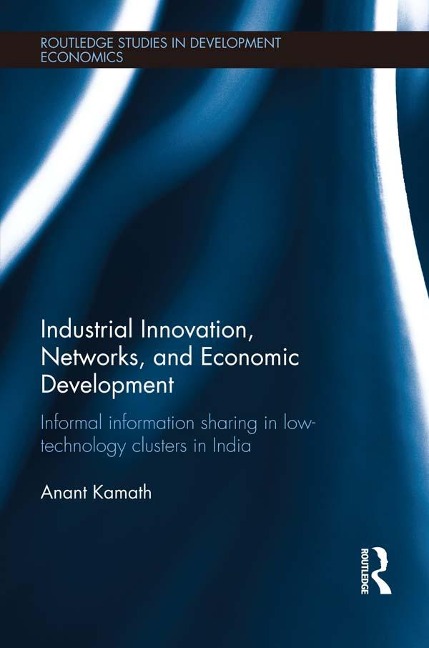
This book offers an innovative examination of how 'low-technology' industries operate. Based on extensive fieldwork in India, the book fuses economic and sociological perspectives on information sharing by means of informal interaction in a low-technology cluster in a developing country. In doing so, the book sheds new light on settings where economic relations arise as emergent properties of social relations. This book examines industrial innovation and microeconomic network behaviour among producers and clusters, perceiving knowledge diffusion to be a socially-spatial, as much as a geographically spatial, phenomenon. This is achieved by employing two methods - simulation modelling, and (quantitative, qualitative, and historical) social network analysis. The simulation model, based on its findings, motivates two empirical studies - one descriptive case and one network study - of low-tech rural and semi-urban traditional technology clusters in Kerala state in southern India. These cases demonstrate two contrasting stories of how social cohesion either supports or thwarts informal information sharing and learning. This book pushes towards an economic-sociology approach to understanding knowledge diffusion and technological learning, which perceives innovation and learning as being more social processes than the mainstream view perceives them to be. In doing so, it makes a significant contribution to the literature on defensive innovation and the role of networks in technological innovation and knowledge diffusion, as well as to policy studies of Indian small firm and traditional technology clusters.
Anant Kamath is currently faculty at Azim Premji University, Bangalore, India.
1. Introduction and Outline 2. A Simulation Model of Informal Information Sharing under Complex Social Relations 3. From Modelling to Empirical Study 4. Informal Information Sharing in a Universal Affinity Setting: Empirical Study of a Coir Cluster 5. A Network Study of Two Handloom Weavers' Clusters 6. Community Social Capital and Inherited Cohesive Networks 7. Conclusions and Policy Lessons Appendix - The Saliyars of Balaramapuram
Dieses eBook wird im PDF-Format geliefert und ist mit einem Adobe Kopierschutz (DRM) versehen. Sie können dieses eBook mit allen Geräten lesen, die das PDF-Format und den Adobe Kopierschutz (DRM) unterstützen.
Zum Beispiel mit den folgenden Geräten:
• tolino Reader
Laden Sie das eBook direkt über den Reader-Shop auf dem tolino herunter oder übertragen Sie das eBook auf Ihren tolino mit einer kostenlosen Software wie beispielsweise Adobe Digital Editions.
• Sony Reader & andere eBook Reader
Laden Sie das eBook direkt über den Reader-Shop herunter oder übertragen Sie das eBook mit der kostenlosen Software Sony READER FOR PC/Mac oder Adobe Digital Editions auf ein Standard-Lesegeräte mit epub- und Adobe DRM-Unterstützung.
• Tablets & Smartphones
Möchten Sie dieses eBook auf Ihrem Smartphone oder Tablet lesen, finden Sie hier unsere kostenlose Lese-App für iPhone/iPad und Android Smartphone/Tablets.
• PC & Mac
Lesen Sie das eBook direkt nach dem Herunterladen mit einer kostenlosen Lesesoftware, beispielsweise Adobe Digital Editions, Sony READER FOR PC/Mac oder direkt über Ihre eBook-Bibliothek in Ihrem Konto unter „Meine eBooks“ - „online lesen“.
Schalten Sie das eBook mit Ihrer persönlichen Adobe ID auf bis zu sechs Geräten gleichzeitig frei.
Bitte beachten Sie, dass die Kindle-Geräte das Format nicht unterstützen und dieses eBook somit nicht auf Kindle-Geräten lesbar ist.