Und dann auf "Zum Home-Bildschirm [+]".

Stöbern
genialokal zum Startbildschirm hinzufügen
Installieren Sie die genialokal App auf Ihrem Startbildschirm für einen schnellen Zugriff und eine komfortable Nutzung.
Installieren Sie die genialokal App auf Ihrem Startbildschirm für einen schnellen Zugriff und eine komfortable Nutzung.
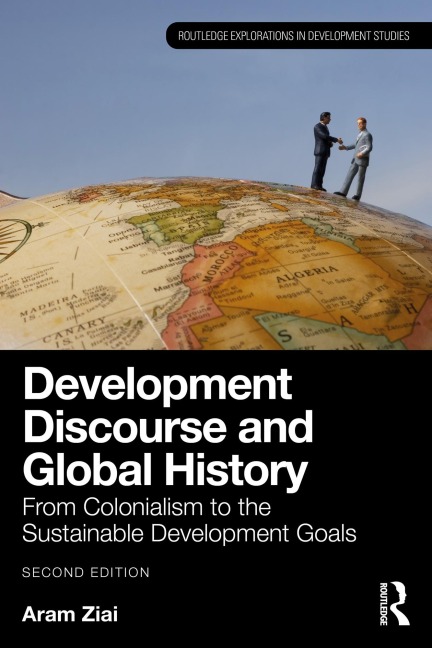
Development Discourse and Global History introduces readers to the shifting ways in which people have been talking and writing about 'development' over time, and the rules governing the conversation. Drawing on the methods of Michel Foucault, Ziai's ground-breaking book traces the origins of development discourse back to late colonialism and notes the significant discontinuities that led to the establishment of a new discourse and its accompanying industry. This book goes on to describe the contestations, appropriations and transformations of the concept over time. It shows that trends which have emerged since the 1980s, such as an emphasis on participation and ownership, sustainable development, and free markets, are incompatible with the original rules and so lead to serious contradictions. The Eurocentric, authoritarian and depoliticising elements in development discourse are uncovered, whilst still recognising its progressive appropriations. This new edition includes revisions throughout, and an important new chapter on race and racism, as well as a discussion of the evolution of the Sustainable Development Goals. This book is perfect for students and researchers in development studies, global history and discourse analysis as well as an interdisciplinary audience from international relations, political science, sociology, geography, anthropology, language and literary studies.
Aram Ziai is Executive Director of the Global Partnership Network (Excellence Centre for Exchange and Development), and Professor for Development and Postcolonial Studies at the University of Kassel, Germany.
New Preface to the second edition 1. New Introduction: The Promise of 'Development' 2. Poststructuralism, Discourse and Power 3. From 'Civilising Mission' to 'Development' 4. An Archaeology of Development Knowledge 5. The Concept of 'Development' and Why It Should Be Abandoned 6. Development Discourse: Appropriation and Tactical Polyvalence 7. The Transformation of Development Discourse: Participation, Sustainability, Heterogeneity 8. From 'Development' to 'Globalisation' 9. World Bank Discourse and Poverty Reduction 10. 'Development': Projects, Power and a Poststructuralist Perspective 11. Millennium Development Goals: Back to the Future? 12. Justice, not Development. Sen and the Hegemonic Framework for Ameliorating Global Inequality 13. Migration Management as Development Aid? The IOM and the International Migration and Development Initiative 14. The Post-2015 Agenda and the Sustainable Development Goals: The Persistence of Development Discourse 15. The Legitimation of Displacement in Development Discourse 16. Race and Gender in Development Discourse 17. Conclusion: The Contribution of Discourse Analysis to Development Studies
Dieses eBook wird im PDF-Format geliefert und ist mit einem Adobe Kopierschutz (DRM) versehen. Sie können dieses eBook mit allen Geräten lesen, die das PDF-Format und den Adobe Kopierschutz (DRM) unterstützen.
Zum Beispiel mit den folgenden Geräten:
• tolino Reader
Laden Sie das eBook direkt über den Reader-Shop auf dem tolino herunter oder übertragen Sie das eBook auf Ihren tolino mit einer kostenlosen Software wie beispielsweise Adobe Digital Editions.
• Sony Reader & andere eBook Reader
Laden Sie das eBook direkt über den Reader-Shop herunter oder übertragen Sie das eBook mit der kostenlosen Software Sony READER FOR PC/Mac oder Adobe Digital Editions auf ein Standard-Lesegeräte mit epub- und Adobe DRM-Unterstützung.
• Tablets & Smartphones
Möchten Sie dieses eBook auf Ihrem Smartphone oder Tablet lesen, finden Sie hier unsere kostenlose Lese-App für iPhone/iPad und Android Smartphone/Tablets.
• PC & Mac
Lesen Sie das eBook direkt nach dem Herunterladen mit einer kostenlosen Lesesoftware, beispielsweise Adobe Digital Editions, Sony READER FOR PC/Mac oder direkt über Ihre eBook-Bibliothek in Ihrem Konto unter „Meine eBooks“ - „online lesen“.
Schalten Sie das eBook mit Ihrer persönlichen Adobe ID auf bis zu sechs Geräten gleichzeitig frei.
Bitte beachten Sie, dass die Kindle-Geräte das Format nicht unterstützen und dieses eBook somit nicht auf Kindle-Geräten lesbar ist.