Und dann auf "Zum Home-Bildschirm [+]".

Stöbern
genialokal zum Startbildschirm hinzufügen
Installieren Sie die genialokal App auf Ihrem Startbildschirm für einen schnellen Zugriff und eine komfortable Nutzung.
Installieren Sie die genialokal App auf Ihrem Startbildschirm für einen schnellen Zugriff und eine komfortable Nutzung.
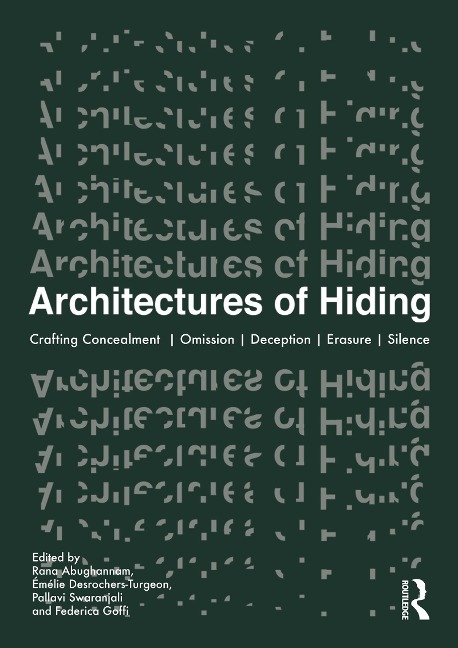
Architecture manifests as a space of concealment and unconcealment, lethe and alêtheia, enclosure and disclosure, where its making and agency are both hidden and revealed. With an urgency to amplify narratives that are overlooked, silenced and unacknowledged in and by architectural spaces, histories and theories, this book contends the need for a critical study of hiding in the context of architectural processes. It urges the understanding of inherent opportunities, power structures and covert strategies, whether socio-cultural, geo-political, environmental or economic, as they are related to their hidescapes - the constructed landscapes of our built environments participating in the architectures of hiding. Looking at and beyond the intentions and agency that architects possess, architectural spaces lend themselves as apparatuses for various forms of hiding and un(hiding). The examples explored in this book and the creative works presented in the interviews enclosed in the interludes of this publication cover a broad range of geographic and cultural contexts, discursively disclosing hidden aspects of architectural meaning. The book investigates the imaginative intrigue of concealing and revealing in design processes, along with moral responsibilities and ethical dilemmas inherent in crafting concealment through the making and reception of architecture.
Rana Abughannam is assistant professor at the School of Architecture and Landscape Architecture, University of British Columbia. She taught at Carleton University, the Canadian University Dubai and Birzeit University. She is a registered architect in Palestine with a degree in architectural engineering (Birzeit University) and a master of history and theory of architecture (McGill University). Her doctoral research (Carleton University) focuses on counter-colonial practices in Palestine. Émèlie Desrochers-Turgeon is assistant professor at the Dalhousie University School of Architecture. Her research areas include the relationship between built environments and grounds through material fictions, architectural representation, extractive infrastructures and liquid landscapes. Educated professionally in architecture (McGill University) and environmental design (UQAM), she practiced design in Canada and Germany before pursuing her PhD in architecture at Carleton University. Pallavi Swaranjali is program coordinator and professor in the Bachelor of Interior Design program, Algonquin College, Ottawa. She holds a PhD in architecture (Azrieli School of Architecture and Urbanism, Carleton University), a BA in architecture and an MDesign in industrial design from India, where she also practiced. She is an intern architect with the Ontario Association of Architects. Her research centers on architecture and storytelling. Federica Goffi is professor of architecture, and co-chair of the architecture PhD Program at the Azrieli School of Architecture and Urbanism at Carleton University, Canada. She published on architectural representation and the role of time in architecture. She holds a PhD in architecture and design research (Virginia Tech), a Dottore in Architettura (University of Genoa), and is a licensed architect in her native country, Italy.
Part 1: Modes of Hiding: Veiled Devices Beyond the Gaze Interlude 1: Verdures: Mimicry and Camouflage 1. Camouflage After the Bauhaus: Oskar Schlemmer, László Moholy-Nagy and György Kepes 2. Walls and Hidden Forms of Walling: The Production of Spatial Violence in Beirut 3. Hiding, Veiling and Transversing: Nubian Madyafa Post-Displacement 4. From Concealed Caves to Dis(Cover)ed Bunkers: Gaetano Pesce's Pre-/Post-Historical Atomic Shelter 5. Concealed Behind Transparencies: A Closer Look at Architecture's Hidden Performativity Through the Barcelona Pavilion 6. Happy Schools: The Visible and Invisible in the Sven Lokrantz School and the Architecture of Special Education Interlude 2: Deformative, Yet Silent Part 2: Motives of Hiding: Disguised Narratives Interlude 3: Avert 7. Hiding in Plain Sight: The White House Solarium and the Projection of History 8. Urban Alibi and Its Terms of Concealment: Cases From Shanghai 9. Hiding Behind Colonial Roots: Investigating the Reconstruction of the Palestinian Presidential Headquarters (the Muqata'a) in Ramallah 10. [Hidden Architecture]: The Paracontextual in Superstudio's Project of Instrumentalizable Muteness 11. Architects' Hidden Building Signatures 12. Clutter, Tidying and Architectural Desires Interlude 4: Hidden Relics Part 3: Concealed Apparatus: Latencies and Potentialities in Material Realities Interlude 5: Yellow + Blue: An Apparatus for Fabricating Illusionary Architecture 13. Hiding in the Wings: A Culture of the Onlooker in Eighteenth-Century France 14. Principles of Masking: Wall Paintings by Thomas Schütte and Ludger Gerdes, Circa 1977 15. Concealment, Costume and Modern Architecture 16. Architecture, Infrastructure and Occlusion in Miami: The Network Access Point of the Americas 17. Drawn Lines Conceal Multitudes: The Hidden Traces of Time in Carlo Scarpa's Drawn Factures for the Brion Memorial 18. Impossible Gag: Clues to a Hidden Reality in Winsor McCay's and Buster Keaton's Representations of Dreams Interlude 6: A New Approach to Hidden History: The Reconstruction of History Through Nodal Spaces in the Ghost City of Lifta Coda: The Architecture of Hiddenness: Latency and Virtuality in the Topology of Concealment
Dieses eBook wird im PDF-Format geliefert und ist mit einem Adobe Kopierschutz (DRM) versehen. Sie können dieses eBook mit allen Geräten lesen, die das PDF-Format und den Adobe Kopierschutz (DRM) unterstützen.
Zum Beispiel mit den folgenden Geräten:
• tolino Reader
Laden Sie das eBook direkt über den Reader-Shop auf dem tolino herunter oder übertragen Sie das eBook auf Ihren tolino mit einer kostenlosen Software wie beispielsweise Adobe Digital Editions.
• Sony Reader & andere eBook Reader
Laden Sie das eBook direkt über den Reader-Shop herunter oder übertragen Sie das eBook mit der kostenlosen Software Sony READER FOR PC/Mac oder Adobe Digital Editions auf ein Standard-Lesegeräte mit epub- und Adobe DRM-Unterstützung.
• Tablets & Smartphones
Möchten Sie dieses eBook auf Ihrem Smartphone oder Tablet lesen, finden Sie hier unsere kostenlose Lese-App für iPhone/iPad und Android Smartphone/Tablets.
• PC & Mac
Lesen Sie das eBook direkt nach dem Herunterladen mit einer kostenlosen Lesesoftware, beispielsweise Adobe Digital Editions, Sony READER FOR PC/Mac oder direkt über Ihre eBook-Bibliothek in Ihrem Konto unter „Meine eBooks“ - „online lesen“.
Schalten Sie das eBook mit Ihrer persönlichen Adobe ID auf bis zu sechs Geräten gleichzeitig frei.
Bitte beachten Sie, dass die Kindle-Geräte das Format nicht unterstützen und dieses eBook somit nicht auf Kindle-Geräten lesbar ist.