Und dann auf "Zum Home-Bildschirm [+]".

Stöbern
genialokal zum Startbildschirm hinzufügen
Installieren Sie die genialokal App auf Ihrem Startbildschirm für einen schnellen Zugriff und eine komfortable Nutzung.
Installieren Sie die genialokal App auf Ihrem Startbildschirm für einen schnellen Zugriff und eine komfortable Nutzung.
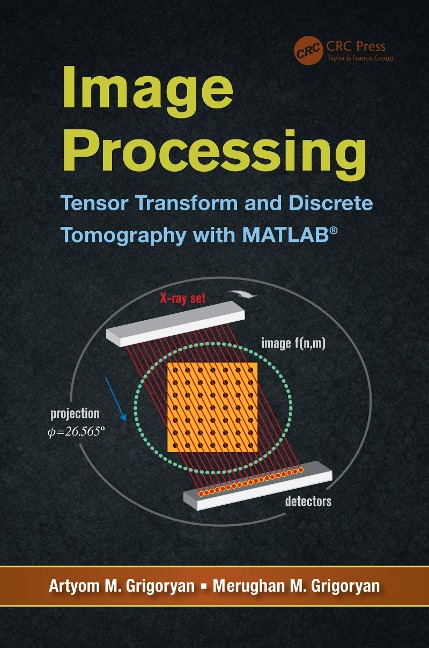
Focusing on mathematical methods in computer tomography, Image Processing: Tensor Transform and Discrete Tomography with MATLAB® introduces novel approaches to help in solving the problem of image reconstruction on the Cartesian lattice. Specifically, it discusses methods of image processing along parallel rays to more quickly and accurately reconstruct images from a finite number of projections, thereby avoiding overradiation of the body during a computed tomography (CT) scan. The book presents several new ideas, concepts, and methods, many of which have not been published elsewhere. New concepts include methods of transferring the geometry of rays from the plane to the Cartesian lattice, the point map of projections, the particle and its field function, and the statistical model of averaging. The authors supply numerous examples, MATLAB®-based programs, end-of-chapter problems, and experimental results of implementation. The main approach for image reconstruction proposed by the authors differs from existing methods of back-projection, iterative reconstruction, and Fourier and Radon filtering. In this book, the authors explain how to process each projection by a system of linear equations, or linear convolutions, to calculate the corresponding part of the 2-D tensor or paired transform of the discrete image. They then describe how to calculate the inverse transform to obtain the reconstruction. The proposed models for image reconstruction from projections are simple and result in more accurate reconstructions. Introducing a new theory and methods of image reconstruction, this book provides a solid grounding for those interested in further research and in obtaining new results. It encourages readers to develop effective applications of these methods in CT.
Artyom M. Grigoryan, Ph.D., is currently an associate professor at the Department of Electrical Engineering, University of Texas at San Antonio. He has authored or co-authored three books, including Brief Notes in Advanced DSP: Fourier Analysis with MATLAB® (2009) and Multidimensional Discrete Unitary Transforms: Representation: Partitioning, and Algorithms (2003) as well as two book chapters and many journal papers. He specializes in the theory and application of fast one- and multi-dimensional Fourier transforms, elliptic Fourier transforms, tensor and paired transforms, integer unitary heap transforms, design of robust linear and nonlinear filters, image encryption, computerized 2-D and 3-D tomography, and processing of biomedical images. Merughan M. Grigoryan is currently conducting research on the theory and application of quantum mechanics in signal processing, differential equations, Fourier analysis, elliptic Fourier transforms, Hadamard matrices, fast integer unitary transformations, the theory and methods of the fast unitary transforms generated by signals, and methods of encoding in cryptography. He is the coauthor of the book Brief Notes in Advanced DSP: Fourier Analysis with MATLAB® (2009).
Discrete 2-D Fourier Transform. Direction Images. Image Sampling Along Directions. Main Program of Image Reconstruction. Reconstruction for Prime Size Image. Method of Particles. Methods of Averaging Projections. Bibliography. Appendices. Index.
Dieses eBook wird im PDF-Format geliefert und ist mit einem Adobe Kopierschutz (DRM) versehen. Sie können dieses eBook mit allen Geräten lesen, die das PDF-Format und den Adobe Kopierschutz (DRM) unterstützen.
Zum Beispiel mit den folgenden Geräten:
• tolino Reader
Laden Sie das eBook direkt über den Reader-Shop auf dem tolino herunter oder übertragen Sie das eBook auf Ihren tolino mit einer kostenlosen Software wie beispielsweise Adobe Digital Editions.
• Sony Reader & andere eBook Reader
Laden Sie das eBook direkt über den Reader-Shop herunter oder übertragen Sie das eBook mit der kostenlosen Software Sony READER FOR PC/Mac oder Adobe Digital Editions auf ein Standard-Lesegeräte mit epub- und Adobe DRM-Unterstützung.
• Tablets & Smartphones
Möchten Sie dieses eBook auf Ihrem Smartphone oder Tablet lesen, finden Sie hier unsere kostenlose Lese-App für iPhone/iPad und Android Smartphone/Tablets.
• PC & Mac
Lesen Sie das eBook direkt nach dem Herunterladen mit einer kostenlosen Lesesoftware, beispielsweise Adobe Digital Editions, Sony READER FOR PC/Mac oder direkt über Ihre eBook-Bibliothek in Ihrem Konto unter „Meine eBooks“ - „online lesen“.
Schalten Sie das eBook mit Ihrer persönlichen Adobe ID auf bis zu sechs Geräten gleichzeitig frei.
Bitte beachten Sie, dass die Kindle-Geräte das Format nicht unterstützen und dieses eBook somit nicht auf Kindle-Geräten lesbar ist.