Und dann auf "Zum Home-Bildschirm [+]".

Stöbern
genialokal zum Startbildschirm hinzufügen
Installieren Sie die genialokal App auf Ihrem Startbildschirm für einen schnellen Zugriff und eine komfortable Nutzung.
Installieren Sie die genialokal App auf Ihrem Startbildschirm für einen schnellen Zugriff und eine komfortable Nutzung.
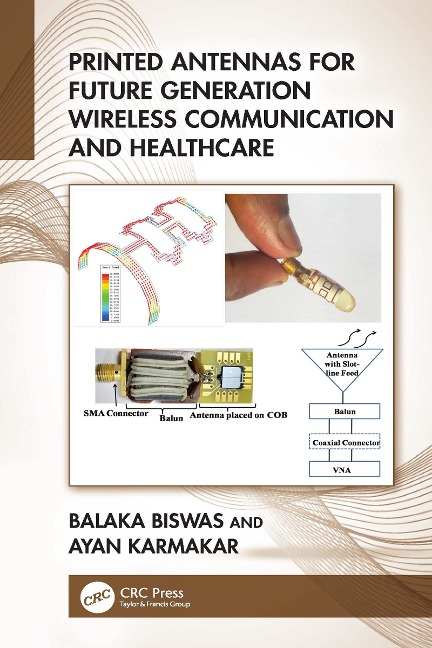
This proposed book focuses on the design and development of printed antennas along with modeling aspects for multifaceted applications. It further investigates imperfections in the manufacturing processes and assembly operation during the testing/characterization of printed antennas. This text- - Discusses in a comprehensive manner the design and development aspects of printed antennas. - Provides fractal engineering aspects for miniaturization and wideband characteristics of the low-profile antenna with high performances. - Covers high gain printed antenna for Terahertz application. - Showcases electrical modeling of smart antennas. - Pedagogical features such as review questions based on practical experiences are included at the end of each chapter. The book comprehensively discusses fractal engineering in printed antennas for miniaturization and enhancement of performance factors. It further covers the modeling of electrically small antennas, circuit modeling, modeling of factual-based Ultra-Wide Band antennas, and modeling of reconfigurable micro-electromechanical system-based patch antennas. The book highlights performance metrics of multiple-input-multiple-output antennas. It will serve as an ideal reference text for senior undergraduate, graduate students, and academic researchers in fields including electrical engineering, electronics, communications engineering, and computer engineering.
Dr. Balaka Biswas received her B.E degree in Electronics and Communication Engineering from the University of Burdwan, West Bengal and thereafter finished her masters in the year 2008. She received 1st class 1st (gold medal) in M.Tech and subsequently joined in the Ph.D program in Jadavpur University, Kolkata with DST-INSPIRE fellowship. Later, she joined CSIO-CSIR, Chandigarh as a SRA under Scientist Pool scheme and did her Post-Doc from IISER, Mohali. Currently, she is working in Chandigarh University, Mohali as an Associate Professor. She has more than 25 publications in reputed referred journals and conferences. She serves as a reviewer in several top tier journals, like- IEEE Trans. on Antenna propagation, IETE Journals, PIER-C, PIER-M, JEMWA, etc. She is life member of IETE, ISSE and Indian Science Congress Association. Ayan Karmakar received the B.Tech degree (Electronics and Communication) from WBUT, Kolkata in 2005. Later he did his masters from NIT, Durgapur. He joined ISRO as a 'Scientist' and subsequently posted to Semi-Conductor Laboratory (SCL), Chandigarh. His research interests include design and development of passive microwave integrated circuits and antennas using silicon based MIC and RF-MEMS technology. His field of expertise are expanded in fabrication technology of various MEMS based sensors and evolving the test strategies for the same. He has more than 40 publications in reputed journals and conferences at various national and international levels. In 2019, he has authored one technical book named 'Si-RF Technology' from Springer Publication, Singapore. He is a Fellow member of IETE, India and life member of Indian Science Congress Association, ISSE and Bangiya Bigyan Parishad.
Chapter 1 Printed Antennas for Modern day Communication 1.1 Introduction 1.2 Types of Printed antennas 1.3 Summarization References Problems Chapter 2 Fractals in printed antenna 2.1 Introduction 2.2 Cantor set 2.3 Koch Curve 2.4 Sierpinski carpet 2.5 Sierpinski gasket 2.6 Minkwoski Fractal 2.7 Pythagore tree fractal 2.8 Hilbert Curve fractal 2.9 Background study of fractal in antenna engineering 2.10 Recent works on fractals in antenna engineering 2.11 Summarization References Problems Chapter 3 Printed version of UWB antenna : Evolutionary steps 3.1 Introduction 3.2 Initial developmental phase 3.3 Improvement/developmental phase of UWB antenna 3.4 Band notch characteristics of UWB antenna 3.5 A brief review on tapered slot antenna 3.6 Summarization References Problems Chapter 4 Modeling of printed Antenna 4.1 Introduction 4.2 Modeling of Electrically Small Antenna 4.3 Circuit modeling 4.4 Modeling of fractal based UWB antenna 4.5 Modeling of Reconfigurable MEMS based Patch antenna 4.6 Summary References Problems Chapter 5 Printed Antennas for Biomedical Application 5.1 Introduction 5.2 Inside the capsule antenna development 5.3 Outside the Capsule Antenna Development 5.4 Link budget analysis 5.5 Summary References Problems Chapter High Gain Printed Antenna for Sub-millimeter Wave Application 6.1 Introduction 6.2 Design and Development of High Gain Printed Antenna 6.3 Summary References Problems Chapter 7 Systematic investigation of various commonly associated imperfections in printed antenna technology and its empirical modeling 7.1 Introduction 7.2 Fabrication related imperfections 7.3 IC ASSEMBLY OR PACKAGING RELATED ISSUES 7.4 Summary References Problems Chapter 8 Multiple Input Multiple Output(MIMO) technology in Printed antenna 8.1 Background and history 8.2 Performance metrics of MIMO antenna 8.3 Challenges in MIMO antenna designing 8.4 Different Methods to reduce mutual coupling 8.5 Types of MIMO antennas 8.6 MIMO antennas in Biomedical Usage 8.7 Reconfigurable MIMO Antenna 8.8 Conclusion References Problems Chapter9 Printed version of Antenna for Medical Imaging 9.1 Introduction 9.2 Types of Microwave Imaging 9.3 Antenna for microwave imaging References Problems Chapter 10 Rectenna : A frontier for future wireless communication 10.1 Introduction 10.2 Performance metrics of RF harvester 10.3 Design protocols of RF energy harvesting circuit 10.4 Building blocks of Rectenna 10.5 Practical applications of RF energy harvester 10.6 Conclusion References Problems Appendix Appendix-1 RF and Microwave frequency spectrum along with practical applications Appendix-2 Comparison of different planar antenna Appendix-3 Comparison of various computational electromagnetic solvers Appendix-4 Popular types of planar Antennas for antenna-in-package (AiP) configuration
Dieses eBook wird im PDF-Format geliefert und ist mit einem Adobe Kopierschutz (DRM) versehen. Sie können dieses eBook mit allen Geräten lesen, die das PDF-Format und den Adobe Kopierschutz (DRM) unterstützen.
Zum Beispiel mit den folgenden Geräten:
• tolino Reader
Laden Sie das eBook direkt über den Reader-Shop auf dem tolino herunter oder übertragen Sie das eBook auf Ihren tolino mit einer kostenlosen Software wie beispielsweise Adobe Digital Editions.
• Sony Reader & andere eBook Reader
Laden Sie das eBook direkt über den Reader-Shop herunter oder übertragen Sie das eBook mit der kostenlosen Software Sony READER FOR PC/Mac oder Adobe Digital Editions auf ein Standard-Lesegeräte mit epub- und Adobe DRM-Unterstützung.
• Tablets & Smartphones
Möchten Sie dieses eBook auf Ihrem Smartphone oder Tablet lesen, finden Sie hier unsere kostenlose Lese-App für iPhone/iPad und Android Smartphone/Tablets.
• PC & Mac
Lesen Sie das eBook direkt nach dem Herunterladen mit einer kostenlosen Lesesoftware, beispielsweise Adobe Digital Editions, Sony READER FOR PC/Mac oder direkt über Ihre eBook-Bibliothek in Ihrem Konto unter „Meine eBooks“ - „online lesen“.
Schalten Sie das eBook mit Ihrer persönlichen Adobe ID auf bis zu sechs Geräten gleichzeitig frei.
Bitte beachten Sie, dass die Kindle-Geräte das Format nicht unterstützen und dieses eBook somit nicht auf Kindle-Geräten lesbar ist.