Und dann auf "Zum Home-Bildschirm [+]".

Stöbern
genialokal zum Startbildschirm hinzufügen
Installieren Sie die genialokal App auf Ihrem Startbildschirm für einen schnellen Zugriff und eine komfortable Nutzung.
Installieren Sie die genialokal App auf Ihrem Startbildschirm für einen schnellen Zugriff und eine komfortable Nutzung.
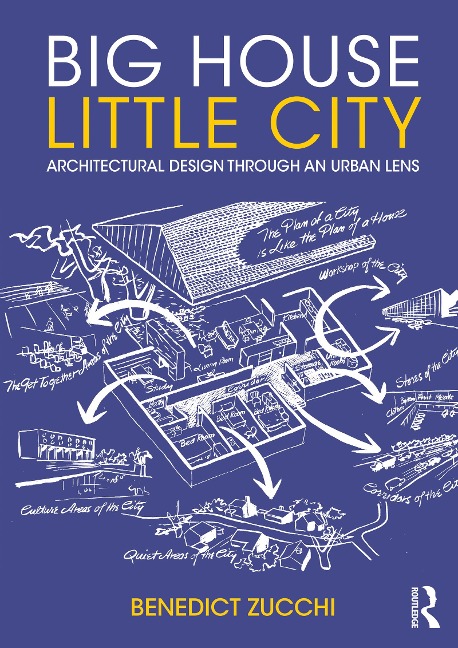
*Shortlisted for the Architectural Book Awards 2024* Combining architectural and urban thinking in an unusual and engaging way, this book presents an integrated approach to architectural theory and design. Leon Battista Alberti's assertion in his famous Renaissance treatise that 'the city is like a big house, and the house is in turn like a little city' forms the springboard for a series of reflections on architecture's relationship with urbanism and how their once intimate symbiosis, unravelled by International Style Modernism, can be recovered. Explicit references to Alberti's house-city phrase have been made by figures as diverse as the architects Louis Kahn, Aldo Van Eyck, Denys Lasdun and Niels Torp and novelist Italo Calvino. But, as the book shows, thinking of buildings as little cities provides a new lens through which to reappraise the contributions of many other architects, including Le Corbusier, Frank Lloyd Wright, Alvar Aalto, Eliel Saarinen, Bernard Rudofsky, Hans Scharoun, Leon Krier, Fumihiko Maki, Charles Correa and Team 10. In doing so, the author identifies common themes that form an unexpected bridgehead between the urban and architectural approaches of Antiquity, the Middle Ages, Renaissance and 20th century. The book explores buildings from across the globe, including lesser-known projects, such as Wright's unbuilt house in Italy or Saarinen's master plan for Cranbrook Academy, as well as more recent projects by Niels Torp, Behnisch Architekten, Sou Fujimoto, Peter Barber and WOHA. It concludes with practical case studies of residential, health, education and workplace projects from different countries, fulsomely illustrated with many drawings and photographs. These show how architectural design viewed through an urban lens provides a conceptual framework for breaking down the scale of large buildings and integrating them with their context. And crucially, these also show a very accessible way of explaining evolving designs to the intended users and eliciting their participation in the design process. The book offers a compelling approach to the design of projects at all scales, within an ecological perspective: the sense that big and small, cities and buildings must be approached holistically if we are to reverse the degradation and depletion of our habitat, both natural and man-made.
Benedict Zucchi, Principal and Head of Architecture at Building Design Partnership, studied architecture at the Universities of Cambridge and Harvard. His previous publications include the first English language monograph on Italian architect Giancarlo De Carlo. A close reading of place and use and an abiding interest in user participation have been common threads in Benedict's projects, which range from mixed-use masterplans, schools and universities to designs for major hospitals.
Part 1: Alberti's House-City 1. A Contested Legacy 2. The City as a Big House 3. The House as a Little City 4. Alberti's 'Method': compartition and concinnitas Part 2: Building Blocks: from house to city 5. House: from villa to ville 6. Ground: natural, historical and social 7. Individual Spaces: from rooms to buildings 8. Connecting Spaces: from corridors to streets 9. Collective Spaces: from living room to piazza Part 3: Designing Buildings as Little Cities 10. Little Cities for Dwelling 11. Little Cities for Work and Interaction 12. Little Cities for Mind and Body Conclusions: House-City as Ecosystem Reflections Niels Torp Bob Allies Richard Hassell
Dieses eBook wird im PDF-Format geliefert und ist mit einem Adobe Kopierschutz (DRM) versehen. Sie können dieses eBook mit allen Geräten lesen, die das PDF-Format und den Adobe Kopierschutz (DRM) unterstützen.
Zum Beispiel mit den folgenden Geräten:
• tolino Reader
Laden Sie das eBook direkt über den Reader-Shop auf dem tolino herunter oder übertragen Sie das eBook auf Ihren tolino mit einer kostenlosen Software wie beispielsweise Adobe Digital Editions.
• Sony Reader & andere eBook Reader
Laden Sie das eBook direkt über den Reader-Shop herunter oder übertragen Sie das eBook mit der kostenlosen Software Sony READER FOR PC/Mac oder Adobe Digital Editions auf ein Standard-Lesegeräte mit epub- und Adobe DRM-Unterstützung.
• Tablets & Smartphones
Möchten Sie dieses eBook auf Ihrem Smartphone oder Tablet lesen, finden Sie hier unsere kostenlose Lese-App für iPhone/iPad und Android Smartphone/Tablets.
• PC & Mac
Lesen Sie das eBook direkt nach dem Herunterladen mit einer kostenlosen Lesesoftware, beispielsweise Adobe Digital Editions, Sony READER FOR PC/Mac oder direkt über Ihre eBook-Bibliothek in Ihrem Konto unter „Meine eBooks“ - „online lesen“.
Schalten Sie das eBook mit Ihrer persönlichen Adobe ID auf bis zu sechs Geräten gleichzeitig frei.
Bitte beachten Sie, dass die Kindle-Geräte das Format nicht unterstützen und dieses eBook somit nicht auf Kindle-Geräten lesbar ist.