Und dann auf "Zum Home-Bildschirm [+]".

Stöbern
genialokal zum Startbildschirm hinzufügen
Installieren Sie die genialokal App auf Ihrem Startbildschirm für einen schnellen Zugriff und eine komfortable Nutzung.
Installieren Sie die genialokal App auf Ihrem Startbildschirm für einen schnellen Zugriff und eine komfortable Nutzung.
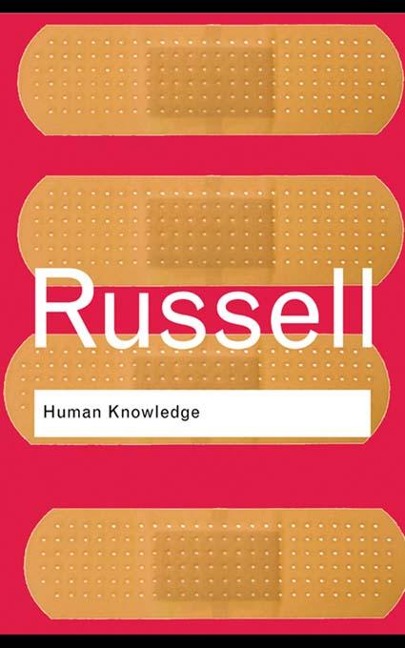
How do we know what we "know"? How did we -as individuals and as a society - come to accept certain knowledge as fact? In Human Knowledge, Bertrand Russell questions the reliability of our assumptions on knowledge. This brilliant and controversial work investigates the relationship between 'individual' and 'scientific' knowledge. First published in 1948, this provocative work contributed significantly to an explosive intellectual discourse that continues to this day.
Bertrand Russell (1872-1970). The leading British Philosopher of the twentieth century, who made major contributions to the area of logic and epistemology. Politically active and habitually outspoken, his ethical principles twice lead to imprisonment
Introduction; Part 1 The World of Science; Chapter I-1 Individual and Social Knowledge; Chapter I-2 The Universe of Astronomy; Chapter I-3 The World of Physics; Chapter I-4 Biological Evolution; Chapter I-5 The Physiology of Sensation and Volition; Chapter I-6 The Science of Mind; Part 2 Language; Chapter II-1 The Uses of Language; Chapter II-2 Ostensive Definition; Chapter II-3 Proper Names; Chapter II-4 Egocentric Particulars; Chapter II-5 Suspended Reactions: Knowledge and Belief; Chapter II-6 Sentences; Chapter II-7 External Reference of Ideas and Beliefs; Chapter II-8 Truth: Elementary Forms; Chapter II-9 Logical Words and Falsehood; Chapter II-10 General Knowledge; Chapter II-11 Fact, Belief, Truth, and Knowledge; Part 3 Science and Perception; introduction3 Introduction; Chapter III-1 Knowledge of Facts and Knowledge of Laws; Chapter III-2 Solipsism; Chapter III-3 Probable Inference in Common-Sense Practice; Chapter III-4 Physics and Experience; Chapter III-5 Time in Experience; Chapter III-6 Space in Psychology; Chapter III-7 Mind and Matter; Part 4 Scientific Concepts; Chapter IV-1 Interpretation; Chapter IV-2 Minimum Vocabularies; Chapter IV-3 Structure; Chapter IV-4 Structure and Minimum Vocabularies; Chapter IV-5 Time, Public and Private; Chapter IV-6 Space in Classical Physics; Chapter IV-7 Space-Time; Chapter IV-8 The Principle of Individuation; Chapter IV-9 Causal Laws; Chapter IV-10 Space-Time and Causality; Part 5 Probability; introduction5 Introduction; Chapter V-1 Kinds of Probability; Chapter V-2 Mathematical Probability; Chapter V-3 The Finite-Frequency Theory; Chapter V-4 The Mises-Reichenbach Theory; Chapter V-5 Keynes's Theory of Probability; Chapter V-6 Degrees of Credibility; Chapter V-7 Probability and Induction; Part 6 Postulates of Scientific Inference; Chapter VI-1 Kinds of Knowledge; Chapter VI-2 The Role of Induction; Chapter VI-3 The Postulate of Natural Kinds, or of Limited Variety; Chapter VI-4 Knowledge Transcending Experience; Chapter VI-5 Causal Lines; Chapter VI-6 Structure and Causal Laws; Chapter VI-7 Interaction; Chapter VI-8 Analogy; Chapter VI-9 Summary of Postulates; Chapter VI-10 The Limits of Empiricism;
Dieses eBook wird im PDF-Format geliefert und ist mit einem Adobe Kopierschutz (DRM) versehen. Sie können dieses eBook mit allen Geräten lesen, die das PDF-Format und den Adobe Kopierschutz (DRM) unterstützen.
Zum Beispiel mit den folgenden Geräten:
• tolino Reader
Laden Sie das eBook direkt über den Reader-Shop auf dem tolino herunter oder übertragen Sie das eBook auf Ihren tolino mit einer kostenlosen Software wie beispielsweise Adobe Digital Editions.
• Sony Reader & andere eBook Reader
Laden Sie das eBook direkt über den Reader-Shop herunter oder übertragen Sie das eBook mit der kostenlosen Software Sony READER FOR PC/Mac oder Adobe Digital Editions auf ein Standard-Lesegeräte mit epub- und Adobe DRM-Unterstützung.
• Tablets & Smartphones
Möchten Sie dieses eBook auf Ihrem Smartphone oder Tablet lesen, finden Sie hier unsere kostenlose Lese-App für iPhone/iPad und Android Smartphone/Tablets.
• PC & Mac
Lesen Sie das eBook direkt nach dem Herunterladen mit einer kostenlosen Lesesoftware, beispielsweise Adobe Digital Editions, Sony READER FOR PC/Mac oder direkt über Ihre eBook-Bibliothek in Ihrem Konto unter „Meine eBooks“ - „online lesen“.
Schalten Sie das eBook mit Ihrer persönlichen Adobe ID auf bis zu sechs Geräten gleichzeitig frei.
Bitte beachten Sie, dass die Kindle-Geräte das Format nicht unterstützen und dieses eBook somit nicht auf Kindle-Geräten lesbar ist.