Und dann auf "Zum Home-Bildschirm [+]".

Stöbern
genialokal zum Startbildschirm hinzufügen
Installieren Sie die genialokal App auf Ihrem Startbildschirm für einen schnellen Zugriff und eine komfortable Nutzung.
Installieren Sie die genialokal App auf Ihrem Startbildschirm für einen schnellen Zugriff und eine komfortable Nutzung.
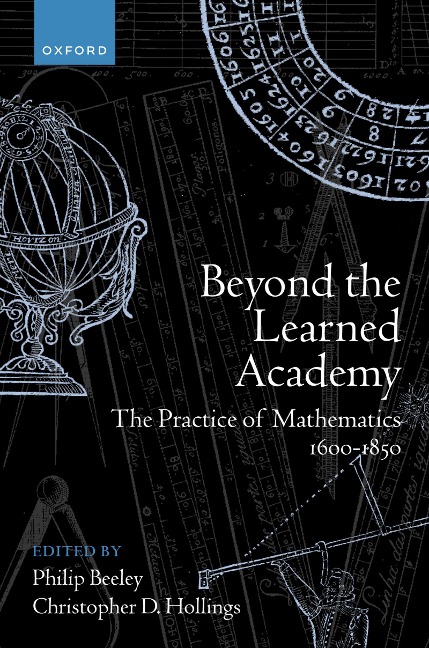
The tremendous growth of the mathematical sciences in the early modern world was reflected contemporaneously in an increasingly sophisticated level of practical mathematics in fields such as merchants' accounts, instrument making, teaching, navigation, and gauging. In many ways, mathematics shaped the knowledge culture of the age, infiltrating workshops, dockyards, and warehouses, before extending through the factories of the Industrial Revolution to the trading companies and banks of the nineteenth century.
While theoretical developments in the history of mathematics have been made the topic of numerous scholarly investigations, in many cases based around the work of key figures such as Descartes, Huygens, Leibniz, or Newton, practical mathematics, especially from the seventeenth century onwards, has been largely neglected.
The present volume, comprising fifteen essays by leading authorities in the history of mathematics, seeks to fill this gap by exemplifying the richness, diversity, and breadth of mathematical practice from the seventeenth century through to the middle of the nineteenth century.
Philip Beeley studied philosophy, mathematics, and history of exact sciences and technology at the University College of North Wales, and at the Technische Universität in Berlin, gaining his PhD in 1993. He held posts at the University of Hamburg and University of Münster before coming to Oxford in 2007. He is the former President of the British Society for the History of Mathematics and is a member of the International Academy of the History of Science.
Christopher Hollings studied mathematics at the University of York, gaining his PhD in 2007. He has held post-doctoral positions in mathematics at the universities of Lisbon and Manchester, before moving to Oxford in 2010 as a researcher in the history of mathematics.
- 1: Philip Beeley and Christopher Hollings: Introduction - Part I - Navigation, Seafaring, Warfare - 2: Jim Bennett: 'Mecanicall Practises Drawne from the Artes Mathematick': the Mathematical Identity of the Elizabethan Navigator John Davis - 3: Margaret E. Schotte: Navigation Exams in the Early Modern Period - 4: Rebekah Higgitt: Mathematical Examiners at Trinity House: Teaching and Examining Mathematics for Navigation in London During the Long Eighteenth Century - 5: João Caramalho Domingues: What Mathematics for Portuguese Military Engineers? From the Class of Fortification to the Military Academy of Lisbon - Part II - Professions, Societies, and Cultures of Mathematics - 6: Sloan Evans Despeaux and Brigitte Stenhouse: Mathematical Men in Humble Life: Philomaths from North-west England as Editors of 'Questions for Answer' Journals - 7: Benjamin Wardhaugh: Collection, Use, Dispersal: The Library of Charles Hutton and the Fate of Georgian Mathematics - 8: Christopher D. Hollings: Mathematics at the Literary and Philosophical Societies - 9: David R. Bellhouse: The Evolution of Actuarial Science to 1848 - Part III - Mathematical Practitioners and their Scientific Milieus - 10: Stefano Gulizia: Assembling the Scribal Self: Gian Vincenzo Pinelli's Circle and Mathematical Practitioners in the Veneto, c. 1580-1606 - 11: Philip Beeley: Mathematical Businesses: Seventeenth-Century Practitioners and their Academic Friends - 12: Thomas Morel: 'All of This Was Born on Paper': The Mathematics of Tunnelling in Eighteenth-Century Metallic Mines - Part IV - The Practice and Teaching of Mathematics - 13: Ivo Schneider: Climbing the Social Ladder: Johannes Faulhaber's Path from Schoolmaster to Fortification Engineer - 14: Albrecht Heeffer: The Difficult Relation of Surveyors with Algebra: The Hundred Mathematical Questions of Cardinael - 15: Boris Jardine: The Life Mathematick: John and Euclid Speidell, and the Centrality of Instruments in Seventeenth-Century Pedagogy - 16: Mark McCartney: James Thomson Senior and Mathematics at the Belfast Academical Institution, 1814-1832
Dieses eBook wird im PDF-Format geliefert und ist mit einem Adobe Kopierschutz (DRM) versehen. Sie können dieses eBook mit allen Geräten lesen, die das PDF-Format und den Adobe Kopierschutz (DRM) unterstützen.
Zum Beispiel mit den folgenden Geräten:
• tolino Reader
Laden Sie das eBook direkt über den Reader-Shop auf dem tolino herunter oder übertragen Sie das eBook auf Ihren tolino mit einer kostenlosen Software wie beispielsweise Adobe Digital Editions.
• Sony Reader & andere eBook Reader
Laden Sie das eBook direkt über den Reader-Shop herunter oder übertragen Sie das eBook mit der kostenlosen Software Sony READER FOR PC/Mac oder Adobe Digital Editions auf ein Standard-Lesegeräte mit epub- und Adobe DRM-Unterstützung.
• Tablets & Smartphones
Möchten Sie dieses eBook auf Ihrem Smartphone oder Tablet lesen, finden Sie hier unsere kostenlose Lese-App für iPhone/iPad und Android Smartphone/Tablets.
• PC & Mac
Lesen Sie das eBook direkt nach dem Herunterladen mit einer kostenlosen Lesesoftware, beispielsweise Adobe Digital Editions, Sony READER FOR PC/Mac oder direkt über Ihre eBook-Bibliothek in Ihrem Konto unter „Meine eBooks“ - „online lesen“.
Schalten Sie das eBook mit Ihrer persönlichen Adobe ID auf bis zu sechs Geräten gleichzeitig frei.
Bitte beachten Sie, dass die Kindle-Geräte das Format nicht unterstützen und dieses eBook somit nicht auf Kindle-Geräten lesbar ist.