Und dann auf "Zum Home-Bildschirm [+]".

Stöbern
genialokal zum Startbildschirm hinzufügen
Installieren Sie die genialokal App auf Ihrem Startbildschirm für einen schnellen Zugriff und eine komfortable Nutzung.
Installieren Sie die genialokal App auf Ihrem Startbildschirm für einen schnellen Zugriff und eine komfortable Nutzung.
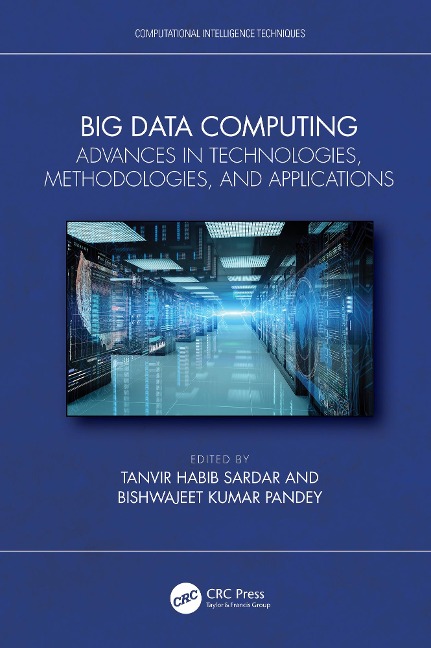
This book primarily aims to provide an in-depth understanding of recent advances in big data computing technologies, methodologies, and applications along with introductory details of big data computing models such as Apache Hadoop, MapReduce, Hive, Pig, Mahout in-memory storage systems, NoSQL databases, and big data streaming services such as Apache Spark, Kafka, and so forth. It also covers developments in big data computing applications such as machine learning, deep learning, graph processing, and many others. Features: - Provides comprehensive analysis of advanced aspects of big data challenges and enabling technologies. - Explains computing models using real-world examples and dataset-based experiments. - Includes case studies, quality diagrams, and demonstrations in each chapter. - Describes modifications and optimization of existing technologies along with the novel big data computing models. - Explores references to machine learning, deep learning, and graph processing. This book is aimed at graduate students and researchers in high-performance computing, data mining, knowledge discovery, and distributed computing.
Tanvir Habib Sardar has 15 years of experience in the IT industry and academia. He is currently working as Assistant Professor, Dept. of CSE, GITAM School of Technology, GITAM University, Bengaluru, India. Dr Sardar obtained his bachelor of technology (BTech) in computer science and engineering from West Bengal University of Technology, Kolkata, India and received his master of technology (MTech) in computer science and engineering from Visvesvaraya Technological University, Karnataka, India. He completed his PhD degree from Visvesvaraya Technological University, Karnataka, India and patented his PhD work in the Indian patent office. His research domain is big data, machine learning, fuzzy logic, and distributed computing using MapReduce. He has published more than 30 research articles and presented at more than eight International conferences. He was the reviewer of many reputed peer-reviewed journals. He has authored two books and edited one. More than six patents have been published by him. Bishwajeet Kumar Pandey is working as a research head of the Department of Computer Science and Engineering, Jain University, Bangalore, India. He received his PhD in CSE from Gran Sasso Science Institute, L'Aquila, Italy under the guidance of Prof Paolo Prinetto, Politecnico Di Torino, Italy. He has worked as a research consultant at Gyancity Research Consultancy and as an associate visiting professor at Eurasian National University Kazakhstan. He has also served as an assistant professor in the Department of Research at Chitkara University and UCSI University Malaysia. He was a junior research fellow (JRF) at South Asian University and a lecturer at Indira Gandhi National Open University. He has completed a master of technology (IIIT Gwalior) in CSE with a specialization in VLSI, a master of Computer Application, R&D Project in CDAC-Noida. He has visited 43 countries to attend 93 conferences across the globe. He has authored and co-authored 160+ papers, available on his Scopus Profile. He has 2,300+ citations and 25+ h index according to his Google Scholar Profile. He has experience in teaching ethical hacking, application and web security, cloud migration, incident handling and response, information security, AI and ML, computer network, digital logic, logic synthesis, and system verilog. His areas of research interest are green computing, high-performance computing, cyber-physical systems, machine learning, and cybersecurity. He is on the board of director of many start-ups of his students e.g., Gyancity Research Consultancy Pvt Ltd.
1. IOT Next Gen and the World of Big Data Computing 2. Large-Scale Data Processing in Cloud Computing Environment: Hadoop-MapReduce 3. Education Enhanced by Big Data as a Technology of the Fourth Industrial Revolution (IR 4.0) 4. Big Data Pre-processing for Machine Parameter Optimization 5. From Data to Insights: A Review of Cloud-Based Big Data Tools and Technologies 6. The Intersection of Machine Learning, Artificial Intelligence, and Big Data 7. Deep Learning in Big Data: Challenges and Perspectives 8. Recent Research Techniques in Processing, Security, and Storage of Real-World Applications of Big Computing 9. Leveraging Big Data Analytics and Conversational AI for Agriculture 10. Artificial Intelligence and Deep Learning Applications on Big Data Computing Frameworks 11. Big Data in Education 12. The Future of Big Data in Customer Experience and Inventory Management 13. Mapping of Nearest Neighbor-Based Quantum Circuits into 2D 14. Credit Card Fraud Detection Using Big Data Analytics and Machine Learning 15. A Review on Machine Learning Approaches in Diagnosis of ADHD Based on Big Data 16. Research on Various Plastic Arts in Interior Decoration Design Based on Big Data under the Environment of Sustainable Development 17. Machine Learning Algorithms in the Handling of Ultrasonography Big Data for Disease Diagnosis and Prediction 18. Machine Learning in Healthcare Sector and the Biomedical Big Data: Techniques, Applications and Challenges
Dieses eBook wird im PDF-Format geliefert und ist mit einem Adobe Kopierschutz (DRM) versehen. Sie können dieses eBook mit allen Geräten lesen, die das PDF-Format und den Adobe Kopierschutz (DRM) unterstützen.
Zum Beispiel mit den folgenden Geräten:
• tolino Reader
Laden Sie das eBook direkt über den Reader-Shop auf dem tolino herunter oder übertragen Sie das eBook auf Ihren tolino mit einer kostenlosen Software wie beispielsweise Adobe Digital Editions.
• Sony Reader & andere eBook Reader
Laden Sie das eBook direkt über den Reader-Shop herunter oder übertragen Sie das eBook mit der kostenlosen Software Sony READER FOR PC/Mac oder Adobe Digital Editions auf ein Standard-Lesegeräte mit epub- und Adobe DRM-Unterstützung.
• Tablets & Smartphones
Möchten Sie dieses eBook auf Ihrem Smartphone oder Tablet lesen, finden Sie hier unsere kostenlose Lese-App für iPhone/iPad und Android Smartphone/Tablets.
• PC & Mac
Lesen Sie das eBook direkt nach dem Herunterladen mit einer kostenlosen Lesesoftware, beispielsweise Adobe Digital Editions, Sony READER FOR PC/Mac oder direkt über Ihre eBook-Bibliothek in Ihrem Konto unter „Meine eBooks“ - „online lesen“.
Schalten Sie das eBook mit Ihrer persönlichen Adobe ID auf bis zu sechs Geräten gleichzeitig frei.
Bitte beachten Sie, dass die Kindle-Geräte das Format nicht unterstützen und dieses eBook somit nicht auf Kindle-Geräten lesbar ist.