Und dann auf "Zum Home-Bildschirm [+]".

Stöbern
genialokal zum Startbildschirm hinzufügen
Installieren Sie die genialokal App auf Ihrem Startbildschirm für einen schnellen Zugriff und eine komfortable Nutzung.
Installieren Sie die genialokal App auf Ihrem Startbildschirm für einen schnellen Zugriff und eine komfortable Nutzung.
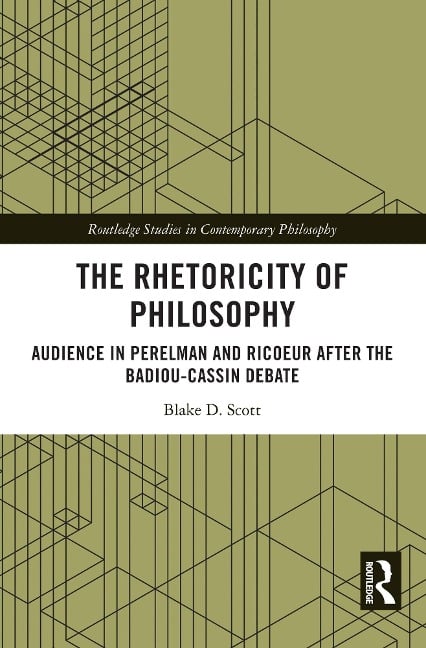
This book aims to recast the way that philosophers understand rhetoric. Rather than follow most philosophers in conceiving rhetoric as a specific way of speaking or writing, it shows that rhetoric is better understood as a dimension of all human discourse and action-what the author calls "rhetoricity". This book provides the first philosophical treatment of rhetoricity. It is motivated by two ongoing developments. The first is the debate between Alain Badiou and Barbara Cassin about philosophy's relation to rhetoric. Both Badiou and Cassin are critical of rhetoric, albeit for different reasons. Second, there has been a growing resurgence of interest in rhetoric considering the recent rise in authoritarian politics as well as new forms of propaganda driven by "persuasive technologies". This book identifies the common target of Badiou's and Cassin's otherwise incompatible critiques: rhetoric's conception of audience. It offers a fresh take on the "new rhetoric" project of Chaïm Perelman and Lucie Olbrechts-Tyteca, putting their work into conversation with the Badiou-Cassin debate. The book then turns to the hermeneutic philosophy of Paul Ricoeur in search of an expanded conception of audience. It shows that Ricoeur's hermeneutic philosophy allows us to extend Perelman and Olbrechts-Tyteca's psychological notion of audience to texts themselves and to argue that human beings have a rhetorical capacity to reflect on audiences in search of what is potentially persuasive. The Rhetoricity of Philosophy will be of interest to scholars and advanced students working in contemporary European philosophy, rhetoric, argumentation studies, and social theory.
Blake D. Scott is Postdoctoral Research Associate at KU Leuven's Institute of Philosophy. His articles have appeared in journals including Philosophy & Rhetoric, Informal Logic, Argumentation, Études Ricoeuriennes/ Ricoeur Studies, Analecta Hermeneutica, and Sartre Studies International.
Introduction 1. The Enemy of My Enemy: Philosophy, Sophistics, and Rhetoric in the Badiou-Cassin Debate 2. The Audience in Perelman and Olbrechts-Tyteca's New Rhetoric 3. Rhetoric on Trial (I): Badiou v. Perelman 4. Rhetoric on Trial (II): Cassin v. Perelman 5. Extending the Audience: Ricoeur's Missed Encounter with Perelman 6. Ricoeur and the Rhetoricity of Philosophy Conclusion: Is Rhetoric a Dead End for Philosophy?
Dieses eBook wird im PDF-Format geliefert und ist mit einem Adobe Kopierschutz (DRM) versehen. Sie können dieses eBook mit allen Geräten lesen, die das PDF-Format und den Adobe Kopierschutz (DRM) unterstützen.
Zum Beispiel mit den folgenden Geräten:
• tolino Reader
Laden Sie das eBook direkt über den Reader-Shop auf dem tolino herunter oder übertragen Sie das eBook auf Ihren tolino mit einer kostenlosen Software wie beispielsweise Adobe Digital Editions.
• Sony Reader & andere eBook Reader
Laden Sie das eBook direkt über den Reader-Shop herunter oder übertragen Sie das eBook mit der kostenlosen Software Sony READER FOR PC/Mac oder Adobe Digital Editions auf ein Standard-Lesegeräte mit epub- und Adobe DRM-Unterstützung.
• Tablets & Smartphones
Möchten Sie dieses eBook auf Ihrem Smartphone oder Tablet lesen, finden Sie hier unsere kostenlose Lese-App für iPhone/iPad und Android Smartphone/Tablets.
• PC & Mac
Lesen Sie das eBook direkt nach dem Herunterladen mit einer kostenlosen Lesesoftware, beispielsweise Adobe Digital Editions, Sony READER FOR PC/Mac oder direkt über Ihre eBook-Bibliothek in Ihrem Konto unter „Meine eBooks“ - „online lesen“.
Schalten Sie das eBook mit Ihrer persönlichen Adobe ID auf bis zu sechs Geräten gleichzeitig frei.
Bitte beachten Sie, dass die Kindle-Geräte das Format nicht unterstützen und dieses eBook somit nicht auf Kindle-Geräten lesbar ist.