Und dann auf "Zum Home-Bildschirm [+]".

Stöbern
genialokal zum Startbildschirm hinzufügen
Installieren Sie die genialokal App auf Ihrem Startbildschirm für einen schnellen Zugriff und eine komfortable Nutzung.
Installieren Sie die genialokal App auf Ihrem Startbildschirm für einen schnellen Zugriff und eine komfortable Nutzung.
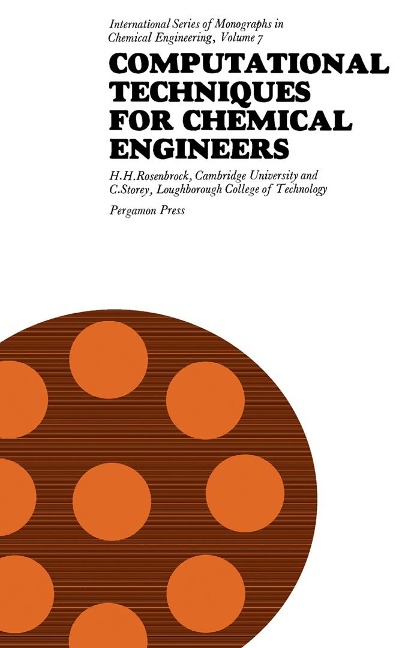
Computational Techniques for Chemical Engineers offers a practical guide to the chemical engineer faced with a problem of computing. The computer is a servant not a master, its value depends on the instructions it is given. This book aims to help the chemical engineer in the right choice of these instructions. The text begins by outlining the principles of operation of digital and analogue computers and then discussing the difficulties which arise in formulating a problem for solution on such a machine. This is followed by separate chapters on digital computers and their programming; the use of digital computers in chemical engineering design work; optimization techniques and their application in the selection of optimum designs; the solution of sets of non-linear algebraic equations via hill-climbing; and determination of equilibrium compositions by minimization of Gibbs free energy. Subsequent chapters discuss the solution of partial or simultaneous differential equations; parameter estimation in differential equations; continuous systems; and analogue computers.
ForewordPrefaceChapter 1. The Use of Analogue and Digital Computers 1. Pilot Plants, Analogues, and Digital Computers 2. The Analogue Computer 3. The Digital Computer 4. Hybrid Machines 5. Large Digital Machines 6. Setting up a Problem 6.1 An Example 7. Mathematics and Engineering 8. Further Reading 9. ReferencesChapter 2. Digital Computers 1. Introduction 2. Technical Details 2.1 Input 2.2 Store or Memory 2.3 Arithmetic Unit 2.4 Control Unit 2.5 Output 3. Programming 3.1 Machine Programming 3.2 Flow Diagrams 3.3 Automatic Programming 4. Recent Developments 5. Further Reading 6. ReferencesChapter 3. Design Problems 1. Introduction 2. Simple Routine Design Calculations 2.1 Flange Design 2.2 Orifice Plate Design 2.3 Tube Sheet Thickness 3. Design Calculations of Intermediate Complexity 3.1 Heat Exchanger Design 3.2 Plate-by-Plate Distillation Calculations 3.3 Piping Flexibility Calculations 4. Flowsheet Calculations by Computer 5. Further Reading 6. ReferencesChapter 4. Optimizing I - Hill-Climbing Methods 1. Scope of the Optimizing Problem 2. Hill-Climbing 2.1 Successive Variation of Parameters 2.2 Ways of Regarding the Hill-Climbing Problem 2.3 Steepest Ascent 2.4 Modified Steepest Ascent 2.5 The Gradient Method 2.6 Generalized Newton-Raphson 2.7 Modified Newton-Raphson 2.8 Methods of Comparison 2.9 A General-Purpose Optimizing Program 3. Some Comparisons of Different Methods 3.1 Discussion of the Results 4. Boundaries 4.1 Modification of F 5. A General-Purpose Optimizing Program with Constraints 6. Status of Hill-Climbing Methods 7. Linear Programming 8. Non-Linear Programming 9. Further Reading 10. ReferencesChapter 5. Optimization in Design 1. Introduction 2. Tonnage Oxygen Plant 3. Heavy Water Plant 4. Kinetic Problem 5. Further Reading 6. ReferencesChapter 6. Solution of Algebraic Equations Using Hill-Climbing 1. Introduction 2. Solution of Sets of Non-Linear Algebraic Equations 2.1 Simple Example 2.2 More Realistic Example 3. High Temperature Equilibrium 4. Other Variational Problems 4.1 Example 1. Torsion in a Bar 4.2 Example 2. Velocity Profiles 5. Further Reading 6. ReferencesChapter 7. Solution of Partial or Simultaneous Differential Equations 1. Relation between Simultaneous and Partial Differential Equations 2. Classification of Partial Differential Equations 2.1 Physical Consideration of Hyperbolic Equations 3. Reduction of Hyperbolic to Parabolic Equations 3.1 Example: Heat Exchanger 3.2 Example: Distillation 3.3 Scope of the above Method 4. Representation of Diffusion 4.1 Example: Regenerator 5. Boundary Conditions 6. Numerical Methods for Parabolic Equations 6.1 Stability: General Considerations 6.2 Stability: an Example 6.3 Stability and Parabolic Equations 6.4 Implicit Processes: Crank and Nicolson's Process 6.5 Computation of the Steady State 6.6 Numerical Precautions 6.7 Application: Distillation 7. Alternative Methods for Solving Parabolic Equations 7.1 Runge-Kutta Processes 7.2 Predictor-Corrector Methods 7.3 Implicit Methods of Successive Substitution 7.4 Methods Which Avoid Difference Equations 8. Status of Numerical Methods 9. Further Reading 10. ReferencesChapter 8. Estimation of Parameters in Differential Equations 1. Statement of the Problem 1.1 Inherent Difficulties 2. Confidence Intervals for Parameters 2.1 Analytical Development 2.