Und dann auf "Zum Home-Bildschirm [+]".

Stöbern
genialokal zum Startbildschirm hinzufügen
Installieren Sie die genialokal App auf Ihrem Startbildschirm für einen schnellen Zugriff und eine komfortable Nutzung.
Installieren Sie die genialokal App auf Ihrem Startbildschirm für einen schnellen Zugriff und eine komfortable Nutzung.
Ihr gewünschter Artikel ist in 0 Buchhandlungen vorrätig - wählen Sie hier eine Buchhandlung in Ihrer Nähe aus:

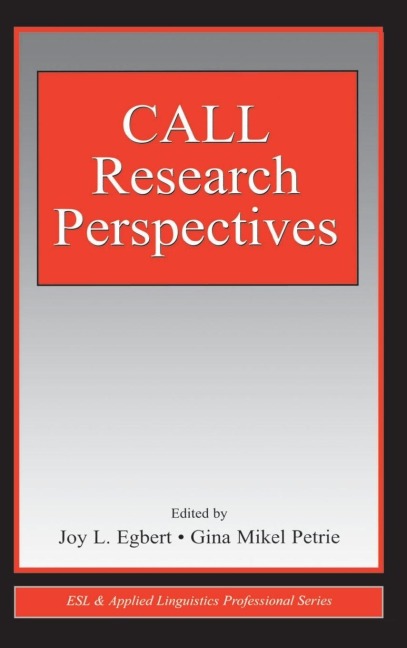
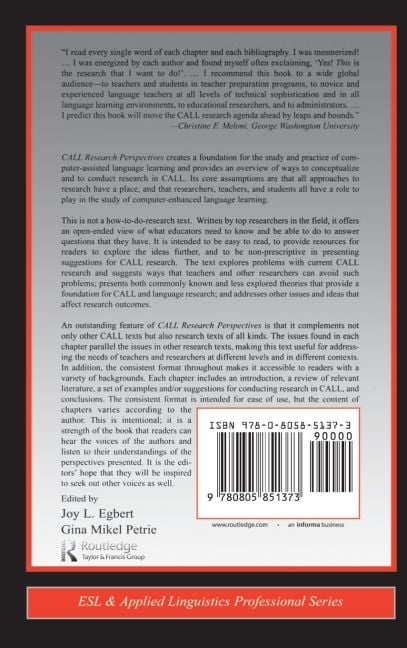
This title creates a foundation for the study and practice of computer-assisted language learning and provides an overview of ways to conceptualize and to conduct research in CALL. Its core assumptions are that all approaches to research have a place, and that researchers, teachers, and students all have a role to play in the study of computer-enhanced language learning.
Joy L. Egbert, Gina Mikel Petrie
Contents: Preface. Part I: Introduction to CALL Research.J.L. Egbert, Conducting Research on CALL. K. Huh, W-c. Hu, Criteria for Effective CALL Research. Part II: Research Perspectives.C. Meskill, Metaphors That Shape and Guide CALL Research. M. Warschauer, Sociocultural Perspectives on CALL. C.A. Chapelle, Interactionist SLA Theory in CALL Research. M. Hauck, Metacognitive Knowledge, Metacognitive Strategies, and CALL. B. Mohan, L. Luo, A Systemic Functional Linguistics Perspective on CALL. G.M. Petrie, Visuality and CALL Research. H. Lotherington, Authentic Language in Digitial Environments. J.L. Egbert, Flow as a Model for CALL Research. B.G. Brander, Considering Culture in CALL Research. Y-F. Yang, Situated Learning as a Framework for CALL Research. S. Yutdhana, Design-Based Research in CALL. F. Raby, A User-Centered Ergonomic Approach to CALL Research. Part III: Conclusion.G.M. Petrie, Towards a Cartography of CALL.