Und dann auf "Zum Home-Bildschirm [+]".

Stöbern
genialokal zum Startbildschirm hinzufügen
Installieren Sie die genialokal App auf Ihrem Startbildschirm für einen schnellen Zugriff und eine komfortable Nutzung.
Installieren Sie die genialokal App auf Ihrem Startbildschirm für einen schnellen Zugriff und eine komfortable Nutzung.

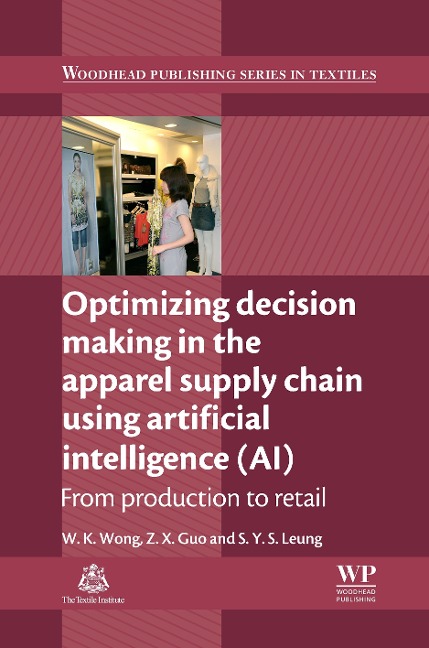
Practitioners in apparel manufacturing and retailing enterprises in the fashion industry, ranging from senior to front line management, constantly face complex and critical decisions. There has been growing interest in the use of artificial intelligence (AI) techniques to enhance this process, and a number of AI techniques have already been successfully applied to apparel production and retailing. Optimizing decision making in the apparel supply chain using artificial intelligence (AI): From production to retail provides detailed coverage of these techniques, outlining how they are used to assist decision makers in tackling key supply chain problems. Key decision points in the apparel supply chain and the fundamentals of artificial intelligence techniques are the focus of the opening chapters, before the book proceeds to discuss the use of neural networks, genetic algorithms, fuzzy set theory and extreme learning machines for intelligent sales forecasting and intelligent product cross-selling systems. - Helps the reader gain an understanding of the key decision points in the apparel supply chain - Discusses the fundamentals of artificial intelligence techniques for apparel management techniques - Considers the use of neural networks in selecting the location of apparel manufacturing plants
W. K. Wong is full professor at The Hong Kong Polytechnic University, Hong Kong and is currently with the endowed professorship title as Cheng Yik Hung Professor in Fashion. His areas of research range from computer vision to artificial intelligence with applications in the textile and fashion industries. He has published over hundred research articles in high-impact artificial intelligence related journals and serves as editorial board member of several journals. He also provides consultancy services to fashion and textile companies in the industry.S. Y. S. Leung is based at the Institute of Textiles and Clothing, The Hong Kong Polytechnic University, China.
Woodhead Publishing Series in Textiles Preface Acknowledgements Chapter 1: Understanding key decision points in the apparel supply chain Abstract: 1.1 Introduction 1.2 Selection of plant locations 1.3 Production scheduling and assembly line balancing control 1.4 Cutting room 1.5 Retailing Chapter 2: Fundamentals of artificial intelligence techniques for apparel management applications Abstract: 2.1 Artificial intelligence (AI) techniques: a brief overview 2.2 Rule-based expert systems 2.3 Evolutionary optimization techniques 2.4 Feedforward neural networks (FNNs) 2.5 Fuzzy logic 2.6 Conclusions Chapter 3: Selecting the location of apparel manufacturing plants using neural networks Abstract: 3.1 Introduction 3.2 Classification methods using artificial neural networks 3.3 Classifying decision models for the location of clothing plants 3.4 Classification using unsupervised artificial neural networks (ANN) 3.5 Classification using supervised ANN 3.6 Conclusion 3.7 Acknowledgements 3.9 Appendix: performance of back propagation (BP) and learning vector quantization (LVQ) with a different number of hidden neurons Chapter 4: Optimizing apparel production order planning scheduling using genetic algorithms Abstract: 4.1 Introduction 4.2 Problem formulation 4.3 Dealing with uncertain completion and start times 4.4 Genetic algorithms for order scheduling 4.5 Experimental results and discussion 4.6 Conclusions 4.7 Acknowledgement Chapter 5: Optimizing cut order planning in apparel production using evolutionary strategies Abstract: 5.1 Introduction 5.2 Formulation of the cut order planning (COP) decision-making model 5.3 Genetic COP optimization 5.4 An example of a genetic optimization model for COP 5.5 Conclusions 5.6 Acknowledgement 5.8 Appendix: comparison between industrial practice and proposed COP decision-making model Chapter 6: Optimizing marker planning in apparel production using evolutionary strategies and neural networks Abstract: 6.1 Introduction 6.2 Packing method for optimized marker packing 6.3 Evolutionary strategy (ES) for optimizing marker planning 6.4 Experiments to evaluate performance 6.5 Conclusion Chapter 7: Optimizing fabric spreading and cutting schedules in apparel production using genetic algorithms and fuzzy set theory Abstract: 7.1 Introduction 7.2 Problem formulation in fabric-cutting operations 7.3 Genetic optimization of fabric scheduling 7.4 Case studies using real production data 7.5 Conclusions 7.6 Acknowledgement 7.8 Appendix: nomenclature Chapter 8: Optimizing apparel production systems using genetic algorithms Abstract: 8.1 Introduction 8.2 Problem formulation in sewing operations 8.3 Genetic optimization of production line balancing 8.4 Experimental results 8.5 Conclusions 8.6 Acknowledgement 8.8 Appendix: nomenclature Chapter 9: Intelligent sales forecasting for fashion retailing using harmony search algorithms and extreme learning machines Abstract: 9.1 Introduction 9.2 Hybrid intelligent model for medium-term fashion sales forecasting 9.3 Evaluating model performance with real sales data 9.4 Experimental results and analysis 9.5 Assessing forecasting performance 9.6 Conclusions 6.7 Acknowledgement Chapter 10: Intelligent product cross-selling system in fashion retailing using radio frequency identification (RFID) technology, fuzzy logic and rule-based expert system Abstract: 10.1 Introduction 10.2 Radio frequency identification (RFID)-enabled smart dressing system (SDS) 10.3 Intelligent product cross-selling system (IPCS) 10.4 Implementation of the RFID-enabled SDS and IPCS 10.5 Evaluation of the RFID-enabled SDS 10.6 Assessing the use of RFID technology in fashion retailing 10.7 Conclusions 10.8 Acknowledgement Index