Und dann auf "Zum Home-Bildschirm [+]".

Stöbern
genialokal zum Startbildschirm hinzufügen
Installieren Sie die genialokal App auf Ihrem Startbildschirm für einen schnellen Zugriff und eine komfortable Nutzung.
Installieren Sie die genialokal App auf Ihrem Startbildschirm für einen schnellen Zugriff und eine komfortable Nutzung.
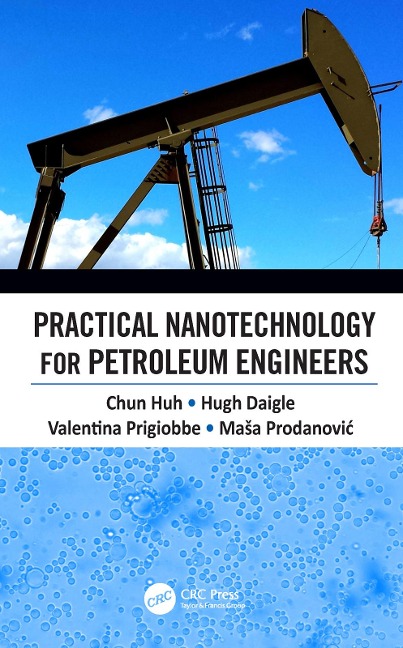
This book is a concise but well-organized introduction to nanotechnology (NT) which the upstream oil industry is now vigorously adapting to develop its own unique applications for improved oilfield operations and, oil and gas production. Its reader will learn nanotechnology fundamentals, be introduced to important NT products and applications from other industries and learn about the current state of development of various NT applications in the upstream oil industry, which include innovative use of nanoparticles for enhanced oil recovery; drilling and completions; reservoir sensing; and production operations and flow assurance. Key Features - Exclusive title on potential of nanoparticle-based agents and interventions for improving myriad of oilfield operations - Unique guide for nanotechnology applications developers and users for oil and gas production - Introduces nanotechnology for oil and gas managers and engineers - Includes research data discussions relevant to field - Offers a practical applications-oriented approach
Prof. Chun Huh is one of the world's leading experts on surfactant- and polymer-based enhanced oil recovery (EOR) methods. "Chun Huh equation," which predicts ultralow interfacial tension from microemulsion solubilization, is widely used for the design of surfactant-based EOR processes. He is also the formulator of "Huh-Scriven paradox," whose resolution is still being proposed by fluid mechanics researchers working on dynamics of wetting. Since joining UT Austin in 2004, Dr. Huh has started research on use of nanoparticles for a variety of upstream oil industry applications. Some of the applications being developed are: use of superparamagnetic nanoparticles (i) for efficient removal of "contaminants" from oilfield produced water, (ii) for improved oil and gas production flow assurance, and (iii) for precision conformance control; and use of silica nanoparticles for EOR mobility control. Prof. Masa Prodanovic, Dept. of Petroleum & Geosystems Engineering, University of Texas at Austin. Prof. Hugh Daigle, Dept. of Petroleum & Geosystems Engineering, University of Texas at Austin. Prof. Valentina Prigiobbe, Dept. of Civil, Environmental & Ocean Engineering, Stevens Inst. of Technology.
1. Introduction. 2. Nanoparticle Synthesis and Surface Coating. 3. Nanoparticles in Fluids. 4. Nanoparticles at Fluid Interfaces. 5. Nanomagnetism. 6. Nanotechnology and the environment. 7. Drilling and Completions. 8. Production Operations and Flow Assurance. 9. Reservoir Sensing. 10. Enhanced Oil Recovery: Foams And Emulsions. 11. Enhanced Oil Recovery: Wettability Alteration And Other Topics. 12. Heavy Oil Recovery. 13. Conclusions and Future Directions.
Dieses eBook wird im PDF-Format geliefert und ist mit einem Adobe Kopierschutz (DRM) versehen. Sie können dieses eBook mit allen Geräten lesen, die das PDF-Format und den Adobe Kopierschutz (DRM) unterstützen.
Zum Beispiel mit den folgenden Geräten:
• tolino Reader
Laden Sie das eBook direkt über den Reader-Shop auf dem tolino herunter oder übertragen Sie das eBook auf Ihren tolino mit einer kostenlosen Software wie beispielsweise Adobe Digital Editions.
• Sony Reader & andere eBook Reader
Laden Sie das eBook direkt über den Reader-Shop herunter oder übertragen Sie das eBook mit der kostenlosen Software Sony READER FOR PC/Mac oder Adobe Digital Editions auf ein Standard-Lesegeräte mit epub- und Adobe DRM-Unterstützung.
• Tablets & Smartphones
Möchten Sie dieses eBook auf Ihrem Smartphone oder Tablet lesen, finden Sie hier unsere kostenlose Lese-App für iPhone/iPad und Android Smartphone/Tablets.
• PC & Mac
Lesen Sie das eBook direkt nach dem Herunterladen mit einer kostenlosen Lesesoftware, beispielsweise Adobe Digital Editions, Sony READER FOR PC/Mac oder direkt über Ihre eBook-Bibliothek in Ihrem Konto unter „Meine eBooks“ - „online lesen“.
Schalten Sie das eBook mit Ihrer persönlichen Adobe ID auf bis zu sechs Geräten gleichzeitig frei.
Bitte beachten Sie, dass die Kindle-Geräte das Format nicht unterstützen und dieses eBook somit nicht auf Kindle-Geräten lesbar ist.