Und dann auf "Zum Home-Bildschirm [+]".

Stöbern
genialokal zum Startbildschirm hinzufügen
Installieren Sie die genialokal App auf Ihrem Startbildschirm für einen schnellen Zugriff und eine komfortable Nutzung.
Installieren Sie die genialokal App auf Ihrem Startbildschirm für einen schnellen Zugriff und eine komfortable Nutzung.
Ihr gewünschter Artikel ist in 0 Buchhandlungen vorrätig - wählen Sie hier eine Buchhandlung in Ihrer Nähe aus:

0
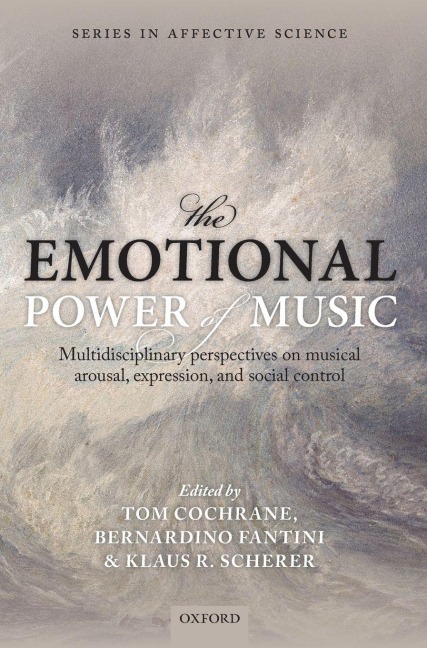
Tom Cochrane is a lecturer in philosophy at the University of Sheffield, where he teaches aesthetics, ethics and the philosophy of mind. He received his PhD from the University of Nottingham in 2007. From 2007 to 2010 he was a postdoctoral researcher at the Swiss Center for Affective Sciences, researching emotions and the arts. He then spent two years at the Sonic Arts Research Centre, Queen's University Belfast, working on an individual research project called 'The Mood Organ: Putting theories of musical expression into practice'. His main areas of interest are music, emotion, extended and collective cognition and complexity.
Bernardino Fantini is a full professor of History of Medicine, director of the Institute of the History of Medicine and Health, Faculty of Medicine, University of Geneva, and director of the WHO Collaborating Centre for the Historical Research on Public Health. Since 2009 he has been active in the Music and Emotion focus at the Swiss Center for Affective Sciences, Geneva. After a PhD in biochemistry in Rome, he also got a PhD in History and Philosophy of Life Sciences at the EPHE-Sorbonne, Paris, in 1992. His main research interests are the history of infectious disease and international health, the epistemology of biology and medicine, and the history of relationships between medicine, science and music.
Klaus Scherer, born in 1943, studied economics and social sciences at the University of Cologne and the London School of Economics. Following postgraduate studies in psychology, he obtained a Ph.D. from Harvard University in 1970. After teaching at the University of Pennsylvania, Philadelphia, and the University of Kiel, Germany, he was appointed, in 1973, full professor of social psychology at the University of Giessen, Germany. From 1985 to 2008, Klaus Scherer was a full professor of psychology at the University of Geneva, Switzerland, and director of the Human Assessment Centre (Laboratoire d'Evaluation Psychologique). Since 2004 he has been the Director of the Swiss Center for Affective Sciences at the University of Geneva. Scherer's research activities focus on different aspects of emotion and other affective states (guided by his Component Process Model of emotion), in particular emotional expression and induction of emotion by music.
- List of Contributors
- Introduction to the volume
- Section I: Musical Expressiveness
- 1: Tom Cochrane: Section Introduction
- 2: Michael Spitzer: Sad Flowers: Analysing affective trajectory in Schubert's Trockne Blumen
- 3: Tom Cochrane: Composing the expressive qualities of music: Interviews with Jean-Claude Risset, Carter Burwell and Brian Ferneyhough
- 4: Daniel Leech-Wilkinson: The emotional power of musical performance
- 5: Klaus R. Scherer: The singer's paradox: On authenticity in emotional expression on the opera stage Interviews with Thomas Moser, Lucy Schaufer, Gillian Keith, Bruno Taddia and Christoph Prégardien
- 6: Tom Cochrane: On the resistance of the instrument
- 7: Christine Jeanneret: Gender Ambivalence and the Expression of Passions in the Performances of Early Roman Cantatas by Castrati and Female Singers
- 8: Claude Palisca (translated by Kirsten Jafflin): The ethos of modes during the Renaissance
- Section II: Emotion Elicitation
- 9: Klaus R. Scherer: Section Introduction
- 10: Klaus R. Scherer and Eduardo Coutinho: How music creates emotion: A multifactorial process approach
- 11: Luca Zoppelli: Mors stupebit: multiple levels of fear-arousing mechanisms in Verdi's Messa da Requiem
- 12: Jenefer Robinson: Three theories of emotion - three routes for musical arousal
- 13: Stephen Davies: Music-to-listener emotional contagion
- 14: Joel Krueger: Empathy, enaction and shared musical experience: Evidence from infant cognition
- 15: Lincoln John Colling and William Forde Thompson: Music, action, and affect
- 16: Wiebke Trost and Patrik Vuilleumier: Rhythmic entertainment as a mechanism for emotion induction and contagion by music: A neurophysiological perspective
- 17: Stefan Koelsch: Striking a chord in the brain: Neurophysiological correlates of music-evoked positive emotions
- Section III: The Powers of Music
- 18: Bernardino Fantini: Section Introduction
- 19: Bernardino Fantini (translated by Kirsten Jafflin): Forms of thought between music and science
- 20: Laurence Wuidar (translated by Kirsten Jafflin): Control and the science of affect: Music and power in the Medieval and Rennaisance periods
- 21: Brenno Boccadoro (translated by Kirsten Jafflin): The psychotropic power of music during the Renaissance
- 22: Penelope Gouk: Music as a means of social control: some examples of practice and theory in early modern Europe
- 23: Jackie Pigeaud (translated by Kirsten Jafflin): The tradition of ancient music therapy in the 18th century
- 24: Jean Starobinski (translated by Kirsten Jafflin): On nostalgia
- 25: Ulrik Volgsten: Emotions, identity and copyright control: The constitutive role of affect attunement and its implications for the ontology of music
- Coda