Und dann auf "Zum Home-Bildschirm [+]".

Stöbern
genialokal zum Startbildschirm hinzufügen
Installieren Sie die genialokal App auf Ihrem Startbildschirm für einen schnellen Zugriff und eine komfortable Nutzung.
Installieren Sie die genialokal App auf Ihrem Startbildschirm für einen schnellen Zugriff und eine komfortable Nutzung.
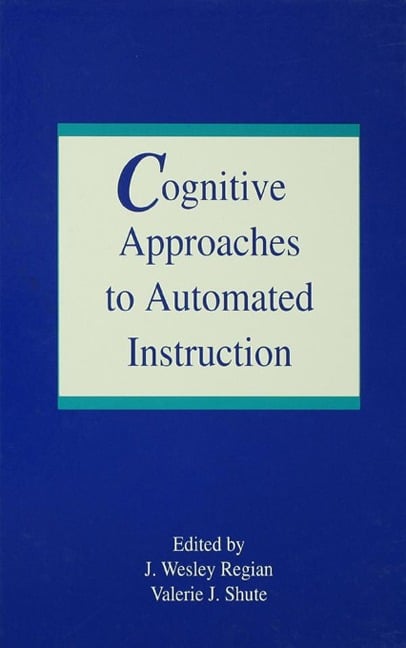
Useful to researchers as well as practitioners looking for guidance on designing automated instruction systems, this book provides a snapshot of the state-of-the-art in this research area. In so doing, it focuses on the two critical problems: first, diagnosis of the student's current level of understanding or performance; and second, selection of the appropriate intervention that will transition the student toward expert performance. Containing a comprehensive set of principled approaches to automated instruction, diagnosis, and remediation, it is the first volume on the topic to provide specific, detailed guidance on how to develop these systems. Leading researchers and practitioners represented in this book address the following questions in each chapter: * What is your approach to cognitive diagnosis for automated instruction? * What is the theoretical basis of your approach? * What data support the utility of the approach? * What is the range of applicability of your approach? * What knowledge engineering or task analysis methods are required to support your approach? Referring to automated instruction as instruction that is delivered on any microprocessor-based system, the contributors to -- and editors of -- this book believe that is it possible for automated instructional systems to be more effective than they currently are. Specifically, they argue that by using artificial intelligence programming techniques, it is possible for automated instructional systems to emulate the desirable properties of human tutors in one-on-one instruction.
Regian, J. Wesley; Shute, Valerie J.; Shute, Valerie
Contents: J.W. Regian, V.J. Shute, Automated Instruction as an Approach to Individualization. V.J. Shute, Aptitude-Treatment Interactions and Cognitive Skill Diagnosis. A. Lesgold, G. Eggan, S. Katz, G. Rao, Possibilities for Assessment Using Computer-Based Apprenticeship Environments. J.R. Anderson, A.T. Corbett, J.M. Fincham, D. Hoffman, R. Pelletier, General Principles for an Intelligent Tutoring Architecture. D.M. Towne, A. Munro, Supporting Diverse Instructional Strategies in a Simulation-Oriented Training Environment. Cognition and Technology Group, Vanderbilt University, An Anchored Instruction Approach to Cognitive Skills Acquisition and Intelligent Tutoring. A.D. Fisk, W.A. Rogers, The Application of Consistency Principles for the Assessment of Skill Development. W.B. Johnson, J.E. Norton, Modeling Student Performance in Diagnostic Tasks: A Decade of Evolution. K. Bennett, The Use of On-Line Guidance, Representation Aiding, and Discovery Learning to Improve the Effectiveness of Simulation Training.
Dieses eBook wird im PDF-Format geliefert und ist mit einem Adobe Kopierschutz (DRM) versehen. Sie können dieses eBook mit allen Geräten lesen, die das PDF-Format und den Adobe Kopierschutz (DRM) unterstützen.
Zum Beispiel mit den folgenden Geräten:
• tolino Reader
Laden Sie das eBook direkt über den Reader-Shop auf dem tolino herunter oder übertragen Sie das eBook auf Ihren tolino mit einer kostenlosen Software wie beispielsweise Adobe Digital Editions.
• Sony Reader & andere eBook Reader
Laden Sie das eBook direkt über den Reader-Shop herunter oder übertragen Sie das eBook mit der kostenlosen Software Sony READER FOR PC/Mac oder Adobe Digital Editions auf ein Standard-Lesegeräte mit epub- und Adobe DRM-Unterstützung.
• Tablets & Smartphones
Möchten Sie dieses eBook auf Ihrem Smartphone oder Tablet lesen, finden Sie hier unsere kostenlose Lese-App für iPhone/iPad und Android Smartphone/Tablets.
• PC & Mac
Lesen Sie das eBook direkt nach dem Herunterladen mit einer kostenlosen Lesesoftware, beispielsweise Adobe Digital Editions, Sony READER FOR PC/Mac oder direkt über Ihre eBook-Bibliothek in Ihrem Konto unter „Meine eBooks“ - „online lesen“.
Schalten Sie das eBook mit Ihrer persönlichen Adobe ID auf bis zu sechs Geräten gleichzeitig frei.
Bitte beachten Sie, dass die Kindle-Geräte das Format nicht unterstützen und dieses eBook somit nicht auf Kindle-Geräten lesbar ist.