Und dann auf "Zum Home-Bildschirm [+]".

Stöbern
genialokal zum Startbildschirm hinzufügen
Installieren Sie die genialokal App auf Ihrem Startbildschirm für einen schnellen Zugriff und eine komfortable Nutzung.
Installieren Sie die genialokal App auf Ihrem Startbildschirm für einen schnellen Zugriff und eine komfortable Nutzung.
Ihr gewünschter Artikel ist in 0 Buchhandlungen vorrätig - wählen Sie hier eine Buchhandlung in Ihrer Nähe aus:

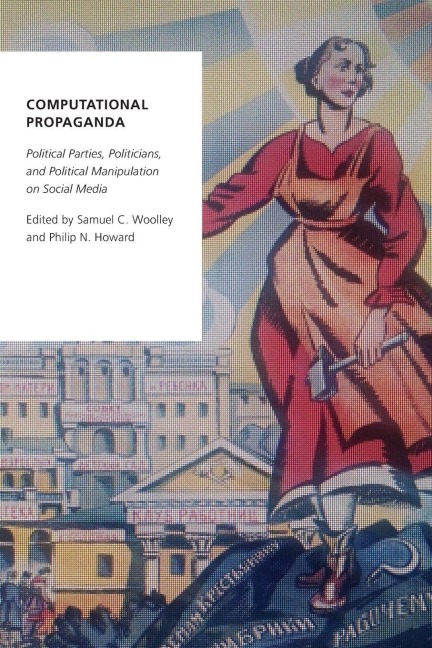
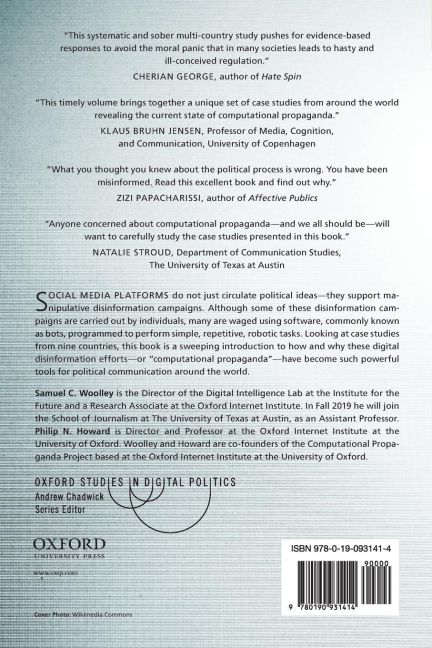
Social media platforms do not just circulate political ideas, but support computational propaganda and manipulative disinformation campaigns. Although some of these disinformation campaigns are carried out directly by individuals, most are waged by software, commonly known as bots, programmed to perform simple, repetitive, robotic tasks. Including case studies from nine countries and covering propaganda efforts over a wide array of social media platforms, this book argues that bots, fake accounts, and social media algorithms amount to a new political communications mechanism that it terms "computational propaganda."
Samuel C. Woolley is Assistant Professor in the School of Journalism at the University of Texas, Austin. Philip N. Howard is Director and Professor at the Oxford Internet Institute at University of Oxford. They are the co-founders of the Computational Propaganda Project. This research endeavour is focused on the study of the manipulation of public opinion via online spaces. The project is based at the Oxford Internet Institute at the University of Oxford.
- Part I: Theoretical Introduction and Analytical Frame - Introduction: Computational Propaganda Worldwide - Chapter 1 - Russia: The Origins of Digital Misinformation - Chapter 2 - Ukraine: External Threats and Internal Challenges - Chapter 3 - Canada: Building Bot Typologies - Chapter 4 - Poland: Unpacking the Ecosystem of Social Media Manipulation - Chapter 5 - Taiwan: Digital Democracy Meets Automated Autocracy - Chapter 6 - Brazil: Political Bot Intervention During Pivotal Events - Chapter 7 - Germany: A Cautionary Tale - Chapter 8 - United States: Manufacturing Consensus Online - Chapter 9 - China: An Alternative Model of a Widespread Practice - Conclusion: Political Parties, Politicians, and Computational Propaganda - Index