Und dann auf "Zum Home-Bildschirm [+]".

Stöbern
genialokal zum Startbildschirm hinzufügen
Installieren Sie die genialokal App auf Ihrem Startbildschirm für einen schnellen Zugriff und eine komfortable Nutzung.
Installieren Sie die genialokal App auf Ihrem Startbildschirm für einen schnellen Zugriff und eine komfortable Nutzung.
Ihr gewünschter Artikel ist in 0 Buchhandlungen vorrätig - wählen Sie hier eine Buchhandlung in Ihrer Nähe aus:

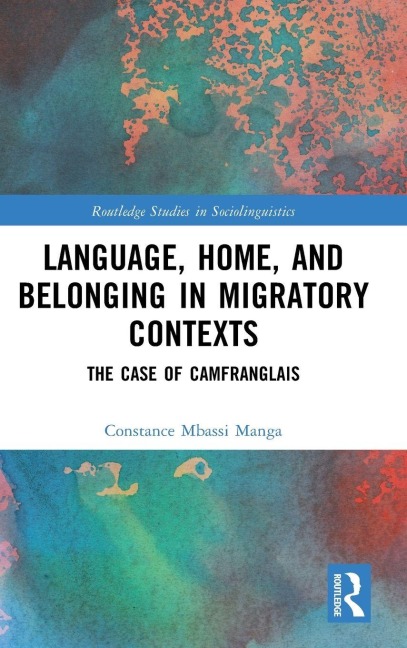
This book presents a study of the role and functions of Camfranglais (CFrA) for diasporic Cameroonians living in the West, showcasing how closely language relates to identity and the role CFrA plays in negotiations of Home and Belonging for these diasporic Cameroonians.
Trained as a translator and interpreter, Constance Mbassi Manga works in the Creative Language Services industry and in Higher Education. After getting a Master's in Research from Kings College, London, she completed her PhD at Lancaster University, UK.
Contents List of figures List of tables Transcription conventions Chapter 1 - Introduction and background 1.1 Introduction 1.2 What do we call Camfranglais? 1.3 My personal interest in CFrA 1.3.1 My relationship to CFrA and other non-standard codes in my repertoire 1.3.2 Reasons that led me to research CFrA 1.4 Background 1.4.1 Colonial history & the link with CFrA 1.4.2 How decoloniality fits in 1.4.3 CFrA in the diaspora 1.4.4 Relevance of the topic 1.4.5 Research question 1.4.6 Ontological and epistemological position 1.4.7 Theoretical framework 1.4.8 Overview of indexical transformations undergone by CFrA in this context 1.5 Value and usefulness of the interdisciplinary lens to this topic 1.5.1 Introduction 1.5.2 (Linguistic) Ethnography 1.5.3 Online/digital ethnography 1.5.3.1 Introduction 1.5.3.2 Nomenclature 1.5.3.3 The online field, its context, and privacy 1.5.3.4 Insights from relevant online ethnographies 1.5.4 Critical Discourse Analysis 1.5.5 Decolonial approaches to CDA 1.5.6 Combining LE & CDA 1.5.7 Key points on data collection (on- and offline) 1.5.8 Life narratives as data 1.5.9 Researcher's position and reflexivity 1.5.10 Data analysis: overview 1.6 Conclusion Chapter 2 - Key concepts 2.1 Theorising Cameroonian-ness 2.1.1 Diaspora 2.1.2 The deconstruction of diasporic Cameroonian-ness 2.2 Community 2.3 'Home' and 'belonging', identity, and the migratory experience 2.3.1 ('Home' and) Belonging 2.3.2 Identity 2.3.3 Migratory experience 2.4 The functions of language 2.5 Translanguaging and its relevance to the project 2.6 Conclusion Chapter 3 - Historical and socioeconomic context 3.1 From colonial era to independence 3.2 Language ideologies of the new Cameroonian state 3.2.1 From independence to the late 1980s 3.2.2 From the 1990s onward 3.2.3 Practical example: Camfranglais in pop culture 3.3 Main trends in the study of CFrA 3.3.1 Introduction 3.3.2 Trends in the study of CFrA: late 1990s to mid-2000s 3.3.2.1 CFrA as a linguistic system 3.3.2.2 CFrA and other registers 3.3.2.3 CFrA as an unstable register 3.3.2.4 CFrA and official language ideologies 3.3.2.5 CFrA as a sociolinguistic asset 3.3.3 Trends in the study of CFrA: mid- to late 2000s onward 3.3.3.1 Socioeconomic context of emergence of CFrA 3.3.3.2 CFrA as a language practice 3.3.3.3 CFrA and the diaspora 3.3.3.4 CFrA and identity 3.3.3.5 'Home' and 'belonging' in previous studies about CFrA 3.4 Conclusion Chapter 4 - Skype conversations: narratives and diasporic identities 4.1 Introduction 4.2 The conversations 4.3 Brief vignettes of participants 4.3.1. Adam 4.3.2 Freddy 4.3.3 Lovely 4.3.4 Craig 4.3.5 Thalia 4.3.6 Manuela 4.3.7 Trish 4.3.8 Boris 4.3.9 Conclusion 4.4 Analysis: introduction 4.4.1 Participants' backgrounds and their impact on practices 4.4.2 Socioeconomic background 4.4.3 Age and time of arrival 4.5 Themes emerging from the conversations 4.5.1 Language and identity 4.5.2 Frenchness and Cameroonian-ness 4.5.3 Language and 'race' 4.5.4 Language ideologies about CFrA 4.5.5 'Home' and 'belonging' 4.5.6 Insights from the conversations 4.6 Conclusion Chapter 5 - Facebook Group: an online community built around CFrA 5.1 Introduction 5.2 Overview of Facebook features and their impact on the data 5.2.1 Affordances of participation 5.2.2 Affordances of space 5.2.3 Affordances of personal expression 5.2.4 Affordances of connection 5.2.5 Impact of Facebook features on the project 5.3 General description of the group 5.3.1 Introduction 5.3.2 Organisation of the group 5.3.3 Engaging with the group 5.3.4 Data selection and download 5.4 Activity in the group 5.4.1 Introduction 5.4.2 Member interaction 5.5 Analysis: introduction 5.5.1 Overall content and style 5.6 Selected cases and themes 5.6.1 Diasporic migrant identity 5.6.1.1 Analysis 5.6.2 Community-building 5.6.2.1 Analysis 5.6.3 Cameroonian identity and patriotism 5.6.3.1 Prince 5.6.3.1.1 Analysis 5.6.3.2 Tebo 5.6.3.2.1 Analysis 5.6.4 Metadiscourses about CFrA 5.6.4.1 Analysis 5.6.5 Insights from the Facebook chats 5.7 Conclusion Chapter 6 - Findings and conclusion 6.1 Introduction 6.2 Overall findings 6.3 Global significance of the case study 6.3.1 Links with the Sociolinguistics of Migration 6.3.2 Links with the (updated) Sociolinguistics of Diaspora 6.3.3 Links with postcolonial theories 6.3.4 Why and why now? Timeliness and relevance 6.4 Limitations 6.5 Further areas of research 6.6 Final comments Appendix Index