Und dann auf "Zum Home-Bildschirm [+]".

Stöbern
genialokal zum Startbildschirm hinzufügen
Installieren Sie die genialokal App auf Ihrem Startbildschirm für einen schnellen Zugriff und eine komfortable Nutzung.
Installieren Sie die genialokal App auf Ihrem Startbildschirm für einen schnellen Zugriff und eine komfortable Nutzung.
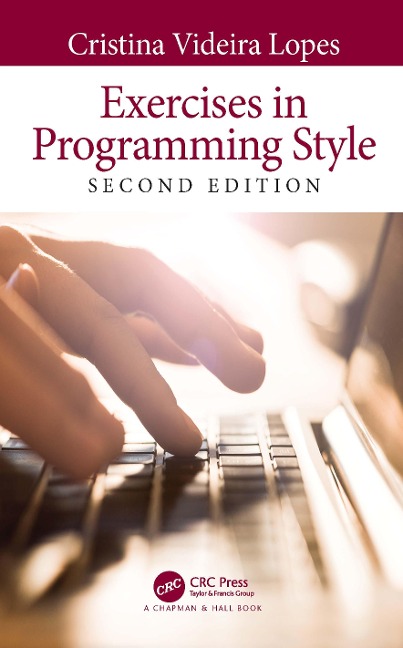
The first edition of Exercises in Programming Style was honored as an ACM Notable Book and praised as "The best programming book of the decade." This new edition retains the same presentation but has been upgraded to Python 3, and there is a new section on neural network styles. Using a simple computational task (term frequency) to illustrate different programming styles, Exercises in Programming Style helps readers understand the various ways of writing programs and designing systems. It is designed to be used in conjunction with code provided on an online repository. The book complements and explains the raw code in a way that is accessible to anyone who regularly practices the art of programming. The book can also be used in advanced programming courses in computer science and software engineering programs. The book contains 40 different styles for writing the term frequency task. The styles are grouped into ten categories: historical, basic, function composition, objects and object interactions, reflection and metaprogramming, adversity, data-centric, concurrency, interactivity, and neural networks. The author states the constraints in each style and explains the example programs. Each chapter first presents the constraints of the style, next shows an example program, and then gives a detailed explanation of the code. Most chapters also have sections focusing on the use of the style in systems design as well as sections describing the historical context in which the programming style emerged.
Cristina (Crista) Lopes is a Professor of Informatics at the Donald Bren School of Information and Computer Sciences, University of California, Irvine. Her research focuses on software engineering for large-scale data and systems. Early in her career, she was a founding member of the team at Xerox PARC that developed Aspect-Oriented Programming and AspectJ. Along with her research program, she is also a proli-c software developer. Her open source contributions include acoustic software modems, and the virtual world server OpenSimulator. She is a co-founder of a company specializing in online virtual reality for early-stage sustainable urban redevelopment projects. She developed and maintains a search engine for OpenSimulator-based virtual worlds. Dr. Lopes has a PhD from Northeastern University, and MS and BS degrees from Instituto Superior T-ecnico in Portugal. She is the recipient of several National Science Foundation grants, including a prestigious CAREER Award. She claims to be the only person in the world who is both an ACM Distinguished Scientist and Ohloh Kudos Rank 9.
Part 1 Historical Part 2 Basic Styles Part 3 Function Composition Part 4 Objects and Object Interaction Part 5 Reflection and Metaprogramming Part 6 Adversity Part 7 Data-Centric Part 8 Concurrency Part 9 Interactivity Part 10 Neural Networks
Dieses eBook wird im PDF-Format geliefert und ist mit einem Adobe Kopierschutz (DRM) versehen. Sie können dieses eBook mit allen Geräten lesen, die das PDF-Format und den Adobe Kopierschutz (DRM) unterstützen.
Zum Beispiel mit den folgenden Geräten:
• tolino Reader
Laden Sie das eBook direkt über den Reader-Shop auf dem tolino herunter oder übertragen Sie das eBook auf Ihren tolino mit einer kostenlosen Software wie beispielsweise Adobe Digital Editions.
• Sony Reader & andere eBook Reader
Laden Sie das eBook direkt über den Reader-Shop herunter oder übertragen Sie das eBook mit der kostenlosen Software Sony READER FOR PC/Mac oder Adobe Digital Editions auf ein Standard-Lesegeräte mit epub- und Adobe DRM-Unterstützung.
• Tablets & Smartphones
Möchten Sie dieses eBook auf Ihrem Smartphone oder Tablet lesen, finden Sie hier unsere kostenlose Lese-App für iPhone/iPad und Android Smartphone/Tablets.
• PC & Mac
Lesen Sie das eBook direkt nach dem Herunterladen mit einer kostenlosen Lesesoftware, beispielsweise Adobe Digital Editions, Sony READER FOR PC/Mac oder direkt über Ihre eBook-Bibliothek in Ihrem Konto unter „Meine eBooks“ - „online lesen“.
Schalten Sie das eBook mit Ihrer persönlichen Adobe ID auf bis zu sechs Geräten gleichzeitig frei.
Bitte beachten Sie, dass die Kindle-Geräte das Format nicht unterstützen und dieses eBook somit nicht auf Kindle-Geräten lesbar ist.