Und dann auf "Zum Home-Bildschirm [+]".

Stöbern
genialokal zum Startbildschirm hinzufügen
Installieren Sie die genialokal App auf Ihrem Startbildschirm für einen schnellen Zugriff und eine komfortable Nutzung.
Installieren Sie die genialokal App auf Ihrem Startbildschirm für einen schnellen Zugriff und eine komfortable Nutzung.
Ihr gewünschter Artikel ist in 0 Buchhandlungen vorrätig - wählen Sie hier eine Buchhandlung in Ihrer Nähe aus:

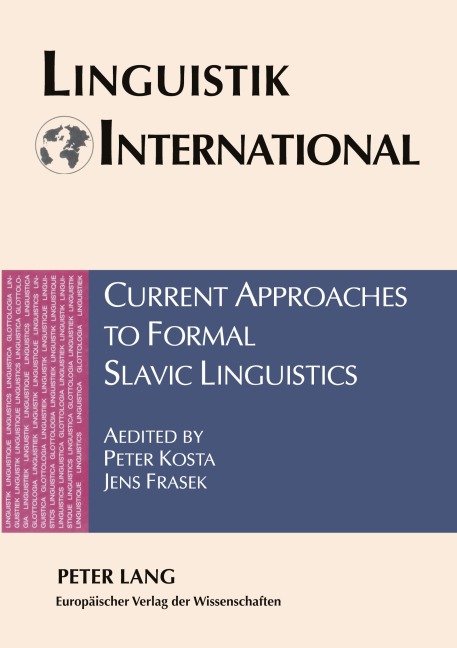
Formal Slavic Linguistics is concerned with explicit descriptions of structure and meaning of Slavic languages within a certain theoretical framework of Principles and Parameters that attempts to situate linguistic theory in the broader cognitive sciences. Many approaches in the present volume reflect this development in a rather significant way. But the book also illustrates the diversity of approaches we use in attempting to reflect the entire range of subfields within a given theoretical framework of cognitive science. Thus, the authors investigate all linguistic levels and interfaces of a large array of Slavic languages, based on current formal models in linguistics (such as Minimalist Program, Generalized Phrase Structure Grammar (GPSG), Head Driven Phrase Structure Grammar (HPSG), Lexical Functional Grammar (LFG), The Prague Generative Functional Grammar and Formal Semantics of different origins).
The Editors: Peter Kosta is Professor of Westslavic linguistics and Chair at the Slavic Department at Potsdam University. Jens Frasek is Assistant of Westslavic linguistics at the Slavic Department at Potsdam University. In 1997 the editors organized the Second European Conference on Formal Description of Slavic Languages (FDSL II) in Potsdam. The FDSL-conferences take place biannually in Leipzig and Potsdam.
Contents: Leonard H. Babby: Argument Suppression and Case in Russian Derived Nominals - Steven Franks: The Pros and Cons of Clitic Cluster Formation - Jens Nørgård-Sørensen: Individuation in Russian: Gender semantics and Other Issues - Tania Avgustinova: Clustering Clitics in Bulgarian Nominal Constituents - Kai Alter/Uwe Junghanns: Topic-Related Prosodic Patterns in Russian - Lukas Szucsich: Case and Configuration: The Problem of Nominal Adjuncts - Olga Mišeska Tomi-: The Site and Status of the South Slavic Negative Particle - Andreas Späth: On Definite Reference of Determinerless Nouns in Russian - Danko Šipka: A Decisionist Model of Slavic Morphology - Nenad Kon-ar/Danko Šipka: Slavic as a Source and Target Language in NeuroTran® Sentence Translation - Bistra Andreeva/William J. Barry: Intonation von checks in der Sofia-Varietät des Bulgarischen - Nancy Smith/Bernhard Staudinger: Einige Probleme der Aspektberechnung in einem deutsch-russischen Übersetzungssystem - Juliane Lagunov: Modaltransfer Russisch-Deutsch: Disambiguierung mittels Thema-Rhema-Gliederung - Ljudmila Geist: Russisch byt ': zwei Kopulae, zwei Kasus, ein integrierter Ansatz - Assinja Demjjanow: Semantik aspektueller Verben im Russischen - Hermann Fegert: Die Hierarchie der Verbbetonungsmuster im Russischen - Andrzej Bogus-awski: Zur sogenannten 'negative transportation' - Irina Sekerina: The Late Closure Principle in Processing of Ambiguous Russian Sentences - Richard Zuber: Some Categorially Polyvalent Modifiers in Polish - Ivanka P. Schick: Clitic-Doubling Constructions in Modern Bulgarian - Peter Kosta: Minimalism and Free Constituent Order in Russian - Barbara Kunzmann-Müller: Impersonale Konstruktionen im Slavischen - Jarmila Panevová/Jan Haji-: The Syntactic Tagging of Corpora: New Issues for Explicit Syntactic Description of Czech - Elena Rudnitskaya: Long-distance Binding into Russian Infinitives: the Blocking Effect of Overt Complementizers and Dative Subjects - Petr Sgall: Formalizing a Functional Description - Gerald Penn: On the Plausibility of Purely Structural Multiple WH-Fronting - Roland Meyer: Wh -Questions without Overt Wh -Movement in Russian and Polish - Milan Mihaljevi-: The Structure of Croatian Alternative Questions - Anna Kup--/Adam Przepiórkowski: Morphological Aspects of Verbal Negation in Polish - Eva Haji-ová: Focalizers and their Status in the Topic/Focus Articulation of the Sentence - Hélène Le Guillou de Penanros: Prefixes-prepositions Revisited - Chris Wilder/Damir -avar: Verb Movement, Cliticization and Coordination - Joanna B-aszczak: Towards a Binding Analysis of Negative Polarity Items in Polish - Adam Przepiórkowski: Verbal Proforms and the Complement-Adjunct Distinction in Polish - Loren A. Billings: Word Order and Argument Structure of Russian Psych Predicates - Leonid Birjulin: ----------- -----------: ---- ----------- --- ----------- --.