Und dann auf "Zum Home-Bildschirm [+]".

Stöbern
genialokal zum Startbildschirm hinzufügen
Installieren Sie die genialokal App auf Ihrem Startbildschirm für einen schnellen Zugriff und eine komfortable Nutzung.
Installieren Sie die genialokal App auf Ihrem Startbildschirm für einen schnellen Zugriff und eine komfortable Nutzung.
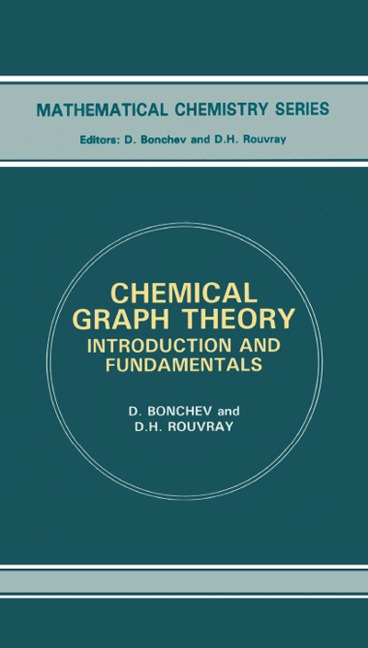
This volume presents the fundamentals of graph theory and then goes on to discuss specific chemical applications. Chapter 1 provides a historical setting for the current upsurge of interest in chemical graph theory. Chapter 2 gives a full background of the basic ideas and mathematical formalism of graph theory and includes such chemically relevant notions as connectedness, graph matrix representations, metric properties, symmetry and operations on graphs. This is followed by a discussion on chemical nomenclature and the trends in its rationalization by using graph theory, which has important implications for the storage and retrieval of chemical information. This volume also contains a detailed discussion of the relevance of graph-theoretical polynomials; it describes methodologies for the enumeration of isomers, incorporating the classical Polya method, as well as more recent approaches.
Bonchev, D
1. THE ORIGINS OF CHEMICAL GRAPH THEORY/Dennis H. Rouvray -- 1. Introduction -- 2. The first Use of Chemical Graphs -- 3. The Emergence of Structure Theory -- 4. The Concept of Valence -- 5. The Growth of Chemical Graph Theory -- 6. Isomer Enumeration Techniques -- 7. Early Additivity Studies -- 8. The Introduction of Topological Indices -- 9. Elementary Bonding Theory -- 10. Conclusion -- 11. References -- 2. ELEMENTS OF GRAPH THEORY FOR CHEMISTS/Oskar E. Polansky -- 1. What is a Graph and What Kinds of Graph Exist? -- 2. Some Graph-theoretical Terms -- 3. Connectedness of Graphs -- 4. Partitioning of a Graph -- 5. Planarity of Graphs -- 6. Line Graphs -- 7. Operations on Graphs -- 8. The Autolllorphism Group of a Graph -- 9. Matrix Representation and Eigenvalue Problems of Undirected Graphs -- 10. The Matrix Representation of Digraphs -- 11. Distances in Graphs and Digraphs -- 12. Metric and Topological Spaces for Simple Graphs -- 13. Graphs in Quantum Chemistry -- 14. Weighted Graphs -- 15. Bibliography -- Acknowledgment -- 3. NOMENCLATURE OF CHEMICAL COMPOUNDS/Alan L. Goodson -- 1. Introduction -- 2. Development of Chemical Nomenclature -- 3. Development of Olemical Line Notations -- 4. Development of Graph Theory -- 5. Application of Graph Theory Olemical Nomenclature -- 6. Summary -- 7. References and Notes -- 4. POLYNOMIALS IN GRAPH THEORY/Ivan Gutman -- 1. Why Polynomials in Graph Theory? -- 2. On Olemical Applications of Graphic Polynomials -- 3. Polynomials -- 4. The Characteristic Polynomial -- 5. The Matching Polynomial -- 6. More Graphic Polynomials -- 7. References -- 5. ENUMERATION OF ISOMERS/Alexandru T. Balaban -- 1. Introduction -- 2. Definitions and Mathematical Background -- 3. Historical -- 4. Polya 's Theorem -- s. Generalized Polya Theorem -- 6. Ruch's Double Coset Formalism -- 7. De Bruijn-Harary-Palmer Power Group Theory -- 8. Valence Isomers -- 9. Polyhexes -- 10. Diamond Hydrocarbons and Staggered Alkane Rotamers -- 11. Diastereomeric Annulenes -- 12. Isomers and Compucer Programs for Their Generation -- 13. Isomerism and Reaction Graphs -- 14. Conclusion -- References -- 6 GRAPH THEORY AND MOLECULAR ORBITALS/Nenad TrlnajstiC -- 1. Introduction -- 2. Elements of Graph Spe:cttal Theory -- 3. The Essence of Hilckel Theory -- 4. Isomorphism of Hilckel Theory and Graph Spe:cttal Theory -- s. The Spectrum of a Hilckel Graph -- 6. The Number Non-bonding Molecular Orbitals -- 7. Totalx-Electton Energy -- 8. Topological Resonance Energy -- 9. Concluding Remarks -- 10. References -- INDEX.
Dieses eBook wird im PDF-Format geliefert und ist mit einem Adobe Kopierschutz (DRM) versehen. Sie können dieses eBook mit allen Geräten lesen, die das PDF-Format und den Adobe Kopierschutz (DRM) unterstützen.
Zum Beispiel mit den folgenden Geräten:
• tolino Reader
Laden Sie das eBook direkt über den Reader-Shop auf dem tolino herunter oder übertragen Sie das eBook auf Ihren tolino mit einer kostenlosen Software wie beispielsweise Adobe Digital Editions.
• Sony Reader & andere eBook Reader
Laden Sie das eBook direkt über den Reader-Shop herunter oder übertragen Sie das eBook mit der kostenlosen Software Sony READER FOR PC/Mac oder Adobe Digital Editions auf ein Standard-Lesegeräte mit epub- und Adobe DRM-Unterstützung.
• Tablets & Smartphones
Möchten Sie dieses eBook auf Ihrem Smartphone oder Tablet lesen, finden Sie hier unsere kostenlose Lese-App für iPhone/iPad und Android Smartphone/Tablets.
• PC & Mac
Lesen Sie das eBook direkt nach dem Herunterladen mit einer kostenlosen Lesesoftware, beispielsweise Adobe Digital Editions, Sony READER FOR PC/Mac oder direkt über Ihre eBook-Bibliothek in Ihrem Konto unter „Meine eBooks“ - „online lesen“.
Schalten Sie das eBook mit Ihrer persönlichen Adobe ID auf bis zu sechs Geräten gleichzeitig frei.
Bitte beachten Sie, dass die Kindle-Geräte das Format nicht unterstützen und dieses eBook somit nicht auf Kindle-Geräten lesbar ist.