Und dann auf "Zum Home-Bildschirm [+]".

Stöbern
genialokal zum Startbildschirm hinzufügen
Installieren Sie die genialokal App auf Ihrem Startbildschirm für einen schnellen Zugriff und eine komfortable Nutzung.
Installieren Sie die genialokal App auf Ihrem Startbildschirm für einen schnellen Zugriff und eine komfortable Nutzung.
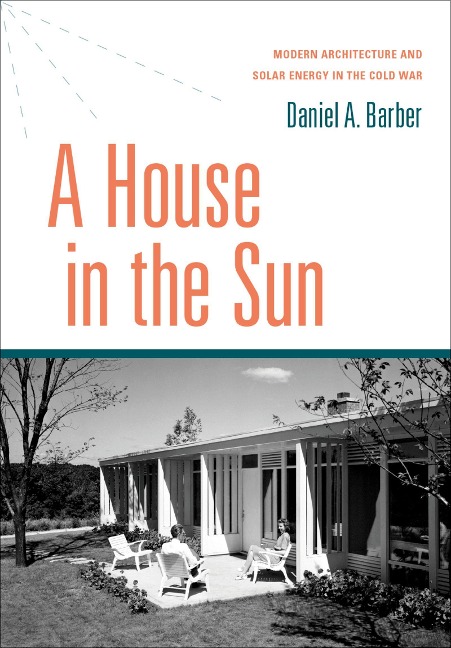
A House in the Sun describes a number of experiments in solar house heating in American architectural, engineering, political, economic, and corporate contexts from the beginning of World War II until the late 1950s. Houses were built across the Midwest, Northeast, and Southwestern United States, and also proposed for sites in India, South Africa, and Morocco. These experiments developed in parallel to transformations in the discussion of modern architecture, relying on new materials and design ideas for both energy efficiency and claims to cultural relevance. Architects were among the myriad cultural and scientific actors to see the solar house as an important designed element of the American future. These experiments also developed as part of a wider analysis of the globe as an interconnected geophysical system. Perceived resource limitations in the immediate postwar period led to new understandings of the relationship between energy, technology and economy. The solar house - both as a charged object in the milieu of suburban expansion, and as a means to raise the standard of living in developing economies - became an important site for social, technological, and design experimentation. This led to new forms of expertise in architecture and other professions. Daniel Barber argues that this mid-century interest in solar energy was one of the first episodes in which resource limitations were seen as an opportunity for design to attain new relevance for potential social and cultural transformations. Furthermore, the solar discussion established both an intellectual framework and a funding structure for the articulation of and response to global environmental concerns in subsequent decades. In presenting evidence of resource tensions at the beginning of the Cold War, the book offers a new perspective on the histories of architecture, technology, and environmentalism, one more fully entangled with the often competing dynamics of geopolitical and geophysical pressures.
Daniel A. Barber is an Assistant Professor of Architecture at the University of Pennsylvania, where he teaches the history of modern architecture. He has published articles in Grey Room and Technology and Culture.
Contents
Acknowledgments
Introduction: Architecture, Technology, and Politics 1. The Modern Solar House 2. What is a House? 3. Discovering Renewable Resources 4. Experimental Dwellings 5. All-Solar Houses 6. The World Solar Energy Project 7. Design and Research 8. Architecture and the Sun Conclusion: Architecture and Environmentalism Notes Bibliography Index
Dieses eBook wird im PDF-Format geliefert und ist mit einem Adobe Kopierschutz (DRM) versehen. Sie können dieses eBook mit allen Geräten lesen, die das PDF-Format und den Adobe Kopierschutz (DRM) unterstützen.
Zum Beispiel mit den folgenden Geräten:
• tolino Reader
Laden Sie das eBook direkt über den Reader-Shop auf dem tolino herunter oder übertragen Sie das eBook auf Ihren tolino mit einer kostenlosen Software wie beispielsweise Adobe Digital Editions.
• Sony Reader & andere eBook Reader
Laden Sie das eBook direkt über den Reader-Shop herunter oder übertragen Sie das eBook mit der kostenlosen Software Sony READER FOR PC/Mac oder Adobe Digital Editions auf ein Standard-Lesegeräte mit epub- und Adobe DRM-Unterstützung.
• Tablets & Smartphones
Möchten Sie dieses eBook auf Ihrem Smartphone oder Tablet lesen, finden Sie hier unsere kostenlose Lese-App für iPhone/iPad und Android Smartphone/Tablets.
• PC & Mac
Lesen Sie das eBook direkt nach dem Herunterladen mit einer kostenlosen Lesesoftware, beispielsweise Adobe Digital Editions, Sony READER FOR PC/Mac oder direkt über Ihre eBook-Bibliothek in Ihrem Konto unter „Meine eBooks“ - „online lesen“.
Schalten Sie das eBook mit Ihrer persönlichen Adobe ID auf bis zu sechs Geräten gleichzeitig frei.
Bitte beachten Sie, dass die Kindle-Geräte das Format nicht unterstützen und dieses eBook somit nicht auf Kindle-Geräten lesbar ist.