Und dann auf "Zum Home-Bildschirm [+]".

Stöbern
genialokal zum Startbildschirm hinzufügen
Installieren Sie die genialokal App auf Ihrem Startbildschirm für einen schnellen Zugriff und eine komfortable Nutzung.
Installieren Sie die genialokal App auf Ihrem Startbildschirm für einen schnellen Zugriff und eine komfortable Nutzung.
Ihr gewünschter Artikel ist in 0 Buchhandlungen vorrätig - wählen Sie hier eine Buchhandlung in Ihrer Nähe aus:

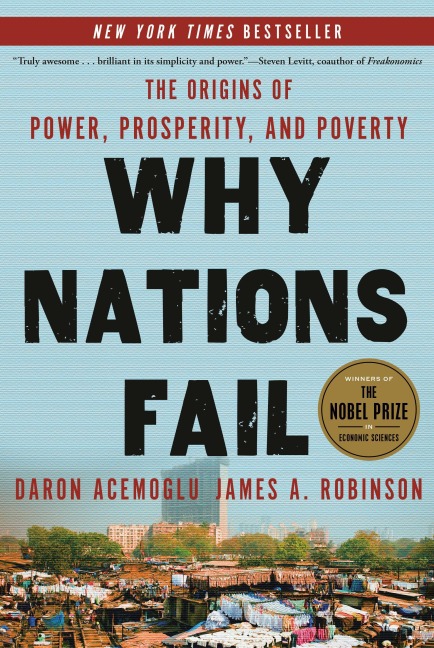

Brilliant and engagingly written, Why Nations Fail answers the question that has stumped the experts for centuries: Why are some nations rich and others poor, divided by wealth and poverty, health and sickness, food and famine? Is it culture, the weather, geography? Perhaps ignorance of what the right policies are? Simply, no. None of these factors is either definitive or destiny. Otherwise, how to explain why Botswana has become one of the fastest growing countries in the world, while other African nations, such as Zimbabwe, the Congo, and Sierra Leone, are mired in poverty and violence? Daron Acemoglu and James Robinson conclusively show that it is man-made political and economic institutions that underlie economic success (or lack of it). Korea, to take just one of their fascinating examples, is a remarkably homogeneous nation, yet the people of North Korea are among the poorest on earth while their brothers and sisters in South Korea are among the richest. The south forged a society that created incentives, rewarded innovation, and allowed everyone to participate in economic opportunities. The economic success thus spurred was sustained because the government became accountable and responsive to citizens and the great mass of people. Sadly, the people of the north have endured decades of famine, political repression, and very different economic institutions-with no end in sight. The differences between the Koreas is due to the politics that created these completely different institutional trajectories. Based on fifteen years of original research Acemoglu and Robinson marshall extraordinary historical evidence from the Roman Empire, the Mayan city-states, medieval Venice, the Soviet Union, Latin America, England, Europe, the United States, and Africa to build a new theory of political economy with great relevance for the big questions of today, including: - China has built an authoritarian growth machine. Will it continue to grow at such high speed and overwhelm the West? - Are America's best days behind it? Are we moving from a virtuous circle in which efforts by elites to aggrandize power are resisted to a vicious one that enriches and empowers a small minority? - What is the most effective way to help move billions of people from the rut of poverty to prosperity? More philanthropy from the wealthy nations of the West? Or learning the hard-won lessons of Acemoglu and Robinson's breakthrough ideas on the interplay between inclusive political and economic institutions? Why Nations Fail will change the way you look at-and understand-the world.
Daron Acemoglu is the Killian Professor of Economics at MIT. In 2005 he received the John Bates Clark Medal awarded to economists under forty judged to have made the most significant contribution to economic thought and knowledge. He is also the co-author of The Narrow Corridor: States, Societies, and the Fate of Liberty. James A. Robinson, a political scientist and an economist, is the David Florence Professor of Government at Harvard University. A world-renowned expert on Latin America and Africa, he has worked in Botswana, Mauritius, Sierra Leone, and South Africa. He is also the co-author of The Narrow Corridor: States, Societies, and the Fate of Liberty.
Preface Why Egyptians filled Tahrir Square to bring down Hosni Mubarak and what it means for our understanding of the causes of prosperity and poverty 1. So Close and Yet So Different Nogales, Arizona, and Nogales, Sonora, have the same people, culture, and geography. Why is one rich and one poor? 2. Theories That Don’t Work Poor countries are poor not because of their geographies or cultures, or because their leaders do not know which policies will enrich their citizens 3. The Making of Prosperity and Poverty How prosperity and poverty are determined by the incentives created by institutions, and how politics determines what institutions a nation has 4. Small Differences and Critical Junctures: The Weight of History How institutions change through political conflict and how the past shapes the present 5. “I’ve Seen the Future, and It Works”: Growth Under Extractive Institutions What Stalin, King Shyaam, the Neolithic Revolution, and the Maya city-states all had in common and how this explains why China’s current economic growth cannot last 6. Drifting Apart How institutions evolve over time, often slowly drifting apart 7. The Turning Point How a political revolution in 1688 changed institutions in England and led to the Industrial Revolution 8. Not on Our Turf: Barriers to Development Why the politically powerful in many nations opposed the Industrial Revolution 9. Reversing Development How European colonialism impoverished large parts of the world 10. The Diffusion of Prosperity How some parts of the world took different paths to prosperity from that of Britain 11. The Virtuous Circle How institutions that encourage prosperity create positive feedback 12. The Vicious Circle How institutions that create poverty generate negative feedback loops and endure 13. Why Nations Fail Today Institutions, institutions, institutions 14. Breaking the Mold How a few countries changed their economic trajectory by changing their institutions 15. Understanding Prosperity and Poverty How the world could have been different and how understanding this can explain why most attempts to combat poverty have failed Acknowledgments Bibliographical Essay and Sources References Index