Und dann auf "Zum Home-Bildschirm [+]".

Stöbern
genialokal zum Startbildschirm hinzufügen
Installieren Sie die genialokal App auf Ihrem Startbildschirm für einen schnellen Zugriff und eine komfortable Nutzung.
Installieren Sie die genialokal App auf Ihrem Startbildschirm für einen schnellen Zugriff und eine komfortable Nutzung.
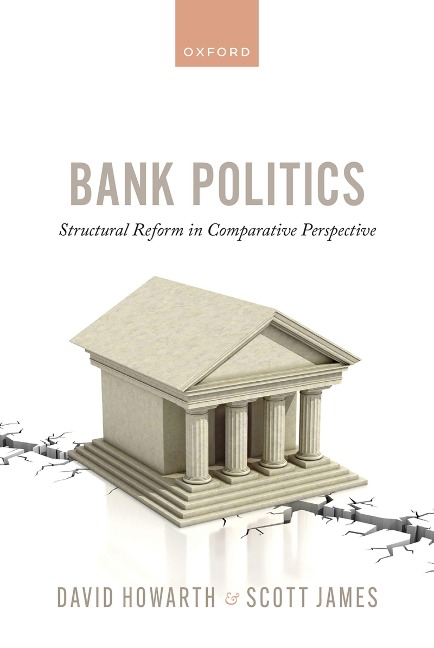
The problem of banks being 'too big to fail' was the defining regulatory issue of the global financial crisis. However, attempts to tackle the problem by separating retail banking from higher risk trading activities - known as structural reform - proved to be highly divisive and contributed to significant regulatory divergence. In this book, David Howarth and Scott James explain this variation by examining the politics of bank structural reform across six key jurisdictions: the United States, the European Union, the United Kingdom, France, Germany, and the Netherlands. Integrating political economy and public policy approaches, they develop a novel 'comparative financial power' framework to analyse how financial industry influence is mediated by two factors: first, whether bank lobbying is unified and centralized (cooperative financial power) or divided and fragmented (competitive financial power); and second, policy makers' use of venue shifting to depoliticize contentious policy issues.
The book explains that the US and UK governments implemented major reforms because the banking industry was divided and faced significant opposition. However, venue shifting to an independent committee led to durable reform in the UK, while political polarization in the US contributed to contested reform. By contrast, the French and German governments balanced unified bank lobbying and political pressures to act by pursuing limited symbolic reforms; the Dutch government deflected the issue through delegation to multiple commissions (no reform); while political stalemate at the EU level resulted from early venue shifting and concerted pan-European bank lobbying. The book makes a major contribution to scholarship on the political economy of finance and business power.
David Howarth has been a Full Professor at the University of Luxembourg since 2012 and was previously a Jean Monnet Chair at the University of Edinburgh. He works on European political economy topics, with specific focus on financial regulation and economic and monetary union. His many publications include The Political Economy of Banking Union (with Lucia Quaglia; OUP, 2016), The Difficult Construction of European Banking Union (with Joachim Schild; Routledge, 2020), and Regional Development Banks in the World Economy (with Judith Clifton and Daniel Fuentes; OUP 2021). Scott James is a Reader in Political Economy at King's College London, having previously held visiting positions at the Blavatnik School of Government (University of Oxford) and the Sheffield Political Economy Research Institute (SPERI). His research interests relate to the political economy of finance and financial regulation; Britain, Europe and the City of London; and the role of economic ideas and knowledge in policy making. He has published over twenty articles in international journals and his book The UK and Multi-Level Financial Regulation: From Post-Crisis Reform to Brexit (with Lucia Quaglia) was published in 2020 by Oxford University Press.
- 1: Introduction: The Puzzle of Bank Structural Reform - 2: A Comparative Financial Power Approach - 3: Failing to Tame Too-Big-To-Fail Banks - 4: From Obama to Trump: Contested Reform in the United States - 5: The Importance of Being Vickers: Venue Shifting in the United Kingdom - 6: Germany: Defending Deutsche Bank AG - 7: Protecting National Bank Champions in France - 8: The Netherlands: Shifting Structural Reform Off the Agenda - 9: Liikanen's Legacy: Financial Power and Political Stalemate in the European Union - 10: Conclusion: Contribution and Future Research
Dieses eBook wird im PDF-Format geliefert und ist mit einem Adobe Kopierschutz (DRM) versehen. Sie können dieses eBook mit allen Geräten lesen, die das PDF-Format und den Adobe Kopierschutz (DRM) unterstützen.
Zum Beispiel mit den folgenden Geräten:
• tolino Reader
Laden Sie das eBook direkt über den Reader-Shop auf dem tolino herunter oder übertragen Sie das eBook auf Ihren tolino mit einer kostenlosen Software wie beispielsweise Adobe Digital Editions.
• Sony Reader & andere eBook Reader
Laden Sie das eBook direkt über den Reader-Shop herunter oder übertragen Sie das eBook mit der kostenlosen Software Sony READER FOR PC/Mac oder Adobe Digital Editions auf ein Standard-Lesegeräte mit epub- und Adobe DRM-Unterstützung.
• Tablets & Smartphones
Möchten Sie dieses eBook auf Ihrem Smartphone oder Tablet lesen, finden Sie hier unsere kostenlose Lese-App für iPhone/iPad und Android Smartphone/Tablets.
• PC & Mac
Lesen Sie das eBook direkt nach dem Herunterladen mit einer kostenlosen Lesesoftware, beispielsweise Adobe Digital Editions, Sony READER FOR PC/Mac oder direkt über Ihre eBook-Bibliothek in Ihrem Konto unter „Meine eBooks“ - „online lesen“.
Schalten Sie das eBook mit Ihrer persönlichen Adobe ID auf bis zu sechs Geräten gleichzeitig frei.
Bitte beachten Sie, dass die Kindle-Geräte das Format nicht unterstützen und dieses eBook somit nicht auf Kindle-Geräten lesbar ist.