Und dann auf "Zum Home-Bildschirm [+]".

Stöbern
genialokal zum Startbildschirm hinzufügen
Installieren Sie die genialokal App auf Ihrem Startbildschirm für einen schnellen Zugriff und eine komfortable Nutzung.
Installieren Sie die genialokal App auf Ihrem Startbildschirm für einen schnellen Zugriff und eine komfortable Nutzung.

Ihr gewünschter Artikel ist in 0 Buchhandlungen vorrätig - wählen Sie hier eine Buchhandlung in Ihrer Nähe aus:

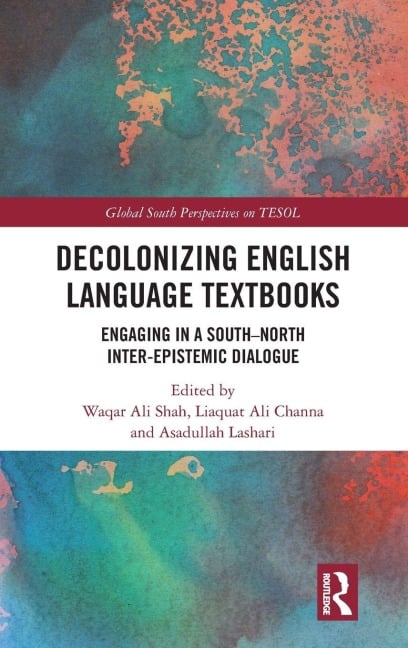
Bringing together diverse perspectives from authors situated in both the South and the Global North, this ground-breaking volume takes a critical, decolonial and global southern approach to exploring colonial epistemologies and pedagogies surrounding textbook discourses and research.
Waqar Ali Shah is Assistant Professor of English, Center of English Language & Linguistics, Mehran University of Engineering and Technology, Sindh, Pakistan. Liaquat Ali Channa is Professor of Linguistics in the Department of English, Government College (GC) University Hyderabad, Sindh, Pakistan. He was the Syed Babar Ali Postdoctoral Fellow at Harvard University in 2022. As a Fulbrighter, he completed his PhD in Language and Literacy Education with concentration on TESOL at the University of Georgia, USA. He also holds an M.Ed. in English Language Teaching (ELT) at the University of Glasgow, UK. He is currently affiliated with the Mittal South Asia Institute at Harvard University as an Honorary Research Fellow. Asadullah Lashari is Assistant Professor and Head of the Department of English, University of Sindh Campus Thatta, Sindh, Pakistan.
Foreword Tommaso M. Milani Introduction Waqar Ali Shah, Liaquat Ali Channa, and Asadullah Lashari Section 1 Textbooks as (de)colonial artefacts: Disrupting discursive/semiotic and pedagogical landscapes in English language textbooks through Southern (re)imaginations 1. English language textbooks: Thinking out of the boxes of coloniality Karen Risager 2. Decolonizing EFL textbooks: Challenging the marginalization of Indigenous cultures in Chile Leonardo Veliz and Mauricio Véliz-Campos 3. Interrogating colonial ideologies in elementary English textbooks in Nigeria Yetunde S. Alabede and Vaughn W.M. Watson 4. Image representation of women in the textbook "Way to English for Brazilian Learners": A critical analysis from the perspective of decoloniality of gender Wagner Barros Teixeira, Doris Cristina Vicente da Silva Matos, and Alciclei da Graça Cruz 5. Untangling coloniality of knowledge and culture in TESOL textbooks in higher education: Implications for epistemic delinking Benachour Saidi 6. Disrupting the standard language ideologies and hegemony of method in Pakistani university ELT curricula: Reclaiming reparations through translingual competence Sarwat Anjum 7. Foreign language textbooks and the multimodal representation of linguistic coloniality: A corpus-assisted discourse study from Indonesia Danang Satria Nugraha Section 2 Textbook production, use, and critical interventions: Re-imagining textbook discourses through South-North dialogues 8. Decolonizing language textbooks through a dialogue with conceptual art Christine Calfoglou 9. Negotiating gender discourses in Algerian EFL textbooks through decolonial pedagogy Ouacila Ait Eldjoudi 10. Collaborative ELT materials design: An alternative to disrupt English textbook hegemony Jhon Eduardo Mosquera Pérez 11. Decolonizing EFL textbooks in Colombia: A pedagogical intervention through contextualized materials Jhonatan Vásquez-Guarnizo and Mairon Felipe Tobar-Gómez 12. Bridging the gap: Materials development for decolonizing English Medium Instruction (EMI) in Bangladeshi higher education Golam Kader Zilany 13. Unsettling entanglements of internal and external forms of colonialism in locally produced English textbooks: Decolonial trio-autoethnographic narratives Liaquat Ali Channa, Asadullah Lashari, and Waqar Ali Shah Conclusion: On decolonial alternatives in English language textbooks and pedagogy Waqar Ali Shah, Liaquat Ali Channa, and Asadullah Lashari