Und dann auf "Zum Home-Bildschirm [+]".

Stöbern
genialokal zum Startbildschirm hinzufügen
Installieren Sie die genialokal App auf Ihrem Startbildschirm für einen schnellen Zugriff und eine komfortable Nutzung.
Installieren Sie die genialokal App auf Ihrem Startbildschirm für einen schnellen Zugriff und eine komfortable Nutzung.
Ihr gewünschter Artikel ist in 0 Buchhandlungen vorrätig - wählen Sie hier eine Buchhandlung in Ihrer Nähe aus:

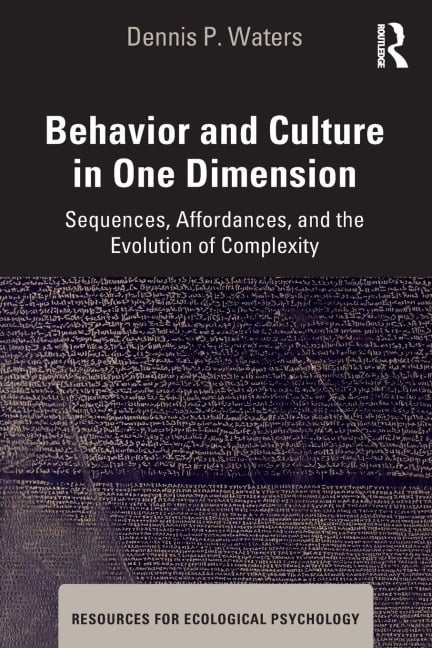

Behavior and Culture in One Dimension adopts a broad interdisciplinary approach, presenting a unified theory of sequences and their functions and an overview of how they underpin the evolution of complexity.
Sequences of DNA guide the functioning of the living world, sequences of speech and writing choreograph the intricacies of human culture, and sequences of code oversee the operation of our literate technological civilization. These linear patterns function under their own rules, which have never been fully explored. It is time for them to get their due. This book explores the one-dimensional sequences that orchestrate the structure and behavior of our three-dimensional habitat. Using Gibsonian concepts of perception, action, and affordances, as well as the works of Howard Pattee, the book examines the role of sequences in the human behavioral and cultural world of speech, writing, and mathematics.-
The book offers a Darwinian framework for understanding human cultural evolution and locates the two major informational transitions in the origins of life and civilization. It will be of interest to students and researchers in ecological psychology, linguistics, cognitive science, and the social and biological sciences.
Dennis P. Waters received his Ph.D. from Binghamton University in 1990. He became a publishing entrepreneur, founding technical news services like GenomeWeb.com. After retiring, Waters continued his Ph.D. research, how one-dimensional patterns of DNA, language, and code guide the three-dimensional world. He is a visiting scientist at Rutgers University.
Introduction: Sequences, Sequences, and Sequences Chapter 1. The Problem of Sequentialization Chapter 2. The Emergence of Constraint Chapter 3. The Grammar of Interaction Chapter 4. The Grammar of Extension Chapter 5. The Grammar of Abstraction Chapter 6. The Conundrum of Replication Chapter 7. The Threshold of Complication Chapter 8. The Institution of Sequences Chapter 9. The Continuum of Abstraction Appendix: Just Enough Molecular Biology