Und dann auf "Zum Home-Bildschirm [+]".

Stöbern
genialokal zum Startbildschirm hinzufügen
Installieren Sie die genialokal App auf Ihrem Startbildschirm für einen schnellen Zugriff und eine komfortable Nutzung.
Installieren Sie die genialokal App auf Ihrem Startbildschirm für einen schnellen Zugriff und eine komfortable Nutzung.
Ihr gewünschter Artikel ist in 0 Buchhandlungen vorrätig - wählen Sie hier eine Buchhandlung in Ihrer Nähe aus:

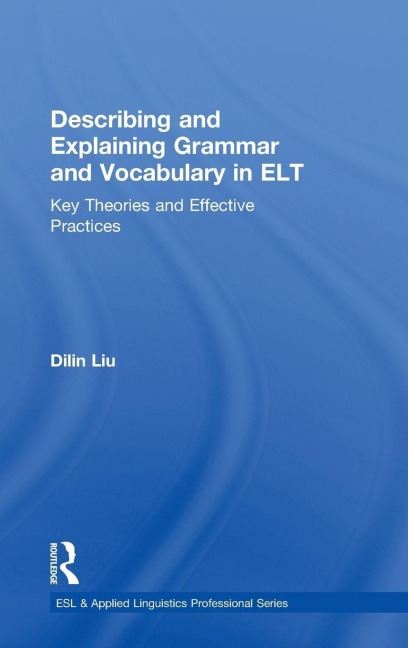

This book provides balanced treatment of theory and practice of language description and its role in ELT via systematic examination of the major linguistic theories and their approaches to language description and concrete examples of how they can be used in teaching English language structures and usages.
Dilin Liu is Professor of Applied Linguistics/TESOL, Department of English, The University of Alabama, USA.
Contents Preface Chapter 1 Language Description: Purview, Importance, and Principles 1.1 Introduction 1.2 The purview of language description 1.3 The importance of language description 1.4 Principles for language description Part I: Foundations: Key theories and approaches to language description Chapter 2. . Prescriptive, Structural, and Generative Linguistics 2.1 Prescriptivism 2.2 Structuralism 2.3 Generativism Chapter 3. Sociolinguistics and Systemic Functional Linguistics 3.1 Sociolinguistics: An overview of Communicative Competence and Speech 3.2 Systemic functional linguistics: An overview 3.3 The impacts of sociolinguistics and SFL on language teaching Chapter 4. . . Cognitive Linguistics 4.1 Theoretical underpinnings and important basic concepts 4.2 Cognitive Linguistics-inspired language description Chapter 5. . . Corpus Linguistics 5.1 Overview 5.2 Significant contributions of corpus linguistics to the study of language 5.3 Impact of corpus linguistics on language teaching Part II: Putting Theory to Practice: Striving for Enhanced Language Description and Explanation Chapter 6. . . Vocabulary Description: Basics, Parts of Speech, and Other Challenging Issues 6.1 What information should be covered in teaching a word? 6.2 Describing/teaching spelling, pronunciation, and morphological rules 6.3 Defining/teaching parts of speech 6.4 Collocations/semantics/register: Other key issues to be addressed 6.5 Explaining/teaching challenging issues with new insights Chapter 7. . . Sentence Structure Description: Basics, Verb Structure/ Subcategorization, and Other Challenging Structural Issues 7.1 Sentence structural analysis: Tasks and processes 7.2 Established practices for describing/analyzing sentence structures 7.3 Explaining/teaching challenging issues with new insight Chapter 8. . . Tense and Aspect 8.1 English tense and aspect system: An overview 8.2 Established useful practices for describing/teaching prepositions 8.3 Explaining/teaching challenging issues with new insights Chapter 9. . . Articles 9.1 The English article system: An overview 9.2 Established useful practices in describing/teaching English articles 9.3 Explaining/teaching challenging issues with new insights Chapter 10. . Prepositions, Prepositional Adjectives/Adverbs, and Particles 10.1 Overview: Basic information, importance, and difficulties 10.2 Established useful practices for describing and teaching prepositions 10.3 Explaining/teaching challenging issues with new insights Chapter 11. . Structural Alternation: English Object Placement, Subject/Object Deletion, and the Passive voice 11.1 Explaining/teaching object placement with new insights 11.2 Explaining/teaching subject/object deletion with new insights 11.3 Explaining/teaching the passive voice with new insights Chapter 12. . Word Meaning and Usage: Polysemy, Synonymy, Culturally- Loaded Words, and Register 12.1 Polysemy: An overview 12.2 Synonymy 12.3 Established useful practices for teaching polysemes and synonyms 12.4 Explaining/teaching challenging issues with new insights Chapter 13. . Word Collocations 13.1 Overview of collocations 13.2 Established useful practices in collocation teaching 13.3 Explaining/teaching collocations and collostructions with new insights Chapter 14. . Multi-Word Expressions: Idioms, Phrasal Verbs, and Formulae/ Lexical Bundles 14.1 Describing idioms/phrasal verbs/formulae and their functions 14.2 Explaining/teaching idioms and phrasal verbs with new insights 14.3 Explaining and teaching formulae/lexical bundles with new insights Annotated List of Free Online Resources for Grammar/Vocabulary Learning/ Teaching Glossary