Und dann auf "Zum Home-Bildschirm [+]".

Stöbern
genialokal zum Startbildschirm hinzufügen
Installieren Sie die genialokal App auf Ihrem Startbildschirm für einen schnellen Zugriff und eine komfortable Nutzung.
Installieren Sie die genialokal App auf Ihrem Startbildschirm für einen schnellen Zugriff und eine komfortable Nutzung.
Ihr gewünschter Artikel ist in 0 Buchhandlungen vorrätig - wählen Sie hier eine Buchhandlung in Ihrer Nähe aus:

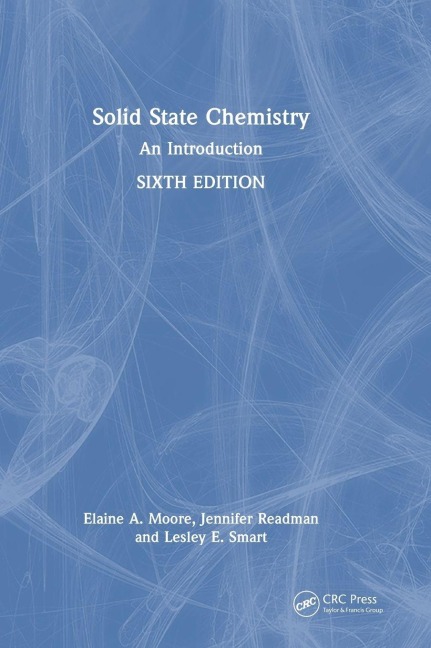

Solid-state chemistry is still a rapidly advancing field, contributing to areas such as batteries for transport and energy storage, nanostructured materials, porous materials for the capture of carbon dioxide and other pollutants.
Elaine A. Moore studied Chemistry as an undergraduate at Oxford University and then stayed on to complete a DPhil in theoretical chemistry with Peter Atkins. After a two-year postdoctoral position at the University of Southampton, she joined the Open University in 1975, becoming a lecturer in Chemistry in 1977, senior lecturer in 1998 and reader in 2004. She retired in 2017 and currently has an honorary position at the Open University. She has produced OU teaching texts in chemistry for courses at levels 1, 2 and 3 and written texts in astronomy at level 2 and physics at level 3. She is the coauthor of Metals and Life (RSC Publishing, 2009) and of Concepts in Transition Metal Chemistry (RSC Publishing, 2010), which were part of a level 3 Open University course in inorganic chemistry and co-published with the Royal Society of Chemistry. She was a team leader for the production and presentation of an Open University level 2 chemistry module delivered entirely online. She is a Fellow of the Royal Society of Chemistry and a Senior Fellow of the Higher Education Academy. She was a co-chair for the successful Departmental submission of an Athena Swan bronze award. Her research interests are in theoretical chemistry applied mainly to solid-state systems and is the author or coauthor of over 50 papers in refereed scientific journals. A long-standing collaboration in this area led to her being invited to help run a series of postgraduate workshops on computational materials science hosted by the University of Khartoum. Jennifer E. Readman was awarded a BA (Hons) chemistry degree from the University of Oxford and a PhD from the University of Birmingham under the supervision of Dr Paul Anderson. The PhD work involved the use of zeolite frameworks to act as host for metal and metal oxide nanoparticles. The postdoctoral work was carried out at the State University of New York at Stony Brook, where the project involved using 17-O solid state NMR to study zeolites. This work was followed by SINTEF in Oslo, Norway, where the research project investigated carbon dioxide absorbents for use in the clean fuel production. After returning to the UK, Dr Readman returned to the University of Birmingham, working on a joint chemistry/biochemistry project with Dr Joe Hriljac and Prof. Lynne Macaskie, investigating synthetic and bio-manufactured layered phosphates for the remediation of nuclear waste. Before coming to work at UCLan, Dr Readman worked at Durham University under the supervision of Prof. John Evans working on negative thermal expansion materials. Jennifer teaches many different aspects of inorganic and physical chemistry across all year of the undergraduate chemistry programmes. The topics include structure and bonding in inorganic chem-istry, X-ray diffraction, chemistry of the s and p block elements, introductory d-block chemistry, advanced structural techniques, group theory, and advanced materials chemistry. She is the Course Leader for the undergraduate BSc (Hons) and MChem programmes. Her research interests lie in the areas of solid state chemistry, particularly in the relationship between the structure of a material and its properties, such as zeolites, metal-organic frameworks, and metal silicates. Her main research interests also lie in techniques such as powder X-ray diffraction in the laboratory and at synchrotron sources such as the diamond light source. These materials have applications in industry, predomi-nately in the treatment of nuclear and pharmaceutical waste. Dr Readman is also interested in diffuse scattering, electron microscopy, X-ray fluorescence spectroscopy, and solid state NMR. Lesley E. Smart studied Chemistry at Southampton University, United Kingdom, and after com-pleting a PhD in Raman spectroscopy, she moved to a lectureship at the (then) Royal University of Malta. After returning to the United Kingdom, she took an SRC Fellowship to Bristol University to work on X-ray crystallography. From 1977 to 2009, she worked at the Open University Chemistry department as a lecturer, senior lecturer and Molecular Science Programme director. She held an honorary senior lectureship there until her death in 2016. At the Open University, she was involved in the production of undergraduate courses in inorganic and physical chemistry and health sciences. She was the coordinating editor and the author of The Molecular World course, a series of eight books and DVDs co-published with the Royal Society of Chemistry, authoring two of these, The Third Dimension (RSC Publishing, 2002) and Separation, Purification and Identification (RSC Publishing, 2002). Her most recent books are Alcohol and Human Health (Oxford University Press, 2007) and Concepts in Transition Metal Chemistry (RSC Publishing, 2010). She has an entry in Mothers in Science: 64 Ways to Have It All (RSC Publishing, 2016; downloadable from the Royal Society website). She served on the Council of the Royal Society of Chemistry and as the chair of their Benevolent Fund. Her research interests were in the characterisation of the solid state, and she authored publications on single-crystal Raman studies, X-ray crystallography, Zintl phases, pigments and heterogeneous catalysis and fuel cells.
Chapter 1 - An Introduction to Crystal Structures Jennifer E. Readman and Lesley E. Smart 1.1 Introduction 1.2 Close packing 1.3 Body-centred and Primitive Structures 1.4 Lattices and Unit Cells 1.4.1 Lattices 1.4.2 One- and Two- Dimensional Unit Cells 1.4.3 Three-Dimensional Lattices and Their Unit Cells 1.5 Crystalline solids 1.5.1 Unit cell stoichiometry and Fractional Coordinates 1.5.2 Ionic Solids with Formula MX 1.5.2.1 Caesium Chloride 1.5.2.2 Sodium Chloride 1.5.2.3 Zinc Blende & Wurtzite 1.5.2.4 Nickel Arsenide 1.5.3 Solids with General Formula MX2 1.5.3.1 Fluorite and Anti-Fluorite 1.5.3.2 Cadmium Chloride and Cadmium Iodide 1.5.3.3 Rutile 1.5.3.4 -Cristobalite 1.5.4 Other Important Crystal Structures 1.5.4.1 Rhenium trioxide 1.5.4.2 Perovskite 1.5.4.3 Spinel and Inverse Spinel 1.5.5 Miscellaneous Oxides 1.6 Ionic Radii and the Radius Ratio Rule 1.7 Extended Covalent Arrays 1.8 Molecular Structures 1.9 Lattice Energy 1.9.1 Born-Haber Cycle 1.9.2 Calculating Lattice Enthalpies 1.9.3 Calculations Using Thermodynamic Cycles and Lattice Energies 1.10 Symmetry 1.10.1 Symmetry Notation 1.10.2 Axes of Symmetry 1.10.3 Planes of Symmetry 1.10.4 Inversion 1.10.5 Inversion Axes, Improper Symmetry Axes, and the Identity Element 1.10.6 Operations 1.10.7 Symmetry in Crystals 1.10.8 Translational Symmetry Elements 1.10.9 Space groups 1.11 Miller Indices and Interplanar spacing 1.12 Quasicrystals Summary. Questions Chapter 2 Scattering Techniques for Characterising Solids Jennifer E. Readman 2.1 Introduction 2.2 X-ray Diffraction 2.2.1 The Generation of X-rays 2.2.2 Scattering of X-rays & Bragg's Law 2.2.3 The Diffraction Experiment 2.2.4 The Powder Diffraction Pattern 2.2.5 The Intensity of Diffracted Peaks 2.2.6 The Width of Diffracted Peaks 2.2.7 Rietveld Refinement 2.2.8 Structure & Single-Crystal Diffraction solution 2.3 Synchrotron Radiation 2.3.1 Introduction 2.3.2 Generation of Synchrotron X-rays 2.3.3 Bending Magnets and Insertion Devices 2.4 Neutron Diffraction 2.4.1 Background & Production of Neutrons 2.4.2 Neutron scattering 2.4.3 Experimental Neutron Diffraction 2.4.4 Magnetic Scattering 2.5 Pair Distribution Function Analysis (PDF) 2.5.1 Introduction 2.5.2 Theoretical background 2.5.3 The Total Scattering Experiment 2.6 In-situ Experiments 2.6.1 Variable Temperature 2.6.2 Variable Pressure 2.7 Free Electron Lasers (XFELs) 2.7.1 Introduction 2.7.2 How XFEL X-rays Are Generated 2.7.3 Typical XFEL Experiments Appendix Allowed reflections for simple cubic cells Questions Chapter 3 - Non-Scattering Characterisation Techniques Jennifer E. Readman 3.1 Introduction 3.2 Electron Microscopy 3.2.1 Scanning Electron Microscopy (SEM} 3.2.2 Transmission Electron Microscopy (TEM) 3.2.3 Electron Diffraction (ED) 3.2.4 Scanning Transmission Electron Microscopy (STEM) 3.2.5 Energy Dispersive X-Ray Analysis (EDS / EDX) 3.2.6 Electron Energy Loss Spectroscopy (EELS) 3.2.7 Scanning Tunnelling Microscopy (STM) & Atomic Force Microscopy (AFM) 3.3 X-ray Spectroscopy 3.3.1 Introduction 3.3.2 X-ray Fluorescence Spectroscopy (XRF) 3.3.3 X-ray Absorption Spectroscopy 3.3.4 EXAFS 3.3.5 XANES 3.3.6 Experimental XAS 3.3.7 X-ray Photoelectron Spectroscopy (XPS) 3.4 Solid State NMR 3.4.1 Introduction 3.4.2 29-Si MAS NMR 3.4.3 Quadrupolar nuclei 3.5 Surface Area Measurements 3.5.1 Gas Adsorption Isotherms 3.5.2 Classification of Isotherms 3.6 Thermal Analysis 3.6.1 Thermogravimetric analysis (TGA) 3.6.2 Differential Thermal Analysis (DTA) 3.6.3 Differential Scanning Calorimetry (DSC) 3.6.4 Temperature Programmed Reduction (TPR) & Temperature Programmed Desorption (TPD) Summary for chapters 2 and 3, Questions Chapter 4 Synthesis Elaine A. Moore and Lesley E. Smart 4.1 Introduction 4.2 High-Temperature Ceramic Methods 4.2.1 Direct Heating of Solids 4.2.2 Precursor Methods 4.2.3 Sol-Gel Methods 4.3. High-Pressure Methods 4.3.1. Using High-Pressure Gases 4.3.2. Using Hydrostatic Pressures 4.4. Chemical Vapour Deposition 4.4.1. Preparation of Semiconductors 4.4.2. Diamond Films 4.4.3 Optical Fibres 4.5. Preparing Single Crystals 4.5.1 Epitaxy Methods 4.5.2 Chemical Vapour Transport 4.5.3. Melt Methods 4.5.4 Solution Methods 4.6. Intercalation 4.7. Green Chemistry 4.7.1. Mechanochemical Synthesis 4.7.2. Microwave Synthesis 4.7.3. Hydrothermal Methods 4.7.4. Ultrasound-assisted synthesis 4.7.5 Biological-related methods 4.7. 6. Barium Titanate 4.8. Choosing a Method Chapter 5 Solids:Bonding and Electronic Properties Elaine A. Moore and Neil Allan 5.2. Bonding in Solids: Free electron theory 5.2.1. Electronic conductivity 5.1 Introduction 5.3. Bonding in Solids: Molecular Orbital Theory 5.3.1. Simple Metals 5.3.2. Group 14 elements 5.4. Semiconductors 5.4.1. Photoconductivity 5.4.2. Doped Semiconductors 5.5. p-n junction and field effect transistors 5.5.1. Flash Memory 5.6. Bands in compounds: Gallium Arsenide 5.7. Bands in d-block compounds: transition metal monoxides 5.8. Superconductivity 5.8.1. BCS Theory of superconductivity 5.8.2. High temperature superconductors: cuprates 5.8.3. Iron superconductors 5.9. Summary Questions Chapter 6 Defects and Non-stoichiometry Elaine A. Moore and Lesley E. Smart 6.1. Introduction 6.2 Point Defects and Their Concentration 6.2.1 Intrinsic Defects 6.2.2 Concentration of Defects 6.2.3 Extrinsic Defects 6.2.4 Defect Nomenclature 6.3 Nonstoichiometric Compounds 6.3.1 Nonstoichiometry in Wüstite (FeO) and MO-Type Oxides 6.3.2 Uranium Dioxide 6.3.3 Titanium Monoxide Structure 6.4 Extended Defects 6.4.1 Crystallographic shear 6.4.2 Planar Intergrowths 6.4.3 Block Structures 6.4.4 Pentagonal Columns 6.4.5 Infinitely Adaptive Structures 6.5 Properties of Nonstoichiometric Oxides 6.5.1. Transition metal monoxides 6.6 Summary Questions Chapter 7 Batteries and Fuel Cells Elaine A. Moore and Lesley E. Smart 7.1. Introduction 7.2. Ionic conductivity in solids 7.3. Solid electrolytes 7.3.1 Silver-ion conductors 7.3.2. Lithium-ion conductors 7.3.3. Sodium-ion conductors 7.3.4. Oxide-ion conductors 7.4. Lithium-based batteries 7.5. Sodium-based batteries 7.6. Fuel cells 7.6.1. Solid oxide fuel cells 7.6.2. Proton Exchange Membrane cells 7.7. Summary Questions Chapter 8 Microporous and Mesoporous solids Jennifer E. Readman (and Lesley E. Smart ?) 8.1. Introduction 8.2 Silicates 8.3. Zeolites 8.3.1. Background 8.3.2. Composition and Structure of Zeolites. 8.3.3. Zeolite Nomenclature 8.3.4. Si/Al ratios in Zeolites 8.3.5. Exchangeable Cations 8.3.6 Synthesis of Zeolites 8.3.7. Uses of Zeolites 8.4. Zeotypes 8.4.1. Aluminophosphates 8.4.2. Mixed Coordination Metallosilicates 8.5. Metal-Organic Frameworks (MOFs) 8.5.1. Composition and Structure of MOFs 8.5.2. Example MOF Structures 8.5.3. Breathing MOFs 8.5.4. Synthesis of MOFs 8.5.5. Applications of MOFs 8.6. Zeolite-like MOFs 8.7. Covalent Organic Frameworks 8.8. Mesoporous Silicas 8.9. Clays Summary Questions Chapter Optical 9 and Thermal Properties of Solids Elaine A. Moore 9.1 Introduction 9.2. Interaction of Light with atoms 9.2.1. Ruby Laser 9.2.2. Phosphors for LEDs 9.3. Colour Centres 9.4. Absorption and Emission of Radiation in Continuous Solids 9.4.1. Gallium Arsenide Laser 9.4.2. Quantum Wells: Blue laser 9.4.3. Light emitting diodes (LEDs) 9.4.4. Photovoltaic (Solar) Cells 9.5. Carbon-based conducting polymers 9.5.1. Polyacetylene 9.5.2. Bonding in Polyacetylene and related polymers 9.5.3 Organic LEDs (QLEDs) 9.6. Refraction 9.6.1. Calcite 9.6.2. Optical Fibres 9.7. Photonic crystals 9.8. Thermal properties of Materials 9.8.1 Heat Capacity 9.8.2. Thermal Energy Storage 9.8.3. Thermal Expansion 9.8.4. Thermal conductivity 9.8.5 Thermal devices 9.9 Summary Questions Chapter 10 Magnetic and Electrical Properties Elaine A. Moore 10.1. Introduction 10.2. Magnetic Susceptibility 10.3. Paramagnetism in metal complexes 10.4. Ferromagnetic Metals 10.4.1. Magnetic Domains 10.4.2 Permanent magnets 10.4.3 Magnetic Shielding 10.5. Ferromagnetic compounds: chromium dioxide 10.6. Antiferromagnetism: transition metal monoxides 10.7. Ferrimagnetism: ferrites 10.7.1. Magnetic strips on swipe cards 10.8. Spiral Magnetism 10.9 Giant, Tunneling and colossal magnetoresistance 10.9.1 Giant Magnetoresistance 10.9.2. Tunneling Magnetoresistance 10.9.3 Car steering angle sensors 10.9.4 Colossal Magnetoresistance: manganites 10.10 Magnetic properties of superconductors 10.11 Electrical Polarisation 10.12. Piezoelectric crystals A-Quartz 10.13 Ferroelectric effect 10.13.1. Capacitors 10.14. Multiferroics 10.14.1. Type 1 multiferroics:bismuth ferrite 10.14.2. Type 2 multiferroics: terbium manganite 10.15. Summary Questions Chapter 11 Nanostructures Elaine A. Moore and Lesley E. Smart 11.1. Introduction 11.2. Consequences of the nanoscale 11.2.1. Nanoparticle morphology 11.2.2. Mechanical Properties 11.2.3 Melting temperature 11.2.4. Electronic properties 11.2.5. Optical Properties 11.2.6 Magnetic Properties 11.3. Nanostructural Carbon 11.3.1. Carbon Black 11.3.2. Graphene 11.3.3. Graphene Oxide 11.3.4. Buckminsterfullerene 11.3.5. Carbon nanotubes 11.4. Noncarbon nanostructures 11.4.1 Fumed Silica 11.4.2. Metal nanoparticles 11.4.3. Non-carbon -ene structures 11.4.4. Other non-carbon nanostructures 11.5. Synthesis of nanostructures 11.5.1 Top-down methods 11.5.2. Bottom-up methods 11.5.3 Synthesis using templates 11.6. Nanostructures in health 11.7. Safety 11.8 Summary Questions Chapter 12 Sustainability Mary Anne White 12.1. Introduction 12.1.1 Definition of Materials Sustainability 12.1.2 Sustainable Materials Chemistry Goals 12.1.3 Materials Dependence in Society 12.1.4 Elemental Abundances 12.1.5 Solid State Chemistry's Role in Sustainability 12.1.6 Material Life Cycle 12.2 Tools for Sustainable Approaches 12.2.1 Green Chemistry 12.2.2 Herfindahl-Hirschman Index (HHI) 12.2.3 Embodied Energy 12.2.4 Exergy 12.2.5 Life Cycle Assessment 12.3 Case Study: Sustainability of a Smartphone 12.4 Theoretical Approaches 12.5 Summary Questions