Und dann auf "Zum Home-Bildschirm [+]".

Stöbern
genialokal zum Startbildschirm hinzufügen
Installieren Sie die genialokal App auf Ihrem Startbildschirm für einen schnellen Zugriff und eine komfortable Nutzung.
Installieren Sie die genialokal App auf Ihrem Startbildschirm für einen schnellen Zugriff und eine komfortable Nutzung.
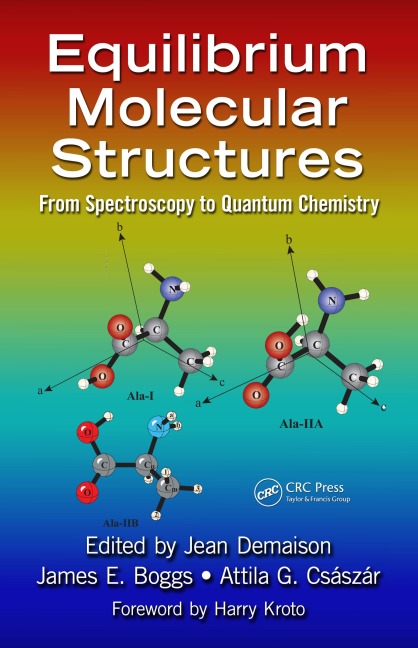
Molecular structure is the most basic information about a substance, determining most of its properties. Determination of accurate structures is hampered in that every method applies its own definition of "structure" and thus results from different sources can yield significantly different results. Sophisticated protocols exist to account for these
Jean Demaison is a former Research Director at CNRS, University of Lille I. The research for his PhD, which he received in 1972, was performed in Freiburg and Nancy in the field of microwave spectroscopy. He was invited to be a Professor at the Universities of Ulm, Louvain-La-Neuve, and Brussels. In 2008, he received the International Barbara Mez-Starck prize for outstanding contribution in the field of structural chemistry. He has published over 300 papers in research journals and contributed to 17 books. Professor Attila G. Császár is the head of the Laboratory of Molecular Spectroscopy at Eötvös University of Budapest, Hungary. He received his PhD in 1985 in theoretical chemistry at the same place. His research interests include computational molecular spectroscopy, structure determinations of small molecules, ab initio thermochemistry, and electronic structure theory. He has published more than 150 papers in these fields, mostly in leading international journals. James E. Boggs is Professor Emeritus at the University of Texas at Austin. His PhD was received from the University of Michigan after working on the Manhattan District Project. He has spent sabbaticals at Harvard, Berkeley, and the University of Oslo. Dr. Boggs has published over 325 papers, mostly on microwave spectroscopy and applications of quantum theory. He organized the first 23 biennial meetings of the Austin Symposium on Molecular Structure. In 2010, he received the International Barbara Mez-Starck prize for outstanding contributions in structural chemistry. He has been chosen as a Fellow of the American Chemical Society.
Quantum Theory of Equilibrium Molecular Structures. The Method of Least Squares.Semiexperimental Equilibrium Structures: Computational Aspects. Spectroscopy of Polyatomic Molecules: Determination of the Rotational Constants. Determination of the Structural Parameters from the Inertial Moments. Determining Equilibrium Structures and Potential Energy Functions for Diatomic Molecules. Other Spectroscopic Sources of Molecular Properties: Intermolecular Complexes as Examples. Structures Averaged over Nuclear Motions. Appendix A: Bibliographies of Equilibrium Structures. Appendix B: Sources for Fundamental Constants, Conversion Factors, and Atomic and Nuclear Masses. Index.
Dieses eBook wird im PDF-Format geliefert und ist mit einem Adobe Kopierschutz (DRM) versehen. Sie können dieses eBook mit allen Geräten lesen, die das PDF-Format und den Adobe Kopierschutz (DRM) unterstützen.
Zum Beispiel mit den folgenden Geräten:
• tolino Reader
Laden Sie das eBook direkt über den Reader-Shop auf dem tolino herunter oder übertragen Sie das eBook auf Ihren tolino mit einer kostenlosen Software wie beispielsweise Adobe Digital Editions.
• Sony Reader & andere eBook Reader
Laden Sie das eBook direkt über den Reader-Shop herunter oder übertragen Sie das eBook mit der kostenlosen Software Sony READER FOR PC/Mac oder Adobe Digital Editions auf ein Standard-Lesegeräte mit epub- und Adobe DRM-Unterstützung.
• Tablets & Smartphones
Möchten Sie dieses eBook auf Ihrem Smartphone oder Tablet lesen, finden Sie hier unsere kostenlose Lese-App für iPhone/iPad und Android Smartphone/Tablets.
• PC & Mac
Lesen Sie das eBook direkt nach dem Herunterladen mit einer kostenlosen Lesesoftware, beispielsweise Adobe Digital Editions, Sony READER FOR PC/Mac oder direkt über Ihre eBook-Bibliothek in Ihrem Konto unter „Meine eBooks“ - „online lesen“.
Schalten Sie das eBook mit Ihrer persönlichen Adobe ID auf bis zu sechs Geräten gleichzeitig frei.
Bitte beachten Sie, dass die Kindle-Geräte das Format nicht unterstützen und dieses eBook somit nicht auf Kindle-Geräten lesbar ist.