Und dann auf "Zum Home-Bildschirm [+]".

Stöbern
genialokal zum Startbildschirm hinzufügen
Installieren Sie die genialokal App auf Ihrem Startbildschirm für einen schnellen Zugriff und eine komfortable Nutzung.
Installieren Sie die genialokal App auf Ihrem Startbildschirm für einen schnellen Zugriff und eine komfortable Nutzung.
Ihr gewünschter Artikel ist in 0 Buchhandlungen vorrätig - wählen Sie hier eine Buchhandlung in Ihrer Nähe aus:

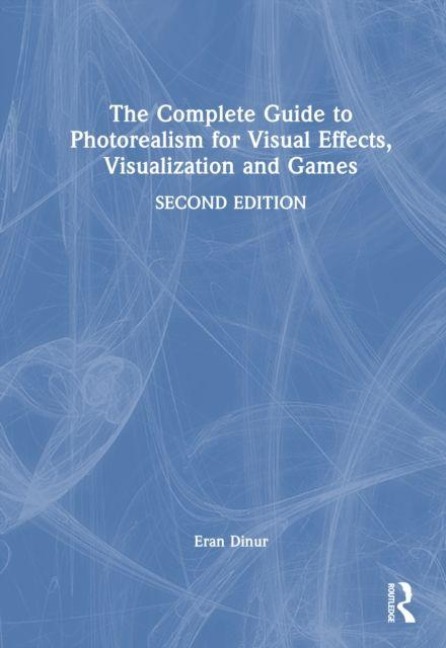
This new edition offers the most up-to-date and comprehensive guide to accomplishing and perfecting a photorealistic look in digital content across visual effects, architectural and product visualization, and games. Emmy award-winning VFX supervisor Eran Dinur offers readers a deeper understanding of the complex interplay of light, surfaces, atmospherics, and optical effects, and then discusses techniques to achieve this complexity in the digital realm, covering 3D, 2D, and generative AI methodologies. In addition, the book features artwork, case studies, and interviews with leading artists in the fields of VFX, visualization, and games. Exploring color, integration, light and surface behavior, atmospherics, shading, texturing, physically-based rendering, procedural modeling, compositing, matte painting, lens/camera effects, and much more, Dinur offers a compelling, elegant guide to achieving photorealism in digital media and creating imagery that is seamless from real footage. In this second edition, the book explores generative AI as a tool for producing photoreal content. It focuses on various workflows and techniques for controlling the generative process and guiding AI models toward the desired results. The book's broad perspective makes this detailed guide suitable for VFX, visualization, and game artists and students, as well as directors, architects, designers, and anyone who strives to achieve convincing, believable visuals in digital media.
Eran Dinur is an Emmy and VES award-winning VFX supervisor, artist, and author of The Filmmaker's Guide to Visual Effects (2024). His film and TV work includes Marty Supreme, The Trial of the Chicago 7, Hereditary, The Greatest Showman, Uncut Gems, The Wolf of Wall Street, Boardwalk Empire, Star Trek, and Iron Man. He is an adjunct professor at the School of Visual Arts and the author of several popular VFX courses at fxphd.com.
Preface to the Second edition Acknowledgments Introduction PART 1: CORE CONCEPTS Chapter 1: Reality and photorealism Human vision and cameras The uncanny valley The detail conundrum The role of imperfections The reality of the unreal Image quality and photorealism 2D and 3D workflows Chapter 2: Photorealism in digital media Visual effects Games Visualization Chapter 3: Color The six-layer approach Thinking additive Hue, saturation, and brightness in RGB Color operations Bit depth and dynamic range The low end The high end PART 2: THE REAL WORLD Chapter 4: Light essentials Light as waves Light as particles Light decay Direct and indirect illumination What is "ambient light"? Chapter 5: Light interaction Absorption Reflection and scattering Diffuse reflection Transmission and refraction Albedo Chapter 6: Daylight The sun The atmosphere Reflection and absorption Atmospheric scattering Aerial perspective Chapter 7: Nighttime and artificial lighting Natural nighttime light Artificial lighting Chapter 8: Shadows Shadow softness Shadow color Overlapping shadows Nested shadows Contact shadows Chapter 9: Basic material properties Dielectric materials Metals Chapter 10: Lens and camera characteristics Defocus Lens distortion Chromatic aberration Lens flares Motion blur Grain PART 3: THE CG WORLD Chapter 11: Rendering and lighting From scanline to path tracing Traditional light emitters Contemporary light emitters Essential strategies for PBR lighting Chapter 12: Shading A brief overview of shader evolution The BRDF Shading model Other common shaders Chapter 13: Texturing PBR texturing Texture generation workflows Image textures Shooting and prepping photos for texturing Procedural textures Combining workflows Chapter 14: Modeling Modeling for lighting Procedural modeling PART 4: THE 2D WORLD Chapter 15: Integrating 2D elements Color matching Edges: problems and solutions Chapter 16: Integrating CG elements Compositing with render passes Deep compositing Improving CG in comp Chapter 17: Lighting in 2D Relighting with color The challenge of reflections Creating shadows Atmospheric Depth Chapter 18: Lens and camera effects Defocus Lens distortion and chromatic aberration Lens flares Motion blur Grain Chapter 19: Photorealism with generative AI Generative AI for Video versus stills Oh, the errors it makes... A note about Stable Diffusion Epilogue