Und dann auf "Zum Home-Bildschirm [+]".

Stöbern
genialokal zum Startbildschirm hinzufügen
Installieren Sie die genialokal App auf Ihrem Startbildschirm für einen schnellen Zugriff und eine komfortable Nutzung.
Installieren Sie die genialokal App auf Ihrem Startbildschirm für einen schnellen Zugriff und eine komfortable Nutzung.
Ihr gewünschter Artikel ist in 0 Buchhandlungen vorrätig - wählen Sie hier eine Buchhandlung in Ihrer Nähe aus:

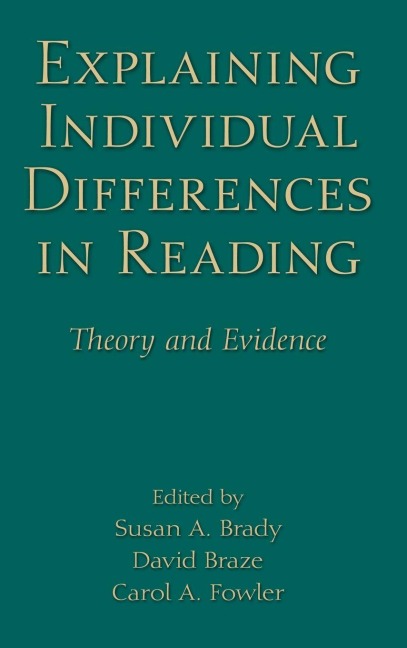
This volume focuses on a wide array of current research topics, examining the scope, limits and implications of phonological theory in research into reading development and reading disabilities. It provides an essential resource for researchers interested in the cognitive foundations of reading and literacy and those working in reading and learning disabilities.
Susan Brady is a Professor of Psychology at the University of Rhode Island. Her basic research focuses primarily on phonological factors in reading ability. In addition, in applied research she investigates the ingredients, such as teacher knowledge, necessary for improving reading achievement in the primary grades. David Braze, a linguist, concentrates his research on the cognitive bases underlying ability to comprehend speech and print. He employs online methods, including monitoring eye-movements during reading, to investigate bottlenecks in comprehension. Likewise, he explores how characteristics of text interact with individual differences in cognitive factors to impact reading comprehension. Carol Fowler is a Professor of Psychology at University of Connecticut. Her research includes an emphasis on the relation between speech production and perception, and the implications of that relation for phonological theory. One aspect of that research explores the nature of the phonological structures accessed by skilled readers of a variety of writing systems. The three editors are all Senior Scientists at Haskins Laboratories in New Haven, Connecticut.
Foreword by William Tunmer. Preface. Part 1. Theoretical Foundations: Phonology and Reading. C.A. Fowler, How Theories of Phonology May Enhance Understanding of the Role of Phonology in Reading Development and Reading Disability. Part 2. Phonological Factors in Learning to Read. D. Braze, G.W. McRoberts, C. McDonough, Early Precursors of Reading-Relevant Phonological Skills. D.L. Share, On the Role of Phonology in Reading Acquisition: The Self-Teaching Hypothesis. S.A. Brady, Efficacy of Phonics Teaching for Reading Outcomes: Indications from Post NRP Research. N. Patton Terry, H. Scarborough, The Phonological Hypothesis as a Valuable Framework for Studying the Relation of Dialect Variation to Early Reading Skills. Part 3. Sources of Individual Differences Beyond Phonological Deficits . M.J. Snowling, Beyond Phonological Deficits: Sources of Individual Differences in Reading Disability. H.W. Catts, S. Adlof, Phonological and Other Language Deficits Associated with Dyslexia. C. Perfetti, Phonology is Critical in Reading -- But a Phonological Deficit is Not the Only Source of Low Reading Skill. Part 4. Unraveling the Biology of Reading and Reading Differences. B. Byrne, Evaluating the Role of Phonological Factors in Early Literacy Development: Insights from Experimental and Behavior-Genetic Studies. R. Olson, Genetic and Environmental Influences on Phonological Abilities and Reading Achievement. J.J. Diehl, S.J. Frost, W.E. Mencl, K.R. Pugh, Neuroimaging and the Phonological Deficit Hypothesis.