Und dann auf "Zum Home-Bildschirm [+]".

Stöbern
genialokal zum Startbildschirm hinzufügen
Installieren Sie die genialokal App auf Ihrem Startbildschirm für einen schnellen Zugriff und eine komfortable Nutzung.
Installieren Sie die genialokal App auf Ihrem Startbildschirm für einen schnellen Zugriff und eine komfortable Nutzung.



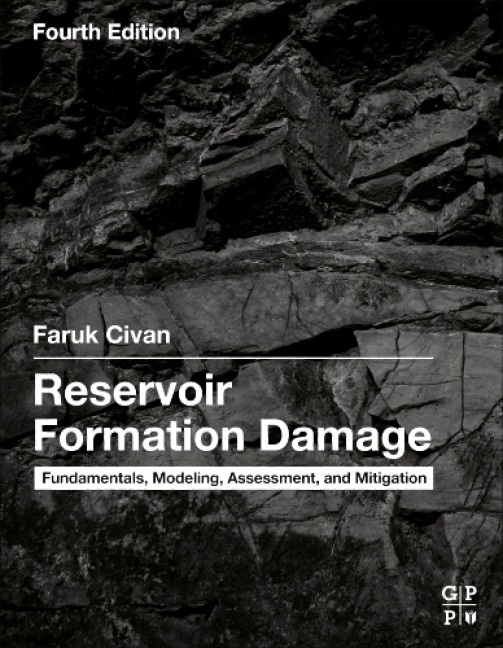
Reservoir Formation Damage: Fundamentals, Modeling, Assessment, and Mitigation, Fourth Edition gives engineers a structured layout to predict and improve productivity, providing strategies, recent developments and methods for more successful operations. Updated with many new chapters, including completion damage effects for fractured wells, flow assurance, and fluid damage effects, the book will help engineers better tackle today's assets. Additional new chapters include bacterial induced formation damage, new aspects of chemically induced formation damage, and new field application designs and cost assessments for measures and strategies. Additional procedures for unconventional reservoirs get the engineer up to date. Structured to progress through your career, Reservoir Formation Damage, Fourth Edition continues to deliver a trusted source for both petroleum and reservoir engineers.
- Covers new applications through case studies and test questions
- Bridges theory and practice, with detailed illustrations and a structured progression of chapter topics
- Considers environmental aspects, with new content on water control, conformance and produced water reinjection
Faruk Civan is the Martin G. Miller Chair Professor of the Mewbourne School of Petroleum and Geological Engineering at the University of Oklahoma in Norman. He formerly held the Brian and Sandra O'Brien Presidential and Alumni Chair Professorships. Previously, he worked in the Chemical Engineering department at the Technical University of Istanbul, Turkey. Dr. Civan received an Advanced Engineering Degree from the Technical University of Istanbul, Turkey, a M.S. degree from the University of Texas at Austin, Texas, and a Ph.D. degree from the University of Oklahoma, Norman, Oklahoma. All of his degrees are in chemical engineering.Dr. Civan specializes in petrophysics and reservoir characterization; fossil and sustainable energy resources development; carbon sequestration; unconventional gas and condensate reservoirs; reservoir and well/pipeline hydraulics and flow assurance; formation and well damage modeling, diagnosis, assessment, and mitigation; reservoir and well analyses, modeling, and simulation; natural gas engineering, measurement, processing, hydrates, transportation, and storage; carbon dioxide sequestration; coalbed methane production; improved reservoir recovery techniques; corrosion protection in oil and gas wells; filtration and separation techniques; oil and gas processing, transportation, and storage; multiphase transport phenomena in porous media; environmental pollution assessment, prevention, and control; mathematical modeling and simulation, and solving differential equations by numerical methods including by the quadrature, cubature, and finite-analytic methods.Dr. Civan is the author of two books, has published more than 330 technical articles in journals, edited books, handbooks, encyclopedia, and conference proceedings, and presented worldwide more than 125 invited seminars and/or lectures at various technical meetings, companies, and universities. He teaches short industry courses on a number of topics worldwide. Additionally, he has written numerous reports on his funded research projects. Dr. Civan's publications have been cited frequently in various publications, as reported by the Science Author Citation Index.He is a member of the Society of Petroleum Engineers and the American Institute of Chemical Engineers. and a member of the editorial boards of several journals. He has served on numerous petroleum and chemical engineering, and other related conferences and meetings in various capacities, including as committee chairman and member, session organizer, chair or co-chair, and instructor. Civan has received 21 honors and awards, including five distinguished lectureship awards and the 2003 SPE Distinguished Achievement Award for Petroleum Engineering Faculty and the 2014 SPE Reservoir Description and Dynamics Award.
1. Overview of Formation DamagePart I. Characterization of Reservoir Rock for Formation Damage. Reservoir Formations, Description and Characterization, Damage Potential, and Petrographics2. Description and Characterization of Oil and Gas Reservoirs for Formation Damage Potential3. Petrographical Characteristics of Petroleum-Bearing FormationsPart II. Characterization of the Porous Media Processes for Formation Damage. Porosity and Permeability, Mineralogy Sensitivity, Petrophysics, Rate Processes, Rock-Fluid-Particle Interactions, and Accountability of Phases and Species4. Alteration of the Porosity and Permeability of Geological Formations- Basic and Advanced Relationships5. Mineral Sensitivity of Petroleum-Bearing Formations6. Petrophysical Alterations- Fluid Disposition, Distribution, and Entrapment, Flow Functions, and Petrophysical Parameters of Geological Formations7. Phase Equilibria, Solubility, and Precipitation in Porous Media8.Particulate Processes in Porous Media9. Multi-Phase and Multi-Species Transport in Porous MediaPart III. Formation Damage by Particulate Processes. Single- and Multi-Phase Fines Migration, Clay Swelling, Filtrate and Particulate Invasion, Filter Cake, Stress Sensitivity, and Sanding10. Single-Phase Formation Damage by Fines Migration and Clay Swelling11. Multi-Phase Formation Damage by Fines Migration12. Cake Filtration: Mechanism, Parameters and Modeling13. Injectivity of the Waterflooding Wells14. Drilling-Induced Near-Wellbore Formation Damage: Drilling Mud Filtrate and Solids Invasion and Mud cake Formation15. Reservoir Stress-Induced Formation Damage: Formation Compaction, Subsidence, Sanding Tendency, Sand Migration, Prediction and Control, and Gravel-Pack DamagePart IV. Formation Damage by Inorganic and Organic Precipitation Processes: Chemical Reactions, Saturation Phenomena, Dissolution, Precipitation, and Deposition16. Inorganic Scaling and Geochemical Formation Damage17. Formation Damage by Organic DepositionPart V. Laboratory Assessment of the Formation Damage Potential. Instrumental Techniques, Testing, Analysis, and Interpretation18. Instrumental and Laboratory Techniques for Characterization of Reservoir Rock19. Laboratory Evaluation of Formation DamagePart VI. Field Diagnosis and Mitigation of Formation Damage. Measurement, Assessment, Control, and Remediation20. Field Diagnosis and Measurement of Formation Damage21. Determination of Formation- and Pseudo-Damage from Well Performance- Identification, Characterization, and Evaluation22. Formation Damage Control and Remediation- Conventional Techniques and Remedial Treatments for Common Problems23. Reservoir Formation Damage Abatement- Guidelines, Methodology, Preventive Maintenance, and Remediation TreatmentsPart VII. Modeling and Simulation of Formation Damage- Prediction of the Near-Wellbore Formation Damage and the Combined Effects of Fluid, Completion, and Formation Damages on Well Performance by Various Modeling and Simulation Approaches and Examples24. Near-Wellbore Formation Damage by Inorganic and Organic Precipitates Deposition25.Interactions and Coupling of Reservoir Fluid, Completion, and Formation Damages26. Formation Damage Simulator Development27. Model Assisted Analysis and Interpretation of Laboratory and Field Tests