Und dann auf "Zum Home-Bildschirm [+]".

Stöbern
genialokal zum Startbildschirm hinzufügen
Installieren Sie die genialokal App auf Ihrem Startbildschirm für einen schnellen Zugriff und eine komfortable Nutzung.
Installieren Sie die genialokal App auf Ihrem Startbildschirm für einen schnellen Zugriff und eine komfortable Nutzung.
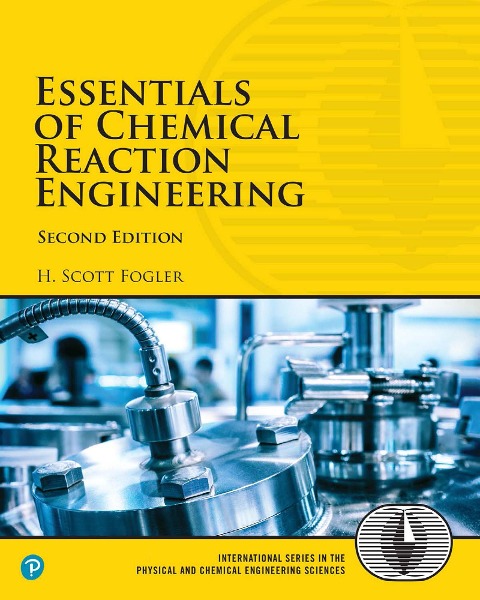
Today's Definitive, Undergraduate-Level Introduction to Chemical Reaction Engineering Problem-Solving For 30 years, H. Scott Fogler's Elements of Chemical Reaction Engineering has been the #1 selling text for courses in chemical reaction engineering worldwide. Now, in Essentials of Chemical Reaction Engineering, Second Edition, Fogler has distilled this classic into a modern, introductory-level guide specifically for undergraduates. This is the ideal resource for today's students: learners who demand instantaneous access to information and want to enjoy learning as they deepen their critical thinking and creative problem-solving skills. Fogler successfully integrates text, visuals, and computer simulations, and links theory to practice through many relevant examples. This updated second edition covers mole balances, conversion and reactor sizing, rate laws and stoichiometry, isothermal reactor design, rate data collection/analysis, multiple reactions, reaction mechanisms, pathways, bioreactions and bioreactors, catalysis, catalytic reactors, nonisothermal reactor designs, and more. Its multiple improvements include a new discussion of activation energy, molecular simulation, and stochastic modeling, and a significantly revamped chapter on heat effects in chemical reactors. To promote the transfer of key skills to real-life settings, Fogler presents three styles of problems: - Straightforward problems that reinforce the principles of chemical reaction engineering - Living Example Problems (LEPs) that allow students to rapidly explore the issues and look for optimal solutions - Open-ended problems that encourage students to use inquiry-based learning to practice creative problem-solving skills About the Web Site (umich.edu/~elements/5e/index.html) The companion Web site offers extensive enrichment opportunities and additional content, including - Complete PowerPoint slides for lecture notes for chemical reaction engineering classes - Links to additional software, including Polymath, MATLAB, Wolfram Mathematica, AspenTech, and COMSOL Multiphysics - Interactive learning resources linked to each chapter, including Learning Objectives, Summary Notes, Web Modules, Interactive Computer Games, Computer Simulations and Experiments, Solved Problems, FAQs, and links to LearnChemE - Living Example Problems that provide more than 75 interactive simulations, allowing students to explore the examples and ask "what-if " questions - Professional Reference Shelf, containing advanced content on reactors, weighted least squares, experimental planning, laboratory reactors, pharmacokinetics, wire gauze reactors, trickle bed reactors, fluidized bed reactors, CVD boat reactors, detailed explanations of key derivations, and more - Problem-solving strategies and insights on creative and critical thinking Register your product at informit.com/register for convenient access to downloads, updates, and/or corrections as they become available.
H. Scott Fogler is the Ame and Catherine Vennema Professor of Chemical Engineering and the Arthur F. Thurnau Professor at the University of Michigan. He has been research advisor to forty-five Ph.D. students, and has more than two hundred thirty-five refereed publications. He was 2009 President of the American Institute of Chemical Engineers. Fogler has chaired ASEE's Chemical Engineering Division, served as director of the American Institute of Chemical Engineers, and earned the Warren K. Lewis Award from AIChE for contributions to chemical engineering education. He has received the Chemical Manufacturers Association's National Catalyst Award and the 2010 Malcom E. Pruitt Award from the Council for Chemical Research.
Preface xv About the Author xxxi Chapter 1: Mole Balances 1 1.1 The Rate of Reaction, -rA 4 1.2 The General Mole Balance Equation 8 1.3 Batch Reactors (BRs) 10 1.4 Continuous-Flow Reactors 12 1.5 Industrial Reactors 23 Chapter 2: Conversiona and Reactor Sizing 33 2.1 Definition of Conversion 34 2.2 Batch Reactor Design Equations 34 2.3 Design Equations for Flow Reactors 37 2.4 Sizing Continuous-Flow Reactors 40 2.5 Reactors in Series 49 2.6 Some Further Definitions 60 Chapter 3: Rate Laws 71 3.1 Basic Definitions 72 3.2 The Rate Law 74 3.3 The Reaction Rate Constant 85 3.4 Molecular Simulations 95 3.5 Present Status of Our Approach to Reactor Sizing and Design 99 Chapter 4: Stoichiometry 111 4.1 Batch Systems 113 4.2 Flow Systems 119 4.3 Reversible Reactions and Equilibrium Conversion 132 Chapter 5: Isothermal Reactor Design: Conversion 147 5.1 Design Structure for Isothermal Reactors 148 5.2 Batch Reactors (BRs) 152 5.3 Continuous-Stirred Tank Reactors (CSTRs) 160 5.4 Tubular Reactors 170 5.5 Pressure Drop in Reactors 177 5.6 Synthesizing the Design of a Chemical Plant 199 Chapter 6: Isothermal Reactor Design: Moles and Molar Flow Rates 217 6.1 The Molar Flow Rate Balance Algorithm 218 6.2 Mole Balances on CSTRs, PFRs, PBRs, and Batch Reactors 218 6.3 Application of the PFR Molar Flow Rate Algorithm to a Microreactor 222 6.4 Membrane Reactors 227 6.5 Unsteady-State Operation of Stirred Reactors 236 6.6 Semibatch Reactors 237 Chapter 7: Collection and Analysis of Rate Data 255 7.1 The Algorithm for Data Analysis 256 7.2 Determining the Reaction Order for Each of Two Reactants Using the Method of Excess 258 7.3 Integral Method 259 7.4 Differential Method of Analysis 263 7.5 Nonlinear Regression 271 7.6 Reaction-Rate Data from Differential Reactors 276 7.7 Experimental Planning 283 Chapter 8: Multiple Reactions 293 8.1 Definitions 294 8.2 Algorithm for Multiple Reactions 297 8.3 Parallel Reactions 300 8.4 Reactions in Series 309 8.5 Complex Reactions 319 8.6 Membrane Reactors to Improve Selectivity in Multiple Reactions 327 8.7 Sorting It All Out 332 8.8 The Fun Part 332 Chapter 9: Reaction Mechanisms, Pathways, Bioreactions, and Bioreactors 349 9.1 Active Intermediates and Nonelementary Rate Laws 350 9.2 Enzymatic Reaction Fundamentals 359 9.3 Inhibition of Enzyme Reactions 372 9.4 Bioreactors and Biosynthesis 380 Chapter 10: Catalysis and Catalytic Reactors 419 10.1 Catalysts 419 10.2 Steps in a Catalytic Reaction 425 10.3 Synthesizing a Rate Law, Mechanism, and Rate-Limiting Step 441 10.4 Heterogeneous Data Analysis for Reactor Design 457 10.5 Reaction Engineering in Microelectronic Fabrication 467 10.6 Model Discrimination 472 10.7 Catalyst Deactivation 475 10.8 Reactors That Can Be Used to Help Offset Catalyst Decay 485 Chapter 11: Nonisothermal Reactor Design-The Steady-State Energy Balance and Adiabatic PFR Applications 515 11.1 Rationale 516 11.2 The Energy Balance 517 11.3 The User-Friendly Energy Balance Equations 525 11.4 Adiabatic Operation 531 11.5 Adiabatic Equilibrium Conversion 541 11.6 Reactor Staging with Interstage Cooling or Heating 546 11.7 Optimum Feed Temperature 550 Chapter 12: Steady-State Nonisothermal Reactor Design-Flow Reactors with Heat Exchange 565 12.1 Steady-State Tubular Reactor with Heat Exchange 566 12.2 Balance on the Heat-Transfer Fluid 569 12.3 Algorithm for PFR/PBR Design with Heat Effects 572 12.4 CSTR with Heat Effects 592 12.5 Multiple Steady States (MSS) 602 12.6 Nonisothermal Multiple Chemical Reactions 609 12.7 Radial and Axial Variations in a Tubular Reactor 624 12.8 Safety 632 Chapter 13: Unsteady-State Nonisothermal Reactor Design 661 13.1 The Unsteady-State Energy Balance 662 13.2 Energy Balance on Batch Reactors (BRs) 664 13.3 Batch and Semibatch Reactors with a Heat Exchanger 679 13.4 Nonisothermal Multiple Reactions 690 Appendix A: Numerical Techniques 715 A.1 Useful Integrals in Reactor Design 715 A.2 Equal-Area Graphical Differentiation 716 A.3 Solutions to Differential Equations 718 A.4 Numerical Evaluation of Integrals 719 A.5 Semilog Graphs 721 A.6 Software Packages 721 Appendix B: Ideal Gas Constant and Conversion Factors 723 Appendix C: Thermodynamic Relationships Involving the Equilibrium Constant 727 Appendix D: Software Packages 733 D.1 Polymath 733 D.2 Wolfram 735 D.3 MATLAB 735 D.4 Excel 736 D.5 COMSOL (http://www.umich.edu/~elements/5e/12chap/comsol.html) 736 D.6 Aspen 737 D.7 Visual Encyclopedia of Equipment-Reactors Section 738 D.8 Reactor Lab 738 Appendix E: Rate-Law Data 739 Appendix F: Nomenclature 741 Appendix G: Open-Ended Problems 745 G.1 Design of Reaction Engineering Experiment 745 G.2 Effective Lubricant Design 745 G.3 Peach Bottom Nuclear Reactor 745 G.4 Underground Wet Oxidation 746 G.5 Hydrodesulfurization Reactor Design 746 G.6 Continuous Bioprocessing 746 G.7 Methanol Synthesis 746 G.8 Cajun Seafood Gumbo 746 G.9 Alcohol Metabolism 747 G.10 Methanol Poisoning 748 Appendix H: Use of Computational Chemistry Software Packages 749 H.1 Computational Chemical Engineering 749 Appendix I: How to Use the CRE Web Resources 751 I.1 CRE Web Resources Components 751 I.2 How the Web Can Help Your Learning Style 754 I.3 Navigation 755 Index 757 Web Chapters (available on companion Web site) Chapter 14: Mass Transfer Limitations in Reacting Systems Chapter 15: Diffusion and Reaction Chapter 16: Residence Time Distributions of Chemical Reactors Chapter 17: Predicting Conversion Directly from the Residence Time Distribution Chapter 18: Models for Nonideal Reactors