Und dann auf "Zum Home-Bildschirm [+]".

Stöbern
genialokal zum Startbildschirm hinzufügen
Installieren Sie die genialokal App auf Ihrem Startbildschirm für einen schnellen Zugriff und eine komfortable Nutzung.
Installieren Sie die genialokal App auf Ihrem Startbildschirm für einen schnellen Zugriff und eine komfortable Nutzung.
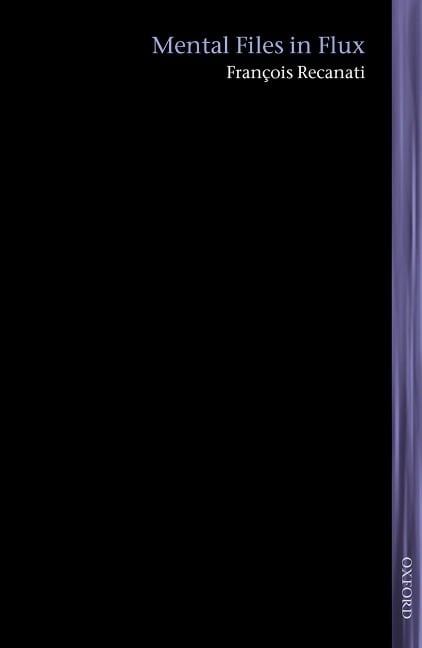
François Recanati has pioneered the 'mental file' framework for thinking about concepts and how we refer to the world in thought and language. Mental files are based on 'epistemically rewarding' relations to objects in the environment. Standing in such relations to objects puts the subject in a position to gain information regarding them. The information thus gained goes into the file based on the relevant relation. Files do not merely store information about objects, however, they refer to them and serve as singular terms in the language of thought, with a relational (nondescriptivist) semantics. In this framework, the reference of linguistic expressions is inherited from that of the files we associate with them. Crucially, files also play the role of 'modes of presentation'. They are used to account for cognitive significance phenomena illustrated by so-called 'Frege cases'. In this new volume, Recanati considers what happens to mental files in a dynamic setting. Mental files are construed as both continuants (dynamic files) and as time-slices thereof (static files). Dynamic files are needed to account for confusion, recognition and tracking. Mental Files in Flux considers what happens to the relation of coreference de jure, central to the functional characterization of files, when one adopts a dynamic perspective. Only a weak form of coreference de jure is said to hold between stages of the same dynamic file. The second part of the book argues that communication involves interpersonal dynamic files. Special attention is paid to the communication of indexical thoughts (de se contents) and communication using proper names.
François Recanati is a philosopher of language and mind based in Paris. His published works include Meaning and Force (CUP 1988), Direct Reference : From Language to Thought (Blackwell 1993), Oratio Obliqua, Oratio Recta (MIT Press/Bradford Books 2000), Literal Meaning (CUP 2004), Perspectival Thought (OUP 2007), Truth-Conditional Pragmatics (OUP 2010) and Mental Files (OUP 2012). He is a Foreign Honorary Member of the American Academy of Arts and Sciences, an honorary doctor of Stockholm University, and a recipient of the CNRS silver medal.
- Part 1: Coreference de jure and the flow of information - 1: Coreference de jure in the mental file framework - 2: Factivity, transparency, and weak coreference de jure - 3: Transitivity and strong coreference de jure - 4: Coreference de jure and sentence grammar - 5: Cognitive dynamics - Part 2: Interpersonal coordination of mental files - 6: Indexical thought - 7: Communication across contexts - 8: Dynamic files in communication - Appendix: Communication with centred contents: a survey
Dieses eBook wird im PDF-Format geliefert und ist mit einem Adobe Kopierschutz (DRM) versehen. Sie können dieses eBook mit allen Geräten lesen, die das PDF-Format und den Adobe Kopierschutz (DRM) unterstützen.
Zum Beispiel mit den folgenden Geräten:
• tolino Reader
Laden Sie das eBook direkt über den Reader-Shop auf dem tolino herunter oder übertragen Sie das eBook auf Ihren tolino mit einer kostenlosen Software wie beispielsweise Adobe Digital Editions.
• Sony Reader & andere eBook Reader
Laden Sie das eBook direkt über den Reader-Shop herunter oder übertragen Sie das eBook mit der kostenlosen Software Sony READER FOR PC/Mac oder Adobe Digital Editions auf ein Standard-Lesegeräte mit epub- und Adobe DRM-Unterstützung.
• Tablets & Smartphones
Möchten Sie dieses eBook auf Ihrem Smartphone oder Tablet lesen, finden Sie hier unsere kostenlose Lese-App für iPhone/iPad und Android Smartphone/Tablets.
• PC & Mac
Lesen Sie das eBook direkt nach dem Herunterladen mit einer kostenlosen Lesesoftware, beispielsweise Adobe Digital Editions, Sony READER FOR PC/Mac oder direkt über Ihre eBook-Bibliothek in Ihrem Konto unter „Meine eBooks“ - „online lesen“.
Schalten Sie das eBook mit Ihrer persönlichen Adobe ID auf bis zu sechs Geräten gleichzeitig frei.
Bitte beachten Sie, dass die Kindle-Geräte das Format nicht unterstützen und dieses eBook somit nicht auf Kindle-Geräten lesbar ist.