Und dann auf "Zum Home-Bildschirm [+]".

Stöbern
genialokal zum Startbildschirm hinzufügen
Installieren Sie die genialokal App auf Ihrem Startbildschirm für einen schnellen Zugriff und eine komfortable Nutzung.
Installieren Sie die genialokal App auf Ihrem Startbildschirm für einen schnellen Zugriff und eine komfortable Nutzung.
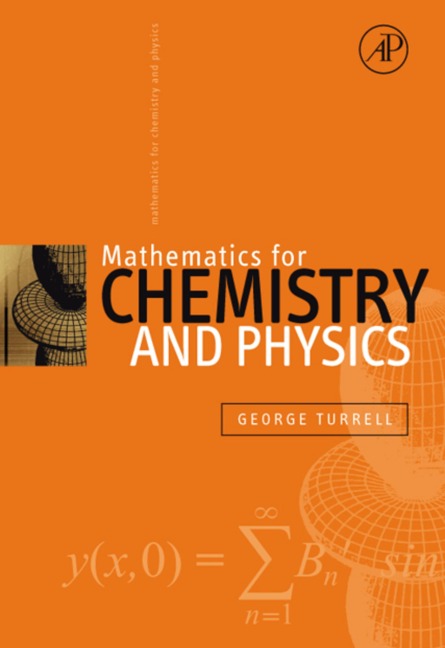
Chemistry and physics share a common mathematical foundation. From elementary calculus to vector analysis and group theory, Mathematics for Chemistry and Physics aims to provide a comprehensive reference for students and researchers pursuing these scientific fields. The book is based on the authors many classroom experience. Designed as a reference text, Mathematics for Chemistry and Physics will prove beneficial for students at all university levels in chemistry, physics, applied mathematics, and theoretical biology. Although this book is not computer-based, many references to current applications are included, providing the background to what goes on "behind the screen" in computer experiments.
Preface1 Variables and Functions 1.1 Introduction 1.2 Functions 1.3 Classification and Properties of Functions 1.4 Exponential and Logarithmic Functions 1.5 Applications of Exponential and Logarithmic Functions 1.6 Complex Numbers 1.7 Circular Trigonometric Functions 1.8 Hyperbolic Functions Problems2 Limits, Derivatives and Series 2.1 Definition of a Limit 2.2 Continuity 2.3 The Derivative 2.4 Higher Derivatives 2.5 Implicit and Parametric Relations 2.6 The Extrema of a Function and Its Critical Points 2.7 The Differential 2.8 The Mean-Value Theorem and l'Hospital's Rule 2.9 Taylor's Series 2.10 Binomial Expansion 2.11 Tests of Series Convergence 2.12 Functions of Several Variables 2.13 Exact Differentials Problems3 Integration 3.1 The Indefinite Integral 3.2 Integration Formulas 3.3 Methods of Integration 3.3.1 Integration by Substitution 3.3.2 Integration by Parts 3.3.3 Integration of Partial Fractions 3.4 Definite Integrals 3.4.1 Definition 3.4.2 Plane Area 3.4.3 Line Integrals 3.4.4 Fido and his Master 3.4.5 The Gaussian and Its Moments 3.5 Integrating Factors 3.6 Tables of Integrals Problems4 Vector Analysis 4.1 Introduction 4.2 Vector Addition 4.3 Scalar Product 4.4 Vector Product 4.5 Triple Products 4.6 Reciprocal Bases 4.7 Differentiation of Vectors 4.8 Scalar and Vector Fields 4.9 The Gradient 4.10 The Divergence 4.11 The Curl or Rotation 4.12 The Laplacian 4.13 Maxwell's Equations 4.14 Line Integrals 4.15 Curvilinear Coordinates Problems5 Ordinary Differential Equations 5.1 First-Order Differential Equations 5.2 Second-Order Differential Equations 5.2.1 Series Solution 5.2.2 The Classical Harmonic Oscillator 5.2.3 The Damped Oscillator 5.3 The Differential Operator 5.3.1 Harmonic Oscillator 5.3.2 Inhomogeneous Equations 5.3.3 Forced Vibrations 5.4 Applications in Quantum Mechanics 5.4.1 The Particle in a Box 5.4.2 Symmetric Box 5.4.3 Rectangular Barrier: The Tunnel Effect 5.4.4 The Harmonic Oscillator in Quantum Mechanics 5.5 Special Functions 5.5.1 Hermite Polynomials 5.5.2 Associated Legendre Polynomials 5.5.3 The Associated Laguerre Polynomials 5.5.4 The Gamma Function 5.5.5 Bessel Functions 5.5.6 Mathieu Functions 5.5.7 The Hypergeometric Functions Problems6 Partial Differential Equations 6.1 The Vibrating String 6.1.1 The Wave Equation 6.1.2 Separation of Variables 6.1.3 Boundary Conditions 6.1.4 Initial Conditions 6.2 The Three-Dimensional Harmonic Oscillator 6.2.1 Quantum-Mechanical Applications 6.2.2 Degeneracy 6.3 The Two-Body Problem 6.3.1 Classical Mechanics 6.3.2 Quantum Mechanics 6.4 Central Forces 6.4.1 Spherical Coordinates 6.4.2 Spherical Harmonics 6.5 The Diatomic Molecule 6.5.1 The Rigid Rotator 6.5.2 The Vibrating Rotator 6.5.3 Centrifugal Forces 6.6 The Hydrogen Atom 6.6.1 Energy 6.6.2 Wavefunctions and The Probability Density 6.7 Binary Collisions 6.7.1 Conservation of Angular Momentum 6.7.2 Conservation of Energy 6.7.3 Interaction Potential: LJ (6-12) 6.7.4 Angle of Deflection 6.7.5 Quantum Mechanical Description: The Phase Shift Problems7 Operators and Matrices 7.1 The Algebra of Operators 7.2 Hermitian Operators and Their Eigenvalues 7.3 Matrices 7.4 The Determinant 7.5 Properties of Determinants 7.6 Jacobians 7.7 Vectors and Matrices 7.8 Linear Equations 7.9 Partitioning of Matrices 7.