Und dann auf "Zum Home-Bildschirm [+]".

Stöbern
genialokal zum Startbildschirm hinzufügen
Installieren Sie die genialokal App auf Ihrem Startbildschirm für einen schnellen Zugriff und eine komfortable Nutzung.
Installieren Sie die genialokal App auf Ihrem Startbildschirm für einen schnellen Zugriff und eine komfortable Nutzung.
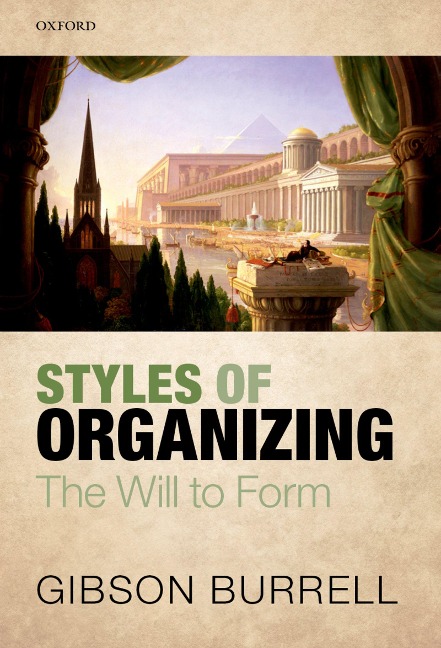
In this book, leading organization theorist Gibson Burrell presents a provocative and challenging approach to the study of organizations, aiming to move beyond the two-dimensionality of much organizational thinking and present more complex 3-D models, which allow for the 'intractions' of apparently disparate perspectives. The book aims to illuminate organization theory by discussing its interrelationship with key features of economics, architecture, aesthetics, design of the built environment, and associated artwork. He argues that by their shared 'definitions', these areas of social science and the humanities are struggling with the same issue - 'the will to form'.
The author suggests that, whilst there are a huge number of possibilities for the process of organizing, the constraints of the human body, our cognitive limitations in space and time, and our relationship to nature, mean that these are necessarily limited to an 'envelope' of possibilities. He then outlines the basic parameters of the 'design envelope', analysing it through discussion of 'styles', and examines the hidden assumptions of these styles with regards the origins and potentialities of human knowledge. Burrell argues that the envelope of organizational, politico-economic, and architectural design possibilities may be seen as a cube, thus taking forward the geometrical notions of 'lines' of fight, 'points' of difference, and 'planes' of agreement to discuss the huge range of, and massive constraints upon, human organizing that are reflected in the 'will to form'. Key differences in assumptions demarcate distinct 'styles of organizing' which every reader possesses - whether they are aware of them or not.
Gibson Burrell is Professor of Organization Theory at Leicester and was Head of the School of Management from 2002-7. He was elected an Academician for the Social Sciences (AcSS) in 2005. Previously at the Universities of Essex, Warwick, and Lancaster, in each of which he undertook a number of administrative roles, he now teaches critical management perspectives at undergraduate and postgraduate levels. He has been a Visiting Fellow or Visiting Professor at Universities in Australia, Poland, Sweden, the UK and the USA. His Sociological Paradigms and Organizational Analysis has been a seminal text for organization studies students for three decades.
- 1: Introduction - 2: The Terror of Nothingness and the Rise of Representations - 3: The Styling of Styles - 4: Geometry in the Organization of Style - 5: The Design Envelope - 6: Three Dimensions, Eight Points, and Six Planes - 7: Lines of Fight in the Built Environment - 8: Lines of Fight in Organizing - 9: Points of Difference in Aesthetics (and Politics) - 10: Points of Difference in Organizing Ourselves - 11: Planes of Agreement in Architecture - 12: Planes of Agreement in Organization Theory - 13: Conclusions: The Face of the Other
Dieses eBook wird im PDF-Format geliefert und ist mit einem Adobe Kopierschutz (DRM) versehen. Sie können dieses eBook mit allen Geräten lesen, die das PDF-Format und den Adobe Kopierschutz (DRM) unterstützen.
Zum Beispiel mit den folgenden Geräten:
• tolino Reader
Laden Sie das eBook direkt über den Reader-Shop auf dem tolino herunter oder übertragen Sie das eBook auf Ihren tolino mit einer kostenlosen Software wie beispielsweise Adobe Digital Editions.
• Sony Reader & andere eBook Reader
Laden Sie das eBook direkt über den Reader-Shop herunter oder übertragen Sie das eBook mit der kostenlosen Software Sony READER FOR PC/Mac oder Adobe Digital Editions auf ein Standard-Lesegeräte mit epub- und Adobe DRM-Unterstützung.
• Tablets & Smartphones
Möchten Sie dieses eBook auf Ihrem Smartphone oder Tablet lesen, finden Sie hier unsere kostenlose Lese-App für iPhone/iPad und Android Smartphone/Tablets.
• PC & Mac
Lesen Sie das eBook direkt nach dem Herunterladen mit einer kostenlosen Lesesoftware, beispielsweise Adobe Digital Editions, Sony READER FOR PC/Mac oder direkt über Ihre eBook-Bibliothek in Ihrem Konto unter „Meine eBooks“ - „online lesen“.
Schalten Sie das eBook mit Ihrer persönlichen Adobe ID auf bis zu sechs Geräten gleichzeitig frei.
Bitte beachten Sie, dass die Kindle-Geräte das Format nicht unterstützen und dieses eBook somit nicht auf Kindle-Geräten lesbar ist.