Und dann auf "Zum Home-Bildschirm [+]".

Stöbern
genialokal zum Startbildschirm hinzufügen
Installieren Sie die genialokal App auf Ihrem Startbildschirm für einen schnellen Zugriff und eine komfortable Nutzung.
Installieren Sie die genialokal App auf Ihrem Startbildschirm für einen schnellen Zugriff und eine komfortable Nutzung.
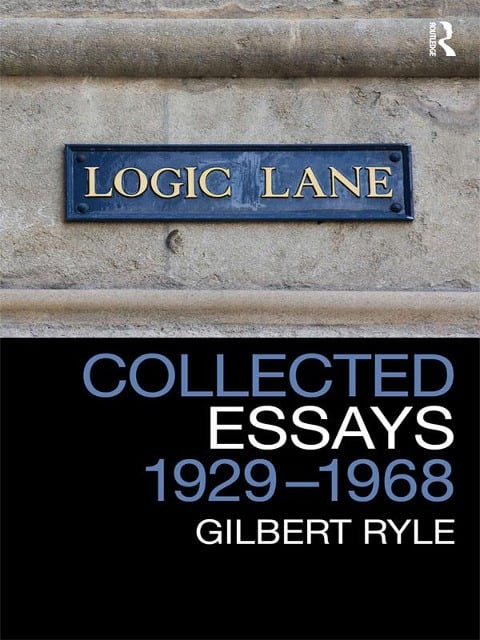
Gilbert Ryle was one of the most important and yet misunderstood philosophers of the Twentieth Century. Long unavailable, Collected Essays 1929-1968: Collected Papers Volume 2 stands as testament to the astonishing breadth of Ryle's philosophical concerns. This volume showcases Ryle's deep interest in the notion of thinking and contains many of his major pieces, including his classic essays 'Knowing How and Knowing That', 'Philosophical Arguments', 'Systematically Misleading Expressions', and 'A Puzzling Element in the Notion of Thinking'. He ranges over an astonishing number of topics, including feelings, pleasure, sensation, forgetting and concepts and in so doing hones his own philosophical stance, steering a careful path between behaviourism and Cartesianism. Together with the Collected Papers Volume 1 and the new edition of The Concept of Mind, these outstanding essays represent the very best of Ryle's work. Each volume contains a substantial preface by Julia Tanney, and both are essential reading for any student of twentieth-century philosophies of mind and language. Gilbert Ryle (1900 -1976) was Waynflete Professor of Metaphysics and Fellow of Magdalen College Oxford, an editor of Mind, and a president of the Aristotelian Society. Julia Tanney is Senior Lectuer at the University of Kent, and has held visiting positions at the University of Picardie and Paris-Sorbonne.
Gilbert Ryle was born in England in 1900, one of ten children. In 1924 he was appointed to a lectureship at Christ Church College, Oxford where he was to remain for his entire academic career until his retirement in 1968. In 1945 he was elected to the Waynflete Chair of Metaphysical Philosophy. He was editor of the journal Mind from 1947 to 1971. A confirmed bachelor, he lived after his retirement with his twin sister Mary in the Oxfordshire village of Islip. Gardening and walking gave him immense pleasure, as did his pipe. He died on 6 October 1976 at Whitby in Yorkshire after a day's walking on the moors.
Preface Julia Tanney Introduction 1.Negation 2. Are There Propositions? 3. Systematically Misleading Expressions 4. Imaginary Objects 5. 'About' 6. Internal Relations 7. Mr. Collingwood and the Ontological Argument 8. Back to the Ontological Argument 9. Unverifiability-By-Me 10. Induction and Hypothesis 11. Taking Sides in Philosophy 12. Categories 13. Conscience and Moral Convictions 14. Philosophical Arguments 15. Knowing How and Knowing That 16. Why are the Calculuses of Logic and Arithmetic Applicable to Reality? 17. 'If', 'So', and 'Because' 18. Heterologicality 19. Thinking and Language 20. Feelings 21. The Verification Principle 22. Thinking 23. Ordinary Language 24. Proofs in Philosophy 25. Pleasure 26. Sensation 27. The Theory of Meaning 28. Predicting and Inferring 29. On Forgetting the Difference Between Right and Wrong 30. A Puzzling Element in the Notion of Thinking 31. Use, Usage and Meaning 32. A Rational Animal 33. Abstractions 34. Thinking Thoughts and Having Concepts 35. Teaching and Training 36. Thinking and Reflecting 37. The Thinking of Thoughts - What is 'Le Penseur' Doing? Index
Dieses eBook wird im PDF-Format geliefert und ist mit einem Adobe Kopierschutz (DRM) versehen. Sie können dieses eBook mit allen Geräten lesen, die das PDF-Format und den Adobe Kopierschutz (DRM) unterstützen.
Zum Beispiel mit den folgenden Geräten:
• tolino Reader
Laden Sie das eBook direkt über den Reader-Shop auf dem tolino herunter oder übertragen Sie das eBook auf Ihren tolino mit einer kostenlosen Software wie beispielsweise Adobe Digital Editions.
• Sony Reader & andere eBook Reader
Laden Sie das eBook direkt über den Reader-Shop herunter oder übertragen Sie das eBook mit der kostenlosen Software Sony READER FOR PC/Mac oder Adobe Digital Editions auf ein Standard-Lesegeräte mit epub- und Adobe DRM-Unterstützung.
• Tablets & Smartphones
Möchten Sie dieses eBook auf Ihrem Smartphone oder Tablet lesen, finden Sie hier unsere kostenlose Lese-App für iPhone/iPad und Android Smartphone/Tablets.
• PC & Mac
Lesen Sie das eBook direkt nach dem Herunterladen mit einer kostenlosen Lesesoftware, beispielsweise Adobe Digital Editions, Sony READER FOR PC/Mac oder direkt über Ihre eBook-Bibliothek in Ihrem Konto unter „Meine eBooks“ - „online lesen“.
Schalten Sie das eBook mit Ihrer persönlichen Adobe ID auf bis zu sechs Geräten gleichzeitig frei.
Bitte beachten Sie, dass die Kindle-Geräte das Format nicht unterstützen und dieses eBook somit nicht auf Kindle-Geräten lesbar ist.