Und dann auf "Zum Home-Bildschirm [+]".

Stöbern
genialokal zum Startbildschirm hinzufügen
Installieren Sie die genialokal App auf Ihrem Startbildschirm für einen schnellen Zugriff und eine komfortable Nutzung.
Installieren Sie die genialokal App auf Ihrem Startbildschirm für einen schnellen Zugriff und eine komfortable Nutzung.
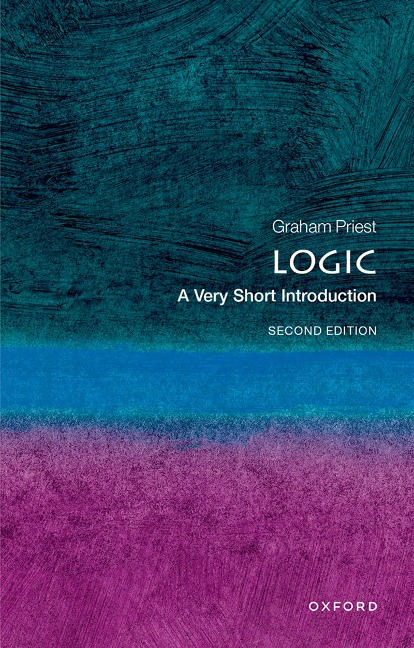
Logic is often perceived as having little to do with the rest of philosophy, and even less to do with real life. In this lively and accessible introduction, Graham Priest shows how wrong this conception is. He explores the philosophical roots of the subject, explaining how modern formal logic deals with issues ranging from the existence of God and the reality of time to paradoxes of probability and decision theory. Along the way, the basics of formal logic are explained in simple, non-technical terms, showing that logic is a powerful and exciting part of modern philosophy. In this new edition Graham Priest expands his discussion to cover the subjects of algorithms and axioms, and proofs in mathematics. ABOUT THE SERIES: The Very Short Introductions series from Oxford University Press contains hundreds of titles in almost every subject area. These pocket-sized books are the perfect way to get ahead in a new subject quickly. Our expert authors combine facts, analysis, perspective, new ideas, and enthusiasm to make interesting and challenging topics highly readable.
Graham Priest is Distinguished Professor of Philosophy at the CUNY Graduate Center , as well as a regular visitor at the University of Melbourne (where he was Boyce Gibson Professor of Philosophy). His books include Doubt Truth to be a Liar (OUP, 2008), One (OUP, 2014), and Towards Non-Being (2nd ed. OUP, 2016).
- Preface to Second Edition - Preface to First Edition - 1: Validity: what follows from what? - 2: Truth funtions - or not? - 3: Names and quantifiers: is nothing something? - 4: Descriptions and existence: did the Greeks worship Zeus? - 5: Self-reference: What is this chapter about? - 6: Necessity and possibility: what will be must be? - 7: Conditionals: what's in an if? - 8: The future and the past: is time real? - 9: Identity and change: is anything ever the same? - 10: Vagueness: how do you stop sliding down a slippery slope? - 11: Probability: the strange case of the missing reference class - 12: Inverse probability: you can't be indifferent about it! - 13: Decision theory: great expectations - 14: Halt! What goes there? - 15: Maybe it is true - but you can't prove it! - A little history and some further reading - Glossary - Problems - Problem solutions - Bibliography - General index
Dieses eBook wird im PDF-Format geliefert und ist mit einem Adobe Kopierschutz (DRM) versehen. Sie können dieses eBook mit allen Geräten lesen, die das PDF-Format und den Adobe Kopierschutz (DRM) unterstützen.
Zum Beispiel mit den folgenden Geräten:
• tolino Reader
Laden Sie das eBook direkt über den Reader-Shop auf dem tolino herunter oder übertragen Sie das eBook auf Ihren tolino mit einer kostenlosen Software wie beispielsweise Adobe Digital Editions.
• Sony Reader & andere eBook Reader
Laden Sie das eBook direkt über den Reader-Shop herunter oder übertragen Sie das eBook mit der kostenlosen Software Sony READER FOR PC/Mac oder Adobe Digital Editions auf ein Standard-Lesegeräte mit epub- und Adobe DRM-Unterstützung.
• Tablets & Smartphones
Möchten Sie dieses eBook auf Ihrem Smartphone oder Tablet lesen, finden Sie hier unsere kostenlose Lese-App für iPhone/iPad und Android Smartphone/Tablets.
• PC & Mac
Lesen Sie das eBook direkt nach dem Herunterladen mit einer kostenlosen Lesesoftware, beispielsweise Adobe Digital Editions, Sony READER FOR PC/Mac oder direkt über Ihre eBook-Bibliothek in Ihrem Konto unter „Meine eBooks“ - „online lesen“.
Schalten Sie das eBook mit Ihrer persönlichen Adobe ID auf bis zu sechs Geräten gleichzeitig frei.
Bitte beachten Sie, dass die Kindle-Geräte das Format nicht unterstützen und dieses eBook somit nicht auf Kindle-Geräten lesbar ist.