Und dann auf "Zum Home-Bildschirm [+]".

Stöbern
genialokal zum Startbildschirm hinzufügen
Installieren Sie die genialokal App auf Ihrem Startbildschirm für einen schnellen Zugriff und eine komfortable Nutzung.
Installieren Sie die genialokal App auf Ihrem Startbildschirm für einen schnellen Zugriff und eine komfortable Nutzung.
Ihr gewünschter Artikel ist in 0 Buchhandlungen vorrätig - wählen Sie hier eine Buchhandlung in Ihrer Nähe aus:

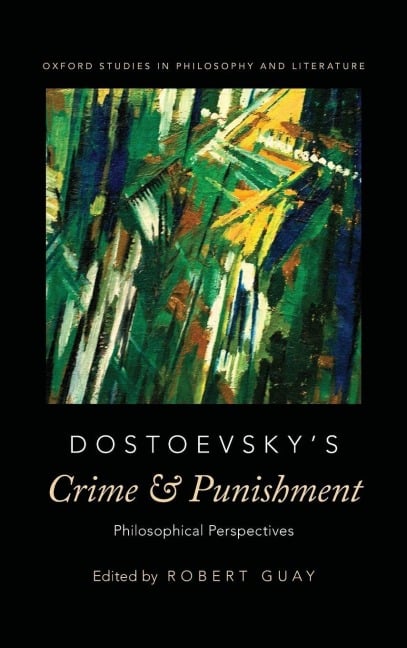
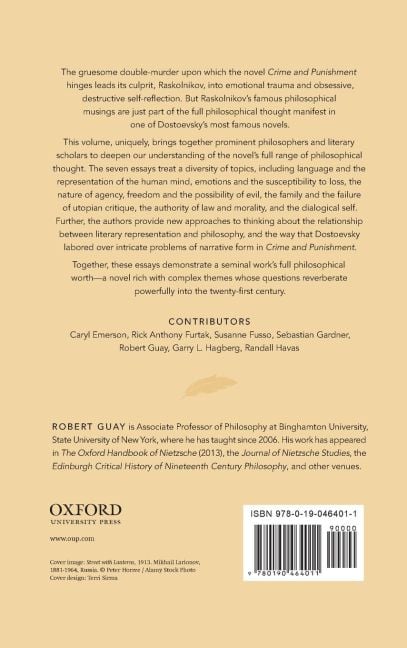
The gruesome double-murder upon which the novel Crime and Punishment hinges leads its culprit, Raskolnikov, into emotional trauma and obsessive, destructive self-reflection. But Raskolnikov's famous philosophical musings are just part of the full philosophical thought manifest in one of Dostoevsky's most famous novels.
This volume, uniquely, brings together prominent philosophers and literary scholars to deepen our understanding of the novel's full range of philosophical thought. The seven essays treat a diversity of topics, including: language and the representation of the human mind, emotions and the susceptibility to loss, the nature of agency, freedom and the possibility of evil, the family and the failure of utopian critique, the authority of law and morality, and the dialogical self. Further, authors provide new approaches for thinking about the relationship between literary representation and philosophy, and the way that Dostoevsky labored over intricate problems of narrative form in Crime and Punishment.
Together, these essays demonstrate a seminal work's full philosophical worth--a novel rich with complex themes whose questions reverberate powerfully into the 21st century.
Robert Guay is Associate Professor of Philosophy at Binghamton University, State University of New York, where he has taught since 2006. He works primarily on nineteenth-century European philosophy, especially as it relates to issues of agency, history, and ethics. His work has appeared in the The Oxford Handbook of Nietzsche (2013), the Journal of Nietzsche Studies, the Edinburgh Critical History of Nineteenth Century Philosophy, and other venues. He is currently working on a book on Nietzsche's ethical thought.
- Introduction, Robert Guay
- Chapter 1: Portrayals of Mind: Raskolnikov, Porfiry, and Psychological Investigation in Crime and Punishment, Garry L. Hagberg
- Chapter 2: Love, Suffering, and Gratitude for Existence: Moral and Existential Emotions in Crime and Punishment, Rick Anthony Furtak
- Chapter 3: Crime and Expression: Dostoevsky on the Nature of Agency, Robert Guay
- Chapter 4: Metaphysical Motivation: Crime and Punishment in the Light of Schelling, Sebastian Gardner
- Chapter 5: The Family in Crime and Punishment: Realism and Utopia, Susanne Fusso
- Chapter 6: Raskolnikov Beyond Good and Evil, Randall Havas
- Chapter 7: Bakhtin's Radiant Polyphonic Novel, Raskolnikov's Perverse Dialogic World, Caryl Emerson
- Bibliography