Und dann auf "Zum Home-Bildschirm [+]".

Stöbern
genialokal zum Startbildschirm hinzufügen
Installieren Sie die genialokal App auf Ihrem Startbildschirm für einen schnellen Zugriff und eine komfortable Nutzung.
Installieren Sie die genialokal App auf Ihrem Startbildschirm für einen schnellen Zugriff und eine komfortable Nutzung.
Ihr gewünschter Artikel ist in 0 Buchhandlungen vorrätig - wählen Sie hier eine Buchhandlung in Ihrer Nähe aus:

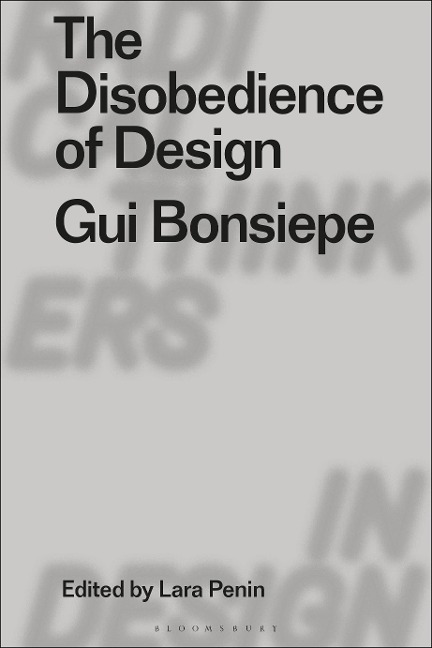
Provides for the first time in English a curated selection of the writings of the design thinker Gui Bonsiepe, representing his writings on the Ulm design school, on the relations of "core" and "periphery" and design as a tool for social and political change.
Gui Bonsiepe studied information design at the hfg ulm (Hochschule für Gestaltung Ulm), Germany from 1955-1959, where he taught as Assistant Professor from 1960-1968. Since 1968 he has been a designer and consultant for industrialization policy in Chile, Argentina, and Brazil. From 1993-2003 he was Professor of Interface Design at the University of Applied Sciences, Cologne, Germany. He lives and works in Brazil and Argentina.
Introduction by Lara Penin Notes on the Making of the Book Recognition and Acknowledgements by Gui Bonsiepe Editorial Acknowledgements Part 1: Thinking Designing Introduction to Part 1 by Frederico Duarte (a) Essays on ulm 1.1 The Cartography of Modernity 1.2 Science and Design 1.3 The Relevance of the Ulm School of Design today 1.4 The Invisible Aspects of the HfG Ulm (b) Theory and Practice 1.5 The Discomfort of Design Theory 1.6 Arabesques of Rationality: Or the Splendor and Boredom of Design Methodology 1.7 The Uneasy Relationship of Design and Design Research (c) Design, Politics, Ethics 1.8 Design, Nomadism and Politics: Interview with Alejandro Lazo Margain 1.9 Design and Democracy 1.10 Some Virtues of Design Part II: Design in the "Periphery" Introduction to Part II by Ethel Leon (a) From Europe to South America 2.1 Peripheral Vision & Design Empowerment: Interview with James Fathers 2.2 Industrial Design in Chile 1971-1973: Interview with Hugo Palmarola 2.3 The Ulm Model in the Periphery 2.4 Industrialization Without Design (b) Design in the "Periphery" 2.5 History of Design in Latin America 2.6 Aspects of Design in the Periphery 2.7 Between Favela Chic and Autonomy: Design in Latin America (c) The Question of Difference 2.8 Between Marasmus and Hope 2.9 The Environment in the North-South Conflict 2.10 Identity and Counter-Identity of Design Part III: Design, Visuality, Cognition Introduction to Part III by Hugh Dubberly (a) Design and Language 3.1 Through Language to Design 3.2 Design: from Material to Digital and Back 3.3 Design as Tool for Cognitive Metabolism: From Knowledge Production to Knowledge Presentation (b) Design/ Visuality/ Theory 3.4 Visual/Verbal Rhetoric 3.5 The Interface Design of Computer Programs 3.6 Designing Information 3.7 Visuality | Discursivity, or Design: The Blind spot of Theory, Theory: the Blind spot of Design (c) Design and Crisis 3.8 Design and Crisis 3.9 Convergences / Divergences - Hannes Meyer and the HfG Ulm 3.10 The Disobedience of Design Part IV: Design and Development / Projects Introduction to Part IV by Constantin Boym (a) Design Policy/Design and Development 4.1 Development Through Design, a Report for UNIDO, 1973 4.2 Design and Development: The Debate with Victor Papanek a. Gui Bonsiepe: Review of Design for the Real World by Victor Papanek b. Victor Papanek: Reply to Bonsiepe's Review 4.3 Design and Development 40 Years Later: Interview with Gabriel Patrocínio and José Mauro Nunes (b) Gui Bonsiepe: Selected Projects in Latin America 4.4 Inexpensive Record Player, Chile, 1972 4.5 Nutrition project: Spoon for Powdered Milk, Chile 1973 4.6 Agriculture project, Chopper, Chile, 1973 4.7 Consumer product: Air-conditioning, Argentina, 1980 4.8 Two projects for Local Industry in Brazil, 1984-86 4.9 Health Care Project: Needle for Blood Sampling, Brazil, 1986 (c) Case Study of Project Cybersyn, Chile 4.10 (a) Opsroom: Interface of a Cybernetic Management Room 4.10 (b) 'Socialism by Design' by Eden Medina Afterword by Zoy Anastassakis & Marcos Martins Appendices: Three Notes on the Closure of ulm (1968) 1. The Situation of the HfG 2. Communication & Power: A Marginal Note 3. Resolution of the Hochschule für Gestaltung, Ulm Gui Bonsiepe: A Brief Biography Contributors Index